
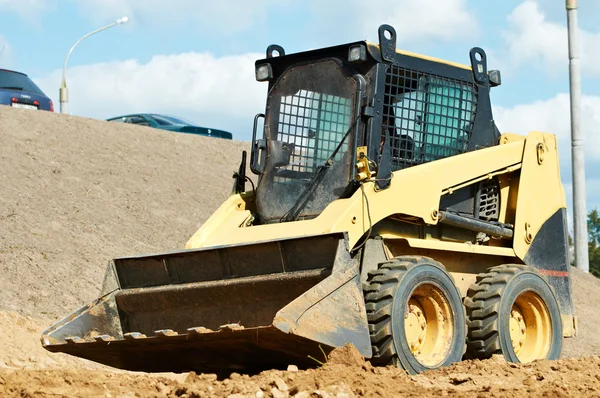
A skid steer loader is one of the most recognisable pieces of construction equipment on an Australian job site, often called a “bobcat” regardless of who actually built it. Compact and quick to swap attachments, it can do the work of several machines. This guide covers how skid steers work, the wheeled versus tracked choice, common attachments and applications, and what to weigh up when choosing or hiring one through Quotor’s skid steer loader listings.
Understanding Skid Steer Loaders
What Is a Skid Steer Loader?
A skid steer loader is a small, rigid-frame construction machine with lift arms on either side of the cab and a bucket or attachment mounted on the front. Unlike an excavator, which is built around a digging arm, a skid steer is built around loading, lifting and carrying. It sits within Quotor’s broader loader category, alongside backhoe, wheel and Posi-Track loaders, as the smallest and most manoeuvrable of the group. It’s also known as a skid loader, sometimes written as skidsteer, and commonly called a “bobcat” on Australian sites regardless of brand.
How Skid Steering Works
The “skid” in skid steer describes how the machine turns. All four wheels, or both tracks, stay fixed facing forward; there’s no separate steering linkage. Instead, the wheels on one side spin faster than the other, forcing the tyres to skid, or drag, sideways across the ground as the machine pivots. This lets a skid steer turn within its own footprint, working in tight spaces most other loaders can’t reach. Quotor’s guide on how to operate a skid steer loader covers the hand and foot controls used to manage this.
What Skid Steer Loaders Are Used For
Skid steers are general-purpose machines rather than specialists. With the right attachment, the same skid steer can load a truck, dig a shallow trench, clear debris or shift pallets around a job site. That flexibility, more than any single spec, is why skid steers turn up across construction, landscaping, agriculture, material handling and demolition work.
Skid Steer Types
Wheeled Skid Steer Loaders
Wheeled skid steer loaders run on four rubber tyres and are the traditional, lower-cost version of the machine. They travel faster than tracked models and handle paved or compacted surfaces well. Their trade-off is ground pressure: tyres concentrate weight over less surface area, so wheeled machines struggle on mud, sand or freshly turned ground.
Compact Track Loaders
Compact track loaders replace the wheels with rubber tracks. The wider contact area spreads the machine’s weight over more ground, improving traction and flotation on soft, wet or uneven terrain where a wheeled machine would get bogged. On Quotor, these are listed as Posi-Track loaders, a separate category from wheeled skid steers. Tracked machines are typically slower on hard ground and cost more to buy or hire, but can generally carry a higher rated load for a similar frame size.
Skid Steer vs Posi-Track Loader
The difference between a skid steer and a Posi-Track loader comes down to wheels versus tracks, and it affects more than traction. Rated operating capacity for a wheeled skid steer is commonly based on around 50 percent of tipping load, while compact track loaders are often rated more conservatively at around 35 percent. Choose a wheeled skid steer for hard or paved sites where speed matters, and a Posi-Track loader for landscaping, agriculture or wet-season sites where flotation matters more. Quotor’s skid steer vs Posi-Track comparison covers specific models.
Skid Steer Attachments
Attachments are a major part of the buying and hiring decision, turning one base machine into many. Quotor’s guide to skid steer attachments lists the full range; the most common are below.
Buckets
Buckets are the default attachment and come in general-purpose, high-capacity and grading styles, used for moving soil, sand, gravel and other loose material around a site.
Forks
Pallet forks turn a skid steer into a compact forklift, useful for moving pallets of bricks, timber or bagged materials on sites without room for a dedicated forklift.
Augers
An auger attachment drills post holes for fencing, footings or landscaping, with interchangeable bits sized to the job rather than requiring a separate machine.
Trenchers
Trencher attachments use a chain or wheel-saw cutting bar to dig narrow trenches for irrigation, drainage or cabling, work that would otherwise need a dedicated trenching machine.
Grapples and Other Attachments
Grapples clamp and lift irregular loads such as logs, brush or demolition debris. Less common attachments include stump grinders, snow blades, brooms, cement mixers and pavement millers for specialised site work.
Skid Steer Applications
Construction and Earthmoving
On construction and earthmoving sites, skid steers handle site clean-up, material movement, backfilling and light excavation that doesn’t need a full excavator, and their small footprint suits working around existing structures.
Landscaping
In landscaping, a skid steer’s tight turning radius and range of attachments make it the standard choice for grading, turf preparation, garden bed construction and moving mulch, soil or pavers around residential sites.
Agriculture
On farms, skid steers handle feeding, land clearing, fencing work with an auger attachment, and general material handling around sheds and yards, work that would otherwise need several separate machines.
Material Handling
For material handling, forks and buckets let a skid steer load and unload trucks, move heavy materials around a warehouse or yard, and stack palletised goods without a wheel loader’s larger footprint.
Demolition and Site Cleanup
In demolition and site cleanup, skid steers fitted with grapples or buckets clear debris quickly in spaces too tight for larger equipment, and their manoeuvrability keeps them working close to standing structures without an excavator’s reach.
Benefits and Limitations of Skid Steers
Compact Size and Manoeuvrability
A skid steer’s biggest advantage is size. Smaller skid steer models can fit through narrow gates and tight access points, while the zero-radius turn means they need very little room to reposition.
Attachment Versatility
Versatility comes from the quick-attach hydraulic coupler at the front of the machine, which lets an operator swap a bucket for forks or an auger in a few minutes without tools. That makes a skid steer a genuinely multi-purpose machine rather than several separate hires.
Performance in Confined Spaces
Because the whole machine pivots within its own footprint, a skid steer can work in courtyards, basements, narrow site access and other confined spaces where a wheel loader or excavator won’t fit.
Limitations on Soft or Uneven Ground
The scrubbing action that makes skid steers so manoeuvrable also disturbs soft surfaces, which is why wheeled models struggle on wet or uneven ground. A tracked or Posi-Track model, or a different piece of equipment altogether, is often the better choice on those sites.
Popular Skid Steer Brands
Quotor’s skid steer brand comparison covers the full field; two names dominate the market.
Bobcat Skid Steers
Bobcat is often credited as the company that popularised the skid steer design, and the name has become the generic term many Australians use for the whole category. Bobcat’s current range runs from small-frame models suited to landscaping through to larger machines built for construction and demolition work, with Bobcat models on Quotor running from the S70 up to the S510.
CAT Skid Steers
Caterpillar entered the skid steer market later than Bobcat but now offers one of the widest size ranges, from compact models suited to tight residential sites through to large-frame machines built for commercial-scale work. Quotor also lists CASE and John Deere in this category, giving buyers more than the two market leaders to compare.
Bobcat vs CAT Skid Steers
The difference between Bobcat and CAT skid steers comes down less to raw capability, since both brands cover similar size classes, and more to operator preference, dealer support and parts availability. For most buyers, comparing specific models on rated operating capacity and attachment compatibility is more useful than choosing a brand outright.
Choosing the Right Skid Steer
Operating Capacity and Machine Size
Skid steers are grouped into small, medium and large frame classes based on rated operating capacity, the maximum load a machine can safely lift and carry.
| Frame class | Rated Operating Capacity | Typical Use |
|---|---|---|
| Small frame | Under about 790 kg | Landscaping, interior work, confined sites |
| Medium frame | About 790-1,000 kg | General construction, most job sites |
| Large frame | Over about 1,000 kg | Commercial construction, demolition, heavy material handling |
Skid steers also use one of two lift paths. Radial lift arms move through an arc, giving strong breakout force close to the ground for digging and loading. Vertical lift arms push straight up, giving more height and reach, better suited to loading trucks or hoppers. Matching frame size and lift path to the job narrows the choice between smaller skid steers for residential sites and large skid steers for commercial work.
Site and Ground Conditions
Ground conditions decide wheeled versus tracked as much as budget does. A hard-standing commercial site favours a faster wheeled machine; a wet paddock, a landscaped garden or an uneven rural block favours a tracked or Posi-Track model that won’t tear up the surface.
Attachment Requirements
Before choosing a model, confirm which attachments the job needs, since not every skid steer has the hydraulic flow or coupler type to run every attachment. Matching attachment needs and hydraulic capacity to the task avoids paying for a bigger machine than necessary.
Skid Steer Hire
When to Hire a Skid Steer
For most contractors and homeowners, the buy or rent decision comes down to frequency of use. Anyone who’ll only use a skid steer for one job, or a handful a year, is almost always cheaper off hiring than owning once maintenance, storage and depreciation are counted.
Factors to Consider When Hiring
Skid steer hire is available as wet hire, machine and operator supplied together, or dry hire, machine only, with the renter providing a skid steer operator. Commercial sites generally require demonstrated competency for the specific machine, whether through the RIIMPO318F unit of competency, prior experience, or a site-based verification of competency (VOC), rather than any rule tied to the machine’s size. Confirm attachment compatibility and site access before booking.
Skid Steer Hire Costs
Hire cost for a skid steer depends on frame size, attachments needed, hire duration and whether it’s wet or dry hire, so quotes for what looks like the same machine can vary significantly between suppliers. Rather than calling suppliers individually, Quotor researches the market, compares available options and shortlists suppliers that match the job.