
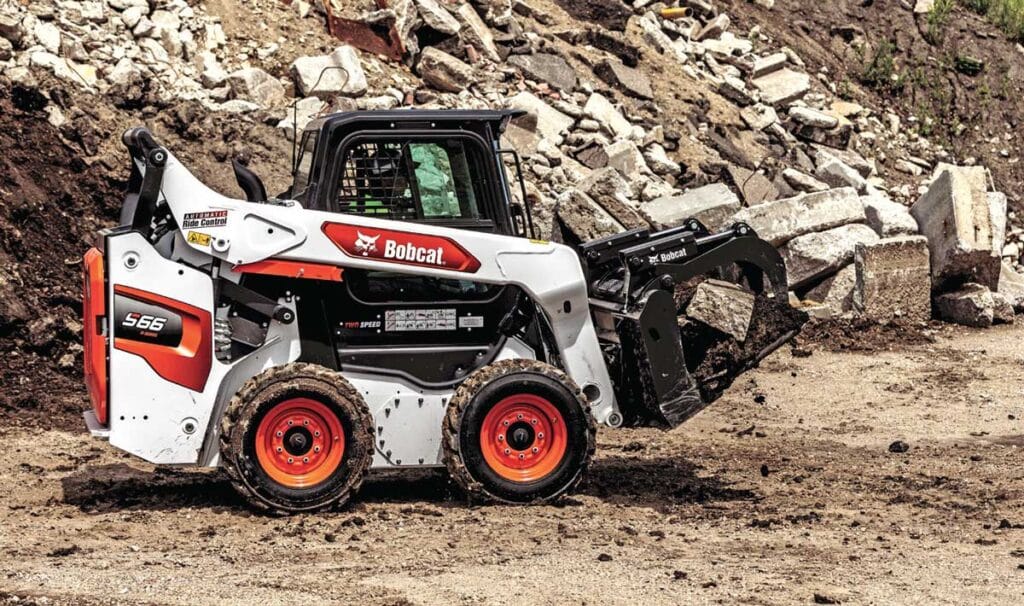
Bobcat and CAT are two of the most established names in wheeled skid steer loaders, and Australian contractors weigh them against each other constantly when booking a hire. This guide compares the current and commonly available Bobcat and CAT wheeled skid steer ranges on the differences that matter most on site, including capacity, hydraulics, lift design, controls and attachment compatibility, so the detail У below focuses on what actually affects a hire decision.
Understanding Bobcat and CAT Skid Steers
How Bobcat and CAT Compete in the Skid Steer Market
This comparison covers wheeled skid steer loaders, the configuration most contractors mean when they say “skid steer,” one of several types of earthmoving equipment used on Australian construction sites. If a job calls for tracked traction instead, Bobcat also builds compact track loaders, which Quotor groups within its broader Posi-Track Loader category.
What Is a Bobcat Skid Steer?
Bobcat is credited with building the first skid steer loader more than 60 years ago. Its wheeled lineup has moved through several generations since: the R-Series, including the S66, remains commonly available in Australian and New Zealand hire fleets, while a newer S64-2, S66-2, S76-2 and S86-2 generation is rolling out globally, with a Pro cab option now joining that range. For the fundamentals of how the category works, what is a skid steer loader covers the basics.
What Is a CAT Skid Steer?
CAT, short for Caterpillar, entered the category later than Bobcat, launching its first skid steer models in 1999. Its wheeled lineup moved through the D and D2 Series to the D3 Series, and most recently to a next-generation line, the 250, 260, 270 and 270 XE, a ground-up redesign with four models replacing the eight in the D3 Series.
Other brands also offer wheeled skid steers in the Australian market, including Kubota, JCB, John Deere, New Holland, Takeuchi and ASV. Quotor’s brands of skid steer loaders guide runs through the wider field, but Bobcat and CAT are the two most commonly cross-shopped in Australian hire fleets, which is why this piece sticks to the two of them.
What Bobcat Skid Steers Do Best
Compact Loader Range and Manoeuvrability
Bobcat’s smaller wheeled models, the S64-2 and S66-2, keep a tight turning radius and compact frame that suit landscaping and residential work where access is narrow. The range doesn’t stop at compact, though: the S86-2 reaches up to 115 horsepower on the newer Pro-spec models, putting it in similar territory to CAT’s larger machines rather than a smaller one. Across the range, Bobcat’s Bob-Tach mounting system and Selectable Joystick Control (SJC) give operators a consistent attachment and control experience whether they’re running the smallest or largest model in the lineup. A guide to operating a skid steer loader covers the controls for anyone new to running one.
Best Jobs for Bobcat Skid Steers
The smaller S64-2 and S66-2 suit residential landscaping, courtyard and laneway access, and site clean-up where the machine needs to fit through a standard gate or move between garden beds without reworking the site first. Larger Bobcat models take on grading and material-moving work much like their CAT equivalents; which one makes sense for a given job often comes down to what a supplier actually has on the yard. Quotor’s current skid steer loader listings show Bobcat availability by location, worth checking alongside CAT before locking in a job plan.
What CAT Skid Steers Do Best
Power and Hydraulic Performance
CAT’s current SSL lineup, the 250, 260, 270 and 270 XE, replaced the D3 Series as a ground-up redesign, with meaningful torque gains over the old generation (13 percent on the 250 and 260, 35 percent on the 270) and rated operating capacity across the four models running from about 1,323 to 1,983 kilograms. The 250 and 260 run CAT’s C2.8T engine at 74 horsepower; the 270 and high-output 270 XE step up to CAT’s C3.6TA engine, with CAT’s own figures putting the 270 in roughly the 100 to 111 horsepower range depending on configuration. A High Flow XPS option is available on the 250, 260 and 270 for attachments that need extra hydraulic pressure.
Operator Comfort and Machine Control
The next-generation cab is a genuine step up from the D3 Series: around 22 percent more interior volume, lower entry points, and new mechanical or air-ride seat suspension options. Intelligent Leveling keeps the load level automatically as the boom raises and lowers, and CAT’s Work Tool Positioner holds a set bucket angle through repetitive grading passes, both carried over from the D3 generation and refined in the redesign. For operators new to the category, Quotor’s guide to becoming a heavy equipment operator covers the training and licensing expectations that come with running a skid steer on an Australian site.
Best Jobs for CAT Skid Steers
The 270 and 270 XE suit larger commercial and civil sites with more open space to manoeuvre, particularly grading and truck-loading work where the extra lift height and breakout force reduce the number of passes needed. CAT’s dealer and support network is worth weighing here too: on a job running one machine hard for weeks at a time, having a nearby dealer for parts and service can matter as much as the spec sheet. If neither brand’s skid steer range ends up fitting the job, the broader loaders category covers backhoe loaders, wheel loaders and mini loaders too.
Bobcat vs CAT Skid Steer Comparison
The table below sets out where Bobcat and CAT genuinely differ. Model-for-model horsepower and rated capacity are covered above where a specific model is named; the table focuses on the structural differences that hold across each brand’s current range.
| Comparison | Bobcat | CAT |
|---|---|---|
| Current, commonly available wheeled range | R-Series (still common in Australian and NZ fleets), transitioning to the S64-2 to S86-2 generation | 250, 260, 270 and 270 XE, four models replacing the eight in the D3 Series |
| Lift path options | Radial and vertical lift depending on model | Primarily vertical lift on the current 250 to 270 XE range; older D3 units still in hire fleets include both |
| Control technology | Selectable Joystick Control (SJC) and Bobcat’s in-cab displays | Intelligent Leveling and Work Tool Positioner |
| Attachment interface | Bob-Tach standard, Power Bob-Tach optional for cab-based swaps; see types of skid steer attachments | Cat quick coupler standard, hydraulic coupler optional |
| High-flow hydraulics | Available on selected models | Available on selected models (High Flow XPS option) |
| Dealer and hire availability | Depends on region | Depends on region |
| Hire pricing | Model and supplier dependent | Model and supplier dependent |
Hire pricing usually follows machine size, capacity, hydraulic specification, location and supplier availability more closely than the badge on the loader. Once the spec differences above are clear, Quotor’s guide to hiring construction equipment covers the booking process from here.
How much these differences matter depends on the job in front of you, which is what the next section works through.
Choosing Between Bobcat and CAT Skid Steers
When to Choose a Bobcat Skid Steer
If your access points are narrow, standard gates, laneways or tight courtyards, or you’re moving the loader between several small sites through the week, one of Bobcat’s smaller-frame models (the S64-2 or S66-2) is generally the safer starting point. The smaller frame is also easier to trailer and reposition without needing a larger transport permit, which matters if the job involves relocating the loader often rather than parking it on one site for a stretch.
When to Choose a CAT Skid Steer
If the job involves one site for an extended stretch, higher daily volumes, or grading and truck-loading work where extra lift height and breakout force cut down the number of passes needed, one of CAT’s larger 270-range models is generally the better starting point.
Job Requirements
Beyond machine size, worth checking before you book: who’s actually running the loader for the job. A newer team member or someone covering for your usual machine handler may need to brush up on the training and licensing expectations that come with running a skid steer on an Australian site, regardless of which brand you hire.
Hire Cost and Machine Availability
Quotor’s guide to estimating equipment cost walks through how to budget for a hire beyond the daily rate, including fuel and site delivery. As the table above shows, hire rates for both brands track machine size, hydraulic specification and rated operating capacity more closely than brand name on its own.