
Understanding Skid Steer Attachments
What Is a Skid Steer Loader?
A skid steer loader is a compact, rigid-frame machine that turns by braking the wheels on one side while driving the other, letting it work in tight spaces a larger loader can’t reach. For the full rundown of how the machine itself is built and controlled, see Quotor’s guide to what a skid steer loader is.
Skid Steer vs Compact Track Loader Attachment Compatibility
Most modern skid steers and compact track loaders use a common skid-steer-style quick-attach interface, so many buckets, forks and grapples can move between the two machine types; compatibility still needs checking against the specific coupler, attachment weight and hydraulic requirements. The bigger difference between the two is the undercarriage: a skid steer runs on wheels, a compact track loader runs on rubber tracks, and the tracks spread the machine’s weight over a wider footprint so it carries the same attachment further into soft or wet ground before it starts to sink. ASV’s Posi-Track loaders are one well-known compact track loader line; Quotor’s guide to what a posi-track loader is and its posi-track loader listings cover that undercarriage difference in more detail.
Why Attachments Matter
Swap the bucket for an auger and the same machine drills post holes instead of moving dirt. Swap it again for a broom and it clears a finished site. One machine covers several jobs without hiring in a separate piece of equipment for each task, which is why attachment choice is as much a part of the hire decision, cost included, as the loader itself; a guide to estimating equipment cost breaks that down further. Quotor lists skid steer loaders alongside the attachments they commonly run.
Types of Skid Steer Attachments
The most common attachments split into digging, lifting and site-finishing work, covered by type below.
Buckets
Most skid steer work starts with a bucket attachment. A standard bucket handles general digging and loading; a four-in-one bucket splits down the middle and adds hydraulic jaws, so the same tool loads, grades, doses and clamps around an irregular load without a swap. A rock bucket adds reinforced tines and a heavier floor for abrasive material like broken concrete or quarry stone that wears through a standard edge faster.
Augers
An auger attachment pairs a hydraulic drive head with a drill bit to dig holes for fence posts, footings or tree planting to a set diameter and depth, in a fraction of the time hand digging takes. The bit gets swapped to match the hole; the drive head stays on the machine.
Backhoe Attachments
A backhoe attachment mounts to the skid steer’s front attachment interface and adds a boom, dipper and bucket for below-grade digging that the standard loader bucket can’t manage, useful for trenching a small drain line or digging a footing without hiring in a separate backhoe loader.
Forks
Fork attachments, more commonly called pallet forks, lift and carry stacked or palletized loads the way a bucket can’t: a bucket scoops loose material, forks slide under a load and carry it level. They’re the common material-handling swap for moving block, bagged product or equipment pallets around a site.
Grapples
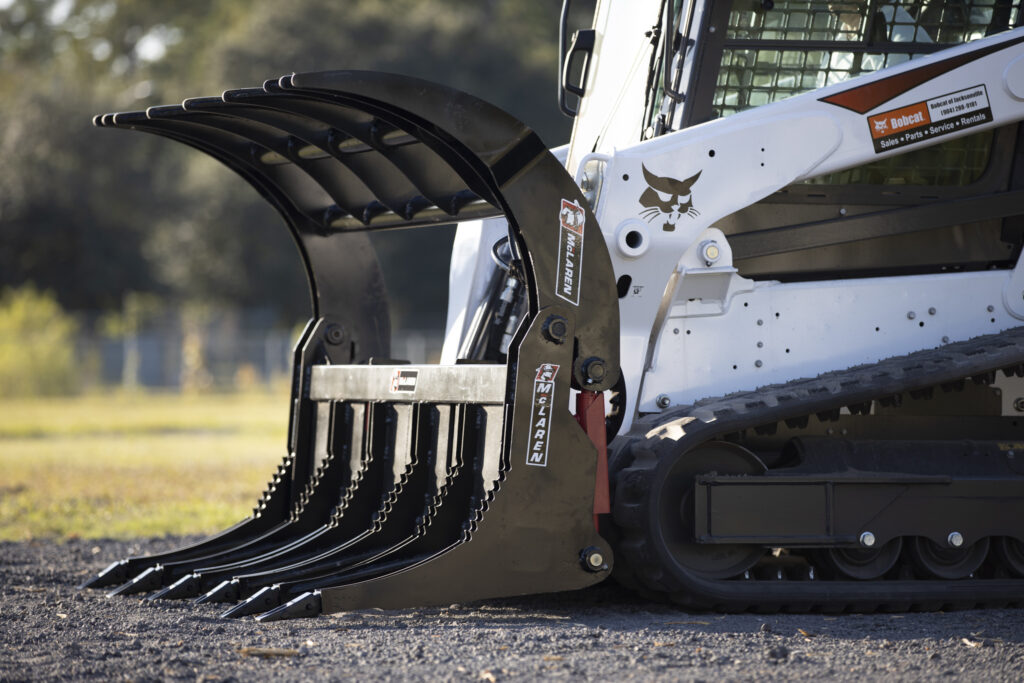
Grapple attachments add a hydraulic clamping arm over a bucket or fork frame so they can close around brush, logs, scrap or demolition debris that would spill straight back out of an open bucket. A rock grapple uses heavier, wider-spaced tines built for boulders and broken material instead of vegetation.
Trenchers
Trencher attachments run a chain fitted with digging teeth around a narrow boom instead of a bucket, cutting a consistent-depth trench for utility, irrigation or drainage lines with far less spoil to clear than excavating the same trench with a backhoe attachment.
Brooms and Sweepers
Broom attachments spin a bristle drum to clear loose debris, gravel or snow off finished surfaces, driveways or parking lots. They’re finishing tools rather than material movers, run after the heavier work on a site is done; for heavier snow removal, a snow pusher or snow blower attachment replaces the broom.
Grading Attachments
A grading attachment, usually a box blade or a laser-guided grading blade, levels and finishes a surface rather than moving material off it. Where a bucket pushes and carries dirt, a grading blade cuts high spots and fills low ones to bring a pad or driveway to grade.
Clearing and Landscaping Attachments
Brushcutters clear scrub and small trees, mulcher attachments grind vegetation into mulch in place, and stump grinders remove what’s left after a tree comes out. That’s what separates them from a grapple: a grapple moves cut material away, a brushcutter or mulcher is what cuts it down in the first place.
Skid Steer Attachment Compatibility
Quick Couplers and Mounting Systems
Because most skid steers and compact track loaders share that quick-attach interface, switching from a bucket to a grapple is usually just a matter of lining up the plate and locking two pins, no tools required. Not every machine uses the same coupler, though, so it’s worth confirming the specific interface, and the attachment’s weight and hydraulic requirements, before assuming a fit.
Hydraulic Flow Requirements
Powered attachments such as augers, trenchers, mulchers and brooms have a specified hydraulic flow and pressure range. Some run fine on standard-flow hydraulics, while more demanding tools like large mulchers or trenchers may call for high-flow. An attachment that needs more flow than the machine can supply may perform poorly or may not be suitable to run at all, so the attachment’s required flow, pressure and any case-drain requirement are worth checking against the specific machine.
Matching Attachments to Machine Size
Attachment size and weight need to suit the loader’s rated operating capacity, tipping load and manufacturer-approved attachment range, and a compact skid steer can’t safely run the same auger or grapple as a full-size one; powered tools also need hydraulic flow and pressure that match the machine. Quotor’s guide to brands of skid steer loaders breaks down how these ratings vary by manufacturer and model, the detail to check before assuming an attachment suits a given machine.
Choosing the Right Skid Steer Attachment
Match the Attachment to the Task
The attachment for your skid steer should match the job, not just the attachment list: moving loose material calls for a bucket, lifting palletized loads calls for forks, drilling holes calls for an auger. Quotor’s guide to how to operate a skid steer loader is worth a look for anyone new to running the machine itself, since the right attachment only helps once it’s operated correctly.
Consider Material and Ground Conditions
Abrasive material like broken concrete wears through a standard bucket faster than a reinforced rock bucket handles it; soft or wet ground favors a track loader’s wider footprint over a wheeled skid steer running the same attachment. Matching ground conditions to the undercarriage matters as much as matching the attachment to the task.
Common Attachment Selection Mistakes
The most common mistake is sizing the attachment to the job and skipping the machine: an attachment rated for a larger loader than the one hiring it will underperform or strain the hydraulics no matter how well it suits the task. Checking hydraulic flow, operating capacity and tipping load against the attachment’s specification, covered above, catches this before it becomes a problem on site.
Hiring Skid Steer Attachments
Hiring Attachments with the Machine
Bundling the attachment with the machine hire is usually the simplest route: the coupler and hydraulic flow are already matched, and there’s one supplier and one delivery to manage instead of two. A guide to how to hire construction equipment covers the general hire process for anyone doing this for the first time.
Hiring Attachments Separately
Sourcing an attachment separately makes sense when a specific tool isn’t offered by the machine’s usual supplier, but it puts the compatibility check back on the hirer: coupler type and hydraulic flow both need confirming before it turns up on site. It also often means running the attachment without support from the machine’s supplier, so anyone doing this on a dry hire might look at what it takes to become a heavy equipment operator before taking it on solo.
Skid Steer Attachment Hire Costs
Attachment hire cost depends on the tool type and size, hire duration, supplier availability and whether it’s bundled with the loader or sourced separately. Compatibility can also affect total cost if the machine needs a particular hydraulic package, case drain or coupler setup to run the attachment at all. Quotor helps line up the right skid steer and the attachment it needs to run in one hire rather than two separate bookings, with the full range of machines browsable through the loader listings.