
Understanding Skid Steer Brands
What Is a Skid Steer?
A skid steer is a compact, rigid-frame wheeled loader that turns by varying wheel speed from one side to the other, letting it pivot in a very tight space, useful from job sites to farm buildings. See Quotor’s guide to what a skid steer loader is for the full picture.
Why Skid Steer Brand Matters
Most skid steers cover the same jobs on construction projects: digging, grading, material handling. Brand affects how a machine holds up over years of daily use, how quickly a dealer can supply parts, and what it’s worth when it’s time to sell or trade. A thin dealer network can leave a machine sitting idle waiting on a part that a better-supported brand would have on the shelf, and resale buyers tend to pay a premium for names with strong local parts backup.
How Skid Steer Brands Differ
There are two main types of skid steers by lift arm. Radial-lift machines swing the arm in an arc for strong mid-height reach, good for digging and grading. Vertical-lift machines raise the arm straight up for more height at the top of the stroke, better for loading trucks. Hydraulic flow, standard or high-flow, determines which attachments a machine can run at full power. Most brands split their range across both paths; JCB’s approach is different, covered below.
Leading Skid Steer Brands
Bobcat
Bobcat helped define the modern skid steer category in the late 1950s and early 1960s, and the Bobcat brand is still closely associated with compact loaders today. Its current range spans radial- and vertical-lift machines across compact and large-frame classes, backed by a broad attachment ecosystem and extensive dealer presence.
Caterpillar
Cat skid steers combine radial- and vertical-lift configurations with standard- and high-flow hydraulics, built for contractors running demanding attachments such as planers and mulchers. Cat’s main advantage is the combination of attachment capability and a large construction-equipment dealer network.
John Deere
John Deere skid steers split into radial-lift G-Series models (312GR, 316GR) for digging, and vertical-lift models (314G, 318G, 330G, 332G) for truck loading. The Quik-Tatch attachment system, with an option that connects some attachments from inside the cab, works across more than 100 attachments. JDLink telematics gives fleet owners machine location and health data remotely.
CASE Construction
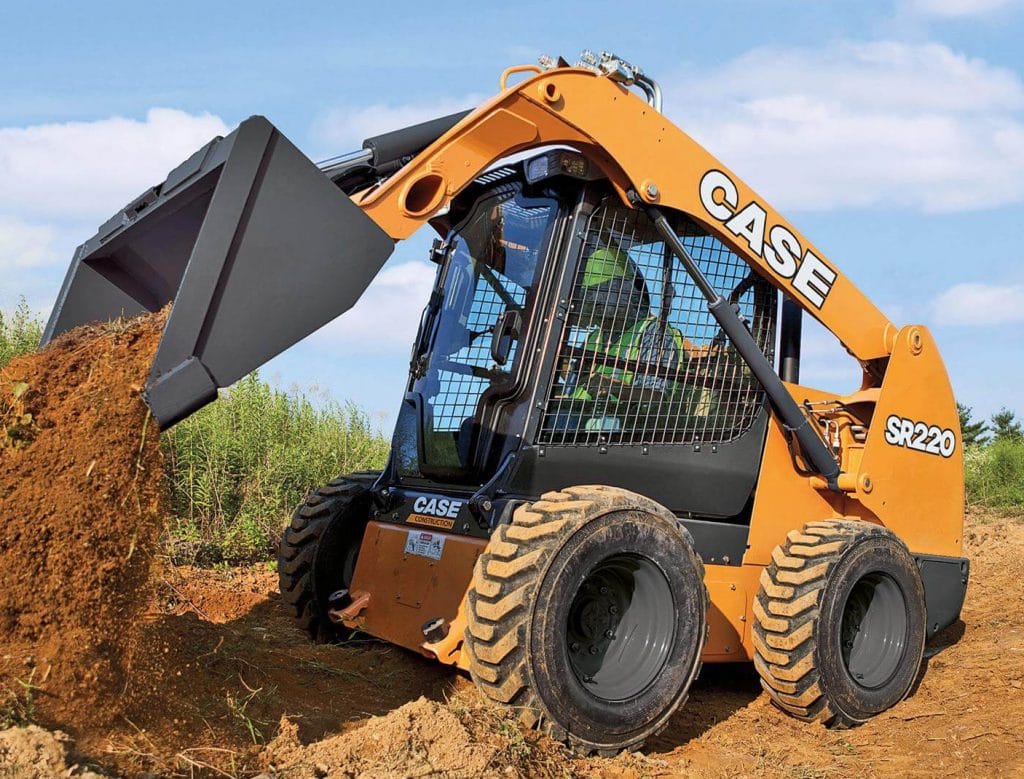
CASE skid steers split the lineup the same way as its CNH Industrial sibling New Holland: radial-lift SR models for digging performance, vertical-lift SV models for reach and lift height. The two brands share platform architecture and hydraulics under CNH Industrial, so the practical difference often comes down to dealer network: Case toward construction contractors, New Holland toward agriculture.
New Holland
New Holland’s L-series skid steers run on the same CNH Industrial platform as Case’s SV range, built around a vertical-lift design it calls Super Boom for reach and lift height. Three auxiliary hydraulic options let buyers match flow to the attachment they run most. Its dealer network tends to overlap with its agricultural business, useful for parts in regional areas.
Kubota
Kubota entered the skid steer market in 2015 with the SSV65 and SSV75, both vertical-lift machines with standard two-speed travel and optional high-flow hydraulics that lift flow from around 18 to 28 gallons per minute on the SSV65 and up to roughly 30 on the SSV75. That formula remains the core of Kubota’s skid steer range today, sold alongside its SVL track loaders so buyers already running Kubota gear get a familiar parts and service relationship.
JCB
JCB skid steers use a single-arm design called Powerboom, in place of the conventional twin-arm arrangement used by most major skid steer manufacturers. The single arm allows a full-width side door, so operators step through rather than over the front attachment, and JCB says the design gives roughly 60 percent more visibility than a twin-arm machine. JCB introduced the approach on its Robot skid steer in 1993 and has kept it as its defining feature.
Wacker Neuson
Wacker Neuson builds its North American range, the SW20 through SW32, on a vertical-lift design with class-leading hinge pin height, useful for loading over the sides of a dump truck; the SW28, for instance, reaches an 11-foot-2-inch lift height at a 2,800-lb rated operating capacity. Its large-frame cabs tip fully forward with the arms down for full access to service points. The brand entered North America in 2014 and manufactures its US skid steers in Menomonee Falls, Wisconsin.
Other Skid Steer Brands to Consider
Regional and Less Common Manufacturers
Among mini skid steer brands, Kanga is one of the more notable skid steer loader brands in Australia, though it sits in a different niche. Built on the Gold Coast since 1981, Kanga’s stand-on mini skid steer loaders were the first commercially produced machines of their kind, a separate claim from Bobcat’s ride-on history, covering the smaller, walk-behind segment used in landscaping and tight spaces around buildings. Gehl skid steers, made since 1973 and now part of France’s Manitou Group with Mustang, and Komatsu skid steers in the SK-series turn up in Australian hire fleets without the dealer footprint above.
Emerging Skid Steer Brands
SANY is a newer entrant to the skid steer market, offering vertical-lift machines with standard- and high-flow hydraulic options. Its shorter track record and developing dealer network make local parts and service support worth checking carefully against established brands.
Comparing Skid Steer Brands
| Brand | Lift Path | Hydraulic Options | Defining Strength |
|---|---|---|---|
| Bobcat | Radial & vertical | Standard/high-flow | Broadest range, deep attachment ecosystem |
| Caterpillar | Radial & vertical | Standard/high-flow | Strong attachment capability, large dealer network |
| John Deere | Radial & vertical | Standard/high-flow | Quik-Tatch attachment system, JDLink telematics |
| CASE | Radial (SR) & vertical (SV) | Standard/high-flow | Shares CNH Industrial platform with New Holland |
| New Holland | Vertical (Super Boom) | Three configurations | Dealer network overlaps with agricultural equipment |
| Kubota | Vertical only | Standard/high-flow | Pairs with Kubota’s SVL track loader line |
| JCB | Single-arm (Powerboom) | Standard/high-flow | Side-door entry, wider visibility |
| Wacker Neuson | Vertical only | Standard/high-flow | Class-leading hinge pin height |
Bobcat vs Caterpillar
Both build wide ranges across radial and vertical lift; the practical difference usually comes down to dealer footprint and which brand a fleet already runs. Quotor’s Bobcat vs Caterpillar comparison goes through specific skid steer models side by side.
John Deere vs CASE
John Deere’s Quik-Tatch system and JDLink telematics suit operators who want attachment speed and remote fleet data built in. CASE’s SR and SV ranges, sharing engineering with New Holland, suit buyers already inside that dealer network. Neither has a clear edge on specification; it comes down to what’s already in the shed.
Kubota vs New Holland
Kubota builds vertical-lift skid steers only, simple and consistent across its two models. New Holland’s L-series spans more sizes and offers three hydraulic configurations for a wider mix of attachments. Buyers already running Kubota tractors or New Holland farm gear usually lean toward the matching skid steer brand for shared parts and service.
Choosing the Right Skid Steer Brand
Choosing a skid steer brand comes down to the job, the attachments needed and the support available locally, more than the badge on the machine.
Machine Size and Operating Capacity
Rated operating capacity, typically 50 percent of tipping load, should match the heaviest material the machine lifts regularly, not the biggest one-off job. Rated operating capacities across the category run from around 1,700 lbs on compact skid steer loaders to over 4,000 lbs on large-frame machines. Oversizing adds cost and reduces manoeuvrability; undersizing shortens the machine’s working life.
Hydraulic Performance and Attachment Compatibility
Standard-flow hydraulics run buckets, forks and general-purpose tools. High-flow options, standard on some brands and optional on others, suit demanding attachments like mulchers, planers and trenchers, and can add close to double the hydraulic horsepower at the same engine size. Check the types of skid steer attachments available before settling on a brand, since flow rate varies between manufacturers at similar horsepower.
Dealer and Parts Support
A spec sheet matters less than whether the nearest dealer can supply parts fast. Established brands with dense dealer networks in a region beat newer entrants on turnaround time for wear parts, filters, seals, undercarriage components, and it’s worth asking a dealer directly how many of a specific model they actually service locally rather than trusting a brochure.
Reliability and Serviceability
Daily service points, oil and fuel filters, grease zerks, battery access, should be easy to reach without tools. Good service access can reduce downtime and make regular maintenance easier, which shows up in machine condition on the used skid steer market over time.
Brand and Model Availability
Not every brand of skid steer is available in every region or supplier, affecting purchase timelines and hire availability alike. Understanding equipment procurement helps clarify what to weigh when a preferred brand isn’t available locally, and Quotor’s listings show which brands and models are in stock nearby.
Hiring Skid Steers by Brand
Comparing Brand Availability Across Suppliers
Skid steer availability by brand varies between hire suppliers, especially for high-flow or vertical-lift models in demand. Quotor lets you compare which brands and models different suppliers have on hand for skid steer loaders in a given area, and the broader loaders category covers wheel loaders and backhoes if a job turns out to need something larger. Quotor’s guide to hiring construction equipment covers what else to check before signing.
Matching Brand and Model to the Job
The right brand for a short hire depends on the attachments the job needs and how comfortable operators already are with a control layout, since hand-foot and joystick patterns differ enough between brands to affect productivity from day one; Quotor’s guide to how to operate a skid steer loader covers the basics for anyone new to the controls.
Brand Preference vs Machine Availability
Brand preference can narrow the shortlist, but the specific machine’s lift pattern, operating capacity, hydraulic flow, attachments and local supplier support matter more than the badge alone. If the preferred brand is unavailable, compare equivalent models from established manufacturers rather than compromising the job specification to secure one make.