
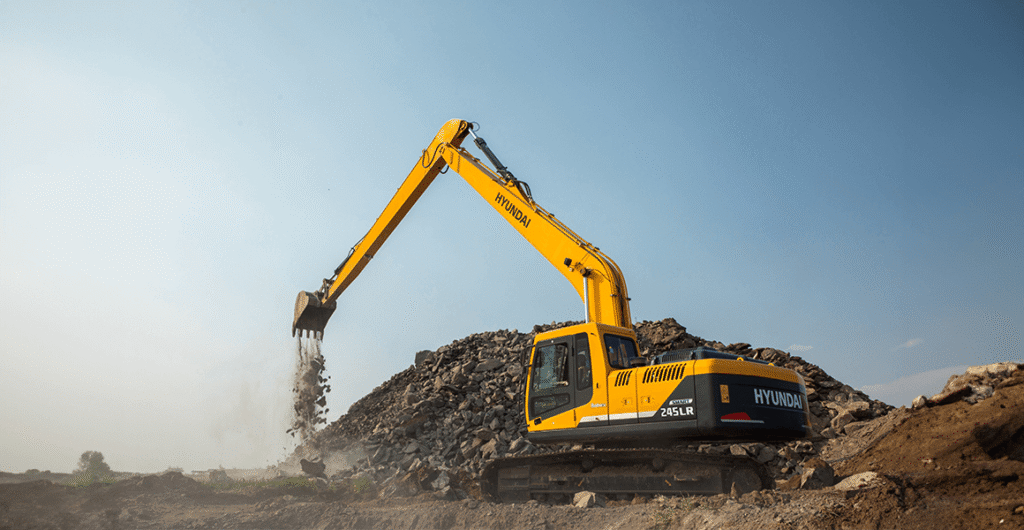
A long reach excavator is a standard excavator fitted with an extended boom and arm, built to dig deeper and reach further while its tracks stay on stable ground. Quotor lists long reach excavators as their own category within its excavator range, alongside standard, mini and wheeled machines. This guide covers how they work, what they’re used for and what to check to choose the right one before hiring.
Understanding Long Reach Excavators
What Is a Long Reach Excavator?
At its core, a long reach excavator is still a piece of heavy machinery built the same basic way as any excavator: a tracked machine that digs and lifts using a boom, arm and bucket, covered in Quotor’s guide to what an excavator is. The difference sits in the front end. Manufacturers extend the boom, the arm, or both, giving the machine significantly greater horizontal reach and digging depth than the standard version of the same base model, with the frame reinforced where the extra length adds strain.
How Long Reach Excavators Work
A long-reach excavator works the same way as any hydraulic excavator, extending and curling the linkage using the same hydraulic system as a standard machine. The extended geometry changes how an operator judges distance and load, since small movements at the controls translate into larger movements at the bucket, which is why operators generally need experience on standard machines first for safe operation. Quotor’s guide on how to operate an excavator covers the fundamentals that carry across.
Long Reach vs Standard Excavator
The clearest way to see what the extra length buys, and costs, is side by side with a standard machine from Quotor’s excavators range:
| Spec | Standard excavator | Long reach excavator |
|---|---|---|
| Horizontal reach | Around 9 to 10 metres | Commonly 15 metres or more |
| Digging force | Full rated breakout force | Reduced by the extended linkage |
| Stability | Standard configuration | Reinforced or rebalanced for the extended geometry |
| Best suited to | General digging and loading | Standoff and deep excavation work |
Reach and depth increase and digging force decreases; the machine may use additional counterweight or other stability measures to compensate for the extended front-end geometry.
Super Long Reach vs Long Reach Excavator
A super long reach excavator takes the idea further again, with an even longer boom and arm for jobs beyond what a standard long reach machine can cover, wide waterway dredging or high reach demolition on tall structures, for example. The extra length brings a further reduction in digging force, so these machines are usually reserved for jobs that genuinely need the additional metres.
Long Reach Excavator Attachments
Long Reach Boom and Arm
The boom and arm are what define a long reach excavator, and Quotor’s guide to excavator parts breaks down how these sections work with the bucket and linkage on a standard machine. Long-reach configurations extend the boom, arm or both, with the exact geometry depending on the manufacturer and intended application. Some manufacturers offer bolt-on extension sections instead of a fixed longer boom.
Excavator Buckets
Long reach excavators generally run narrower, lighter buckets than a standard machine of the same weight class, since a smaller bucket keeps loads within what the extended linkage can lift safely at full reach. Quotor’s guide to excavator bucket types covers the shapes available, from general purpose through to the narrower profiles favoured on long reach work.
Grapples and Demolition Attachments
Grapples, pulverisers and demolition shears are common on long reach machines working structure removal, since the extended reach can allow operators to pull material down from a safe standoff distance rather than working directly underneath it. Check the full attachment range a supplier has available before booking.
Dredging and Specialty Attachments
Dredging buckets, environmental buckets and skeleton buckets are common on long reach machines used to dredge waterways and wet sites, designed to drain material as it’s lifted rather than carrying dead weight back to the bank. These attachments are less common elsewhere, since the application is one long reach machines are particularly suited to.
Long Reach Excavator Applications
Deep Excavation
Deep excavation is a common thread across long reach excavation projects: basement digs, deep drainage lines and foundation work that would otherwise need the excavator to work from progressively lower benched levels. A long reach machine can often reduce the need for benching or repeated repositioning by working from a stable position further back from the excavation edge, reducing the risk of working close to an unsupported face.
Dredging and Waterway Work
Dredging and waterway maintenance are classic long reach applications: canal desilting, river normalisation and dam cleanout all involve removing material from below water level while the machine stays on the bank, clear of unstable, waterlogged ground a shorter reach machine would struggle to work from.
Demolition
High-reach demolition uses the same standoff principle: the excavator pulls a structure down from a safe distance rather than working close beside or beneath it, which matters most on taller or structurally compromised buildings where a standard excavator would put the operator too close to falling material.
Slope and Embankment Work
Slope stabilisation, embankment shaping and riverbank or cliff profiling on civil and construction projects call for a machine that can trim and grade a batter without driving onto it, keeping the excavator’s weight off ground that may already be unstable.
Quarrying and Material Handling
In quarries, long-reach machines handle material stockpiled beyond a shorter machine’s reach, or benches difficult to access directly, though for straightforward loading a large excavator is usually the more efficient choice.
Benefits and Limitations of Long Reach Excavators
Extended Digging Reach
The core benefit is straightforward: a long reach excavator gets to material a standard machine physically can’t, without bringing in a second machine or building a temporary access route. That’s usually the deciding factor when a long reach model gets specified for the job.
Improved Access from a Safe Distance
Working from a standoff distance keeps the excavator off unstable, waterlogged or structurally compromised ground, as much a safety benefit as a practical one on riverbank, demolition and slope work where driving closer isn’t an option.
Reduced Need for Machine Repositioning
Because one setup covers more ground, a long reach excavator often finishes a deep dig or long trench with fewer repositions than a standard machine working the same job in stages, offsetting some of its higher hire cost through reduced time on the job site.
Lower Digging and Lift Capacity at Maximum Reach
The trade-off sits at full extension: digging force and lift capacity both drop compared with a standard excavator of the same weight class, so long reach machines run lighter buckets and generally aren’t suited to high-production loading.
Choosing the Right Long Reach Excavator
Finding the right excavator for a long reach job comes down to four things: reach and depth, weight and stability, bucket size, and site access.
Maximum Digging Depth and Reach
Matching reach and depth to the job comes first: check both figures against the site plan rather than relying on either alone, since a machine with plenty of reach but not enough depth won’t do the job. Quotor’s guide on what size excavator you need covers this alongside weight and access.
Operating Weight and Stability
Machine stability at full extension typically depends on additional counterweight or other measures, which can add to overall weight and footprint compared with a standard excavator. Confirm the site can support that weight, particularly on soft or reclaimed ground near waterways.
Bucket Size and Attachment Requirements
Bucket size needs to match the reduced lift capacity at full reach, not just the machine’s weight class. Quotor’s guide to excavator bucket sizes is a useful starting point, and any grapple, shear or dredging bucket is worth confirming as rated for use at maximum extension.
Site Access and Ground Conditions
Even though a long reach excavator works from stable ground, it still needs a clear, level position on the construction site to set up, with room to slew the extended boom safely. Confirm access for delivery too, since extra boom length can affect transport dimensions.
Long Reach Excavator Hire
When to Hire a Long Reach Excavator
Hiring makes sense for most contractors, since long reach work tends to be project specific rather than a constant need, and the machines carry a higher purchase cost than standard equivalents. Quotor lists suppliers offering long reach excavators for hire, making it straightforward to compare machines against a reach and dig depth brief.
Factors to Consider When Hiring
Confirm the supplier’s machine matches the job’s reach and depth, not just its weight class, and check what attachments are included versus charged as an extra. On a commercial site, the operator is generally expected to demonstrate competency for the machine and task, which may be supported by relevant training, experience or a site-based verification. Quotor’s guide on excavator licensing covers the pathways available.
Long Reach Excavator Hire Costs
Long reach machines cost more to hire than a comparable standard machine, reflecting the reinforced linkage and any added stability measures, and rates vary too widely across size and reach to quote a single figure. Wet hire adds an operator’s day rate; Quotor’s guide on becoming an excavator operator explains that competency path for contractors without one already trained.