
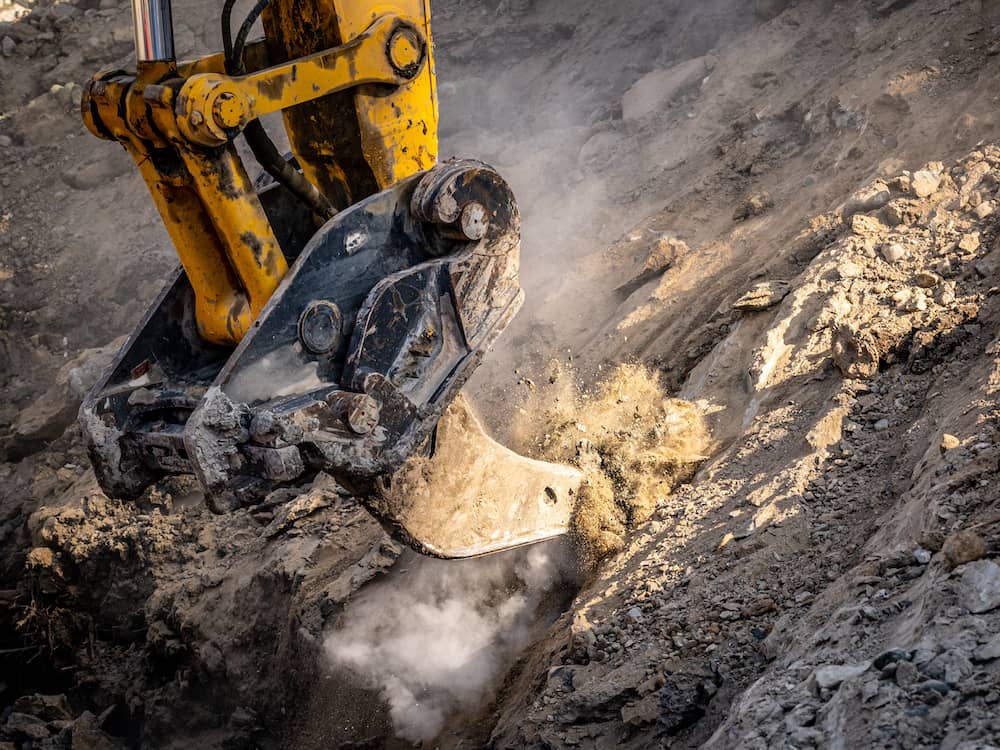
Understanding Excavator Attachments
What Are Excavator Attachments?
Excavator attachments are tools mounted on the excavator’s arm in place of, or alongside, the standard bucket. Some rely on the excavator’s normal boom, arm and bucket movement, while powered attachments such as hammers, augers and grapples use auxiliary hydraulics. Buckets, hammers, grapples, augers, rippers and thumbs are the various types in common use. Each one turns the same base machine into something built for a different job. This piece assumes you already know the basics of the machine itself; for the full breakdown of how an excavator is built and controlled, see Quotor’s guide to what an excavator is.
Why Choosing the Right Excavator Attachment Matters
The right attachment allows the same excavator to perform trenching, concrete breakout, debris sorting and post-hole drilling without a second machine on site. The reverse is also true: the wrong attachment for the material or task slows the job down and wears out faster than it should. Attachment choice is often the difference between a machine that’s earning its hire cost and one that’s fighting the ground it’s working in.
Types of Excavator Attachments
The sections below cover excavator attachments and their uses, starting with the bucket family.
Excavator Buckets
The bucket is the default attachment and comes in several common types built for different ground. A general purpose or digging bucket handles everyday excavation. A trenching bucket is narrower and deeper for pipe and cable runs. Grading buckets, sometimes sold as clean-up buckets, are wider and flatter for levelling and finishing work. Rock buckets add reinforced teeth for breaking into hard or rocky ground, while riddle buckets have gaps between their tines to sift soil away from stone and debris on site. Quotor’s guide to excavator bucket types covers the full range and where each one fits.
Hydraulic Hammers
A hydraulic hammer, also called a breaker, replaces the bucket with a chisel-tipped tool for breaking up concrete, rock or asphalt. It draws hydraulic power through the excavator’s auxiliary hydraulic circuit rather than the main digging function, so the machine needs to supply the flow and pressure the hammer is rated for.
Grapples
A grapple is a claw-style attachment with two or more hydraulically closing arms, used for material handling that a standard bucket can’t manage, picking up and sorting demolition debris, logs, scrap metal and similar loose or irregular loads. Rotating grapples add the ability to turn the load in place, which matters when material needs to be oriented before it’s dropped into a truck or pile.
Augers
An auger attachment pairs a hydraulic drive unit with a screw-shaped bit to drill round holes for posts, footings or piling work. The drive unit stays on the machine while different bits determine the hole diameter.
Rippers
A ripper is a reinforced tooth used to tear into hard, compacted or frozen ground, roots or fractured rock where a standard bucket struggles. Rather than using percussion like a hydraulic hammer, it concentrates the excavator’s digging force through a narrow point to loosen the material.
Hydraulic Thumbs
A hydraulic thumb is a pivoting arm mounted to the dipper arm alongside the bucket, closing against it to grip irregular material like rocks, logs or pipe sections. It’s a companion to the standard bucket rather than a standalone tool, which is the main thing that separates it from a grapple: a thumb works with the bucket already on the machine, while a grapple replaces it entirely.
Excavator Attachment Compatibility
Couplers and Mounting Systems
Many modern excavators, particularly hire machines, use a quick coupler to change attachments, though how much that speeds things up depends on the coupler type. Hydraulic quick couplers can allow the locking mechanism to be operated from the cab, while manual couplers require the operator to release or secure the mechanism externally. The coupler and attachment mounting dimensions determine whether the tool physically connects to the machine, while attachment weight also has to remain within the excavator’s approved operating and lifting limits, covered in more depth in the guide to excavator parts.
Hydraulic Flow Requirements
Attachments like hammers and augers draw on the excavator’s auxiliary hydraulic circuit, and the machine needs to supply the flow and pressure that attachment is rated for. Too little flow leaves the attachment underpowered; too much can damage its seals or drive components over time. A guide to operating an excavator covers how these auxiliary circuits are controlled from the excavator cab.
Matching Attachments to Excavator Size
Excavators are grouped by weight class, from mini machines through to large standard excavators, and attachments are built to match a specific class based on the weight of the attachment and its mounting bracket size. An attachment rated for larger excavators won’t necessarily fit or run safely on smaller excavators, and the reverse wastes capacity. Some attachments can be used across more than one weight class if the coupler and mounting dimensions line up, though the weight limit for that machine still applies. Machine brand and model can affect this too, which Quotor’s guide to excavator brands goes into further, alongside bucket sizing by excavator class for buckets specifically.
Choosing the Right Excavator Attachment
Match the Attachment to the Task
Choose the right attachment by starting from the job, not the attachment list: a trenching bucket for pipe runs, a hammer attachment for breaking out concrete, an auger for post holes, a grapple for material handling and sorting debris. Some attachments also demand more from the operator than others, a hydraulic thumb or a rotating grapple takes more practice to place accurately than a standard bucket does, which is worth factoring in alongside the equipment itself; a guide to becoming an excavator operator covers what that skill involves.
Consider Material and Ground Conditions
Loose or soft material moves fine with a standard or grading bucket, but compacted ground, rock or asphalt needs a rock bucket, ripper or hammer to break it up first. Using a standard bucket on ground it wasn’t built for wears the attachment out faster and slows the job rather than speeding it up.
Common Attachment Selection Mistakes
Choosing the right attachment means avoiding a few recurring mistakes: picking one that’s the wrong size for the excavator’s weight class, mismatching hydraulic flow to a hammer or auger, or assuming a coupler will fit without checking it first, all covered in more detail under Compatibility above. Skipping that check is usually what turns a straightforward attachment swap into a delay on site.
Hiring Excavator Attachments
Hiring Attachments with the Excavator
Hiring the attachment bundled with the excavator is usually the simplest route: the coupler and hydraulic flow are already matched to the machine, and there’s one supplier and one delivery to manage instead of two. Quotor’s excavator listings show the range of excavator attachments available for each machine before you book.
Hiring Attachments Separately
Sometimes the attachment needed for a job isn’t one the excavator’s supplier stocks, a specialised grapple or a larger hammer, for instance, which means sourcing it separately. Confirm coupler type and hydraulic rating against the excavator before booking, since a mismatch discovered on site is harder to fix than one caught in advance. A guide to hiring construction equipment covers how to line up a separately hired attachment with the machine it needs to run on.
Excavator Attachment Hire Costs
Excavator attachment hire cost depends mainly on attachment type and size, hire duration, supplier availability and whether the attachment is bundled with the excavator or hired separately. Wear items such as hammer tools or auger teeth may also be treated differently under individual hire agreements. Compatibility can affect total project cost if a different coupler, hydraulic setup or excavator is needed to run the attachment. A guide to estimating equipment cost breaks down how these factors add up, and Quotor helps line up the right excavator and attachment together as one hire rather than two separate bookings.