
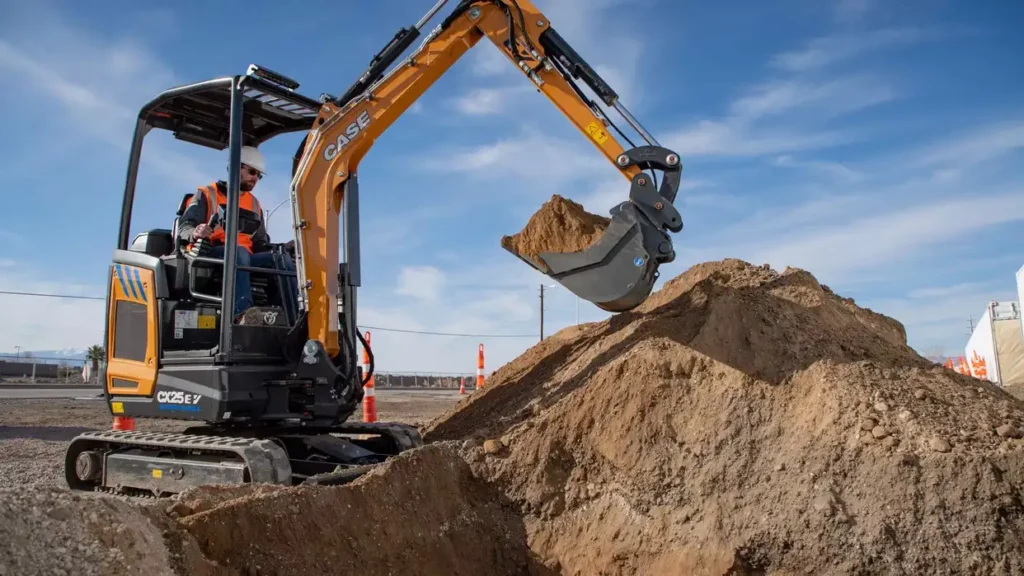
Not every excavation job needs a machine the size of a shipping container. A mini excavator is built for the jobs in between, too big for a shovel and wheelbarrow, too small to justify a full-size excavator. This complete guide covers what a mini excavator is, the size bands Quotor lists it under, and what to check before you hire one.
Understanding Mini Excavators
What Is a Mini Excavator?
A mini excavator, also called a compact excavator, is generally considered a mini once weight passes about 1.7 tonnes, the point where Quotor’s listings move out of the micro excavator class, running to around 10 tonnes before it is classed as a small excavator. Sometimes shortened to a mini digger, or a mini ex on site, it keeps the same basic layout as any other excavator: a rotating house, boom and dipper arm on tracks. Unlike a skid steer loader, its boom and dipper are designed specifically for digging below ground level. Compared with a backhoe loader, the excavator’s upper structure can rotate through 360 degrees, giving it greater flexibility around the machine.
How Mini Excavators Work
A diesel engine drives the hydraulic system that lets a mini excavator dig, lift, rotate and travel through the same controls. Mini excavators come standard with tracks, though a wheeled mini excavator variant suits moving quickly between sealed surfaces. Many models also carry a front dozer blade for backfilling and levelling. Quotor’s guide on how to operate a mini excavator covers the controls.
Benefits of Using a Mini Excavator
The main benefit is access: compact size and a tight turning circle let a mini excavator work in tight spaces a full-size machine cannot reach. Swapping attachments gives the same machine versatility across trenching, landscaping, demolition and material handling, and lower ground pressure than a wheeled machine reduces disruption to lawns and finished surfaces.
Mini Excavator Sizes
Quotor lists a wide range of mini excavator options on its mini excavator category page, from machines barely bigger than a wheelbarrow to nine-tonne units rivalling a small excavator. Weight runs from roughly 1.7 to 10 tonnes, broken into the bands below.
| Quotor Class / Size Band | Weight | Typical Use |
|---|---|---|
| Micro excavator | Under 1t | Tight access, indoor work, light landscaping |
| Mini: 1.7 to 3t | 1.7t to 3t | Residential digging, small footings |
| Mini: 3.5 to 5.5t | 3.5t to 5.5t | Utility digging, site preparation |
| Mini: 6 to 9t | 6t to 9t | Deeper digging, heavier lifting |
Micro and 1-Tonne Excavators
Machines around one tonne sit at the top of the micro excavator class, topping out close to the 1.7-tonne mark where Quotor’s mini excavator listings begin. They are smaller and lighter than the rest of the mini excavator range, built for jobs where fitting through a standard gate matters more than reach. See Quotor’s guide to the micro excavator for the full breakdown.
1.7 to 3-Tonne Mini Excavators
This is the band most homeowners and small contractors picture: narrow enough for most side access and capable of digging service trenches and small footings. The smaller machines in this band can be relatively straightforward to transport, although tow-vehicle and trailer capacity need to be checked against the machine’s actual operating weight. Dig depth typically falls in the 1.8 to 2.5 metre range, and Kubota and Yanmar both build extensively here, where zero tail swing designs are most common.
3.5 to 5.5-Tonne Mini Excavators
Machines in this band start closing the gap with small excavators on dig depth and breakout force, but their greater operating weight also brings more substantial transport requirements. The Bobcat E35, a popular machine in the 3-tonne class, is a common example, and most manufacturers have a long-arm option here.
6 to 9-Tonne Mini Excavators
At six to nine tonnes, a mini excavator behaves more like the next class up than an oversized micro machine, with dig depths approaching four metres and enough lift capacity for grapple work. Yanmar and Bobcat all build in this range, and machines at the top of this band sit close to Quotor’s ten-tonne mini excavator ceiling.
Choosing the Right Mini Excavator Size
Matching machine to job comes down to dig depth or reach needed, site access width, and how much the machine must lift for grapple work. A 1.7 to 3-tonne machine suits most residential jobs, while 3.5 tonnes up is generally better suited to deeper digging and larger footings. For something smaller still, Quotor’s micro excavator category is worth checking too.
Mini Excavator Attachments
The versatility of mini excavators stems largely from their attachment range, since swapping one tool for another changes the job entirely.
Buckets
Most mini excavators run a general purpose digging bucket and a narrower option for tighter cuts, with width matched to the job rather than the largest one the machine can lift. A mud bucket, wider and shallower, suits cleanup and grading instead. Quotor’s guide to excavator bucket types covers the differences.
Augers
An auger turns a mini excavator into a post hole borer, useful for fencing, decking footings and small pile foundations. Bit diameter and drive torque need to match the machine’s hydraulic output, so a bit sized for a 5-tonne excavator will generally underperform on a 1.7-tonne machine.
Hydraulic Breakers
A hydraulic breaker swaps in for the standard digging tool, using a chisel point to break concrete and rock it cannot dig through. Breaker weight needs to match the excavator’s weight, since a mismatch strains the boom or slows the job. On a mini excavator, breakers are generally used for smaller demolition tasks rather than large-scale concrete removal.
Grapples and Other Attachments
A grapple adds material handling capability, letting the machine pick up branches, rubble, pipe or fencing rather than scooping it. Other common tools include rippers for rocky ground and compaction plates for backfilled trenches. The right attachments turn a digging-only machine into one that handles most of a site’s earthworks. Quotor’s guide to excavator attachment types has a fuller breakdown.
Mini Excavator Applications
Mini excavators are often used across residential, utility and light commercial work, wherever a full-size excavator would be overkill or could not fit.
Landscaping and Residential Work
Landscaping is one of the most common uses, from digging garden beds and retaining wall footings to levelling ground before turf or paving. Access is usually the deciding factor on residential sites, which is why the 1.7 to 3-tonne band is the most commonly hired size among landscapers.
Trenching and Utility Work
Trenching for stormwater, sewer, power and irrigation lines is a task a mini excavator handles better than almost any machine its size, since the boom cuts a narrow, consistent depth a loader cannot match.
Site Preparation and Earthmoving
Before a slab, shed or driveway goes in, a mini excavator is commonly used to strip topsoil, cut to level and move spoil into a stockpile or truck. The front blade handles fine levelling while the bucket moves bulk material.
Demolition and Cleanup
For small-scale work, such as demolishing small structures like garden sheds, old decking or a section of paved driveway, a mini excavator fitted with a breaker or grapple can do in an hour what would otherwise take a crew a full day by hand, then switch back to loading mode to clear material for removal.
Choosing the Right Mini Excavator
Digging Depth and Reach
Digging depth is the first spec worth checking, since it rules machines in or out before anything else matters. Reach, measured from the centre of rotation to the dipper arm at full extension, matters just as much where the machine works from one position, such as along a fence line. Quotor’s guide on what size excavator you need breaks this down.
Operating Weight and Lift Capacity
Operating weight determines transport requirements and how much the machine can safely lift, particularly with a grapple or pallet fork fitted for heavy lifting. A heavier machine generally has a higher tipping load, but also needs a heavier trailer to move. For jobs mixing digging with occasional lifting, the lift capacity chart at the working radius needed matters more than weight alone.
Site Access and Width
Site access, gate widths, side passages and overhead clearances, usually sets the size ceiling before digging performance does. Zero tail swing models keep the counterweight within track width, reducing the need for repositioning the machine near fences or parked cars, and an expandable undercarriage retracts for tight spaces before widening for stability, letting a mini excavator work in confined spaces a full-size machine could never enter.
Attachment Requirements
Before settling on a machine, check that hydraulic flow and quick hitch type match what the job needs, particularly for tools like breakers and post hole borers, where undersized output means poor performance regardless of size. Getting this right avoids turning up with the wrong tool for the job.
Mini Excavator Hire
When to Hire a Mini Excavator
Hiring a mini excavator makes sense for most homeowners and many contractors, since the machine is only needed for a fraction of a project’s timeline. Renting a mini excavator avoids ownership, storage and depreciation costs on a machine that might only run a handful of days a year.
Factors to Consider When Hiring
Hire duration, tool needs and site access all affect which machine and hire company suit the job. On most commercial sites, the operator is generally expected to demonstrate competency for the machine and task, which may be supported by relevant training, experience or a site-based verification of competency, rather than a single licence covering every excavator size. Quotor’s guide on whether you need an excavator licence covers this further. It’s also worth confirming whether the hire is wet hire (machine and operator) or dry hire (machine only), which affects cost.
Mini Excavator Hire Costs
Hire cost is driven mainly by machine size, hire duration and which attachments are included, rather than a single standard rate. Longer hire periods generally bring the daily rate down, while specialist attachments such as breakers or post hole borers usually cost extra. Comparing quotes across suppliers pays off before your next equipment rental.
Hiring vs Buying a Mini Excavator
Buying only makes sense once a mini excavator runs often enough that ownership costs work out lower than repeated hire, which rarely happens for most trades and homeowners. Hiring keeps capital free and lets machine size change with the job. Quotor compares hire options across the full excavator range, making it straightforward to check whether the right size and attachment combination is available nearby.