
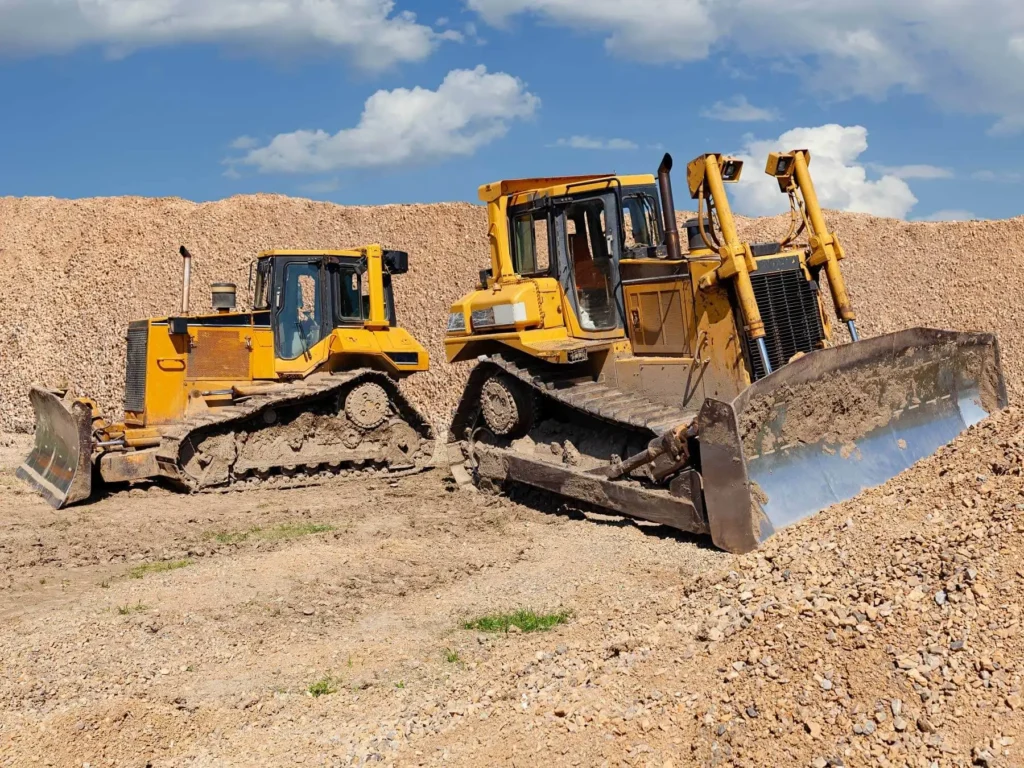
Every dozer pushes material the same way, using a fixed blade on a tracked machine, but the machine behind it ranges from a compact crawler suited to constrained sites to a 100-tonne-plus mining giant. A dozer is one of several types of earthmoving equipment, and getting its size wrong costs money either way: an undersized machine turns a two-day push into a week of overtime, while an oversized one can’t get through the access point or sits on an hourly rate the job never needed. This guide covers how dozer size is measured, what drives the decision, and how to match a class to the job at hand.
Understanding Dozer Sizes
What Does Dozer Size Mean?
When someone asks what size dozer they need, they’re really asking about operating weight, the figure hire companies use to sort dozers into classes and the number nearly everything else, blade capacity, transport requirements, hire cost, scales from. Quotor’s guide to what a dozer is covers the different bulldozer types in more depth.
Operating Weight and Dozer Class
Quotor groups dozer hire into four weight classes, small, medium, large and extra-large, each lining up roughly with a Caterpillar D-series range that’s become shorthand across the industry even where the machine on site is a Komatsu or a John Deere. The weight band and D-series equivalent for each class are set out below. These bounds shift slightly between hire companies, but they’re a reliable starting point before comparing individual models.
Why Dozer Size Matters
Hiring the wrong size shows up fast on site. A dozer that’s too small needs more passes to move the same volume, stretching a straightforward job into overtime. One that’s too large can’t manoeuvre on a confined site and racks up a higher hourly rate for less work. Matching size to the job, rather than defaulting to the biggest machine available “to be safe,” usually decides whether it finishes on budget.
Common Dozer Size Classes
| Class | Operating weight | Common models | Typical role |
|---|---|---|---|
| Small | Under 20 tonnes | D3 to D5 | Residential, tight access, landscaping |
| Medium | 20 to 39 tonnes | D6 to D7 | Roadwork, site preparation, general earthmoving |
| Large | 40 to 69 tonnes | D8 to D9 | Bulk earthworks, mining support, ripping |
| Extra-Large | 70 tonnes and up | D10 to D11 | Mining, quarrying, major infrastructure |
Small Dozers
Small dozers are short, highly manoeuvrable tracked crawlers, sometimes called mini dozers on site, built for landscaping, residential projects and light construction where access matters more than raw pushing power. They usually run a straight or six-way blade for fine grading and backfilling. The Caterpillar D3 is a common choice in this class in Australia, valued for its size and reliability on small development jobs.
Medium Dozers
Medium dozers cover the widest range of everyday commercial work: roadwork, site preparation and general earthmoving. They carry enough weight and horsepower to manage demanding workloads while still fitting into moderately tight areas. The Cat D6 is one of the most widely hired medium bulldozers in Australia.
Large Dozers
Large dozers bring substantially more horsepower and blade capacity than medium machines, built for shifting large volumes and ripping through compacted ground on major infrastructure, mining and quarrying projects. The M12 Motorway earthworks package in Western Sydney moved more than 2.6 million cubic metres of material, the kind of volume that sits squarely in large dozer territory.
Extra-Large Dozers
Extra-large dozers are the biggest machines available for hire, built for mass excavation, overburden removal and large-scale ripping where production per pass matters more than manoeuvrability. The Komatsu D475A is one example listed in this class. Mobilising a machine like that for a job that doesn’t need that power wastes money from the day it arrives on site.
Matching Dozer Size to the Job
Residential and Light Site Work
Backyard levelling, pad preparation, landscaping and light demolition clearing almost always call for a small dozer. Tight side access, fences and existing structures rule out anything bigger, and the volumes involved rarely justify the hire cost of a medium machine.
General Construction and Civil Work
Subdivision earthworks, road construction and general site preparation typically sit in medium dozer territory, with the biggest highway packages stepping up to a large machine. These jobs need enough weight and horsepower to move real volumes, but access usually still rules out a large dozer outside major road projects.
Land Clearing and Bulk Earthmoving
Bulk cut-to-fill earthworks, large-scale vegetation clearing and civil infrastructure work need a large dozer’s blade capacity and ripping ability. These clearing projects are measured in cubic metres moved rather than site area, and a smaller machine can’t keep pace with the schedule.
Mining and Heavy-Duty Applications
Mining operations, quarrying and major infrastructure work call for large or extra-large dozers depending on scale. Continuous overburden removal justifies the extra-large class’s higher hourly rate, since moving more material per pass cuts the total hours a job takes. Machines at this scale are usually run by experienced operators, and Quotor’s guide to becoming a dozer operator covers what that training involves.
Dozer Size Selection Factors
Blade Capacity and Pushing Power
Blade capacity generally increases with dozer size, but it should still be checked as a separate specification, since blade type, width and geometry vary within the same weight class, covered in the breakdown of dozer parts. A bigger dozer typically carries a bigger blade and more horsepower to move it, part of why the jump between medium and large dozers shows up in blade width and pushing force. Undersizing means more passes and a longer job; oversizing means paying for pushing power the job never uses.
Operating Weight and Traction
A dozer’s pushing force comes from weight pressed into the ground through the tracks, not from engine power alone. Operating weight is the real limit on how much a machine can push before the tracks lose grip and start to slip. Heavier dozers handle tougher ground and bigger loads even when horsepower figures look similar across classes.
Ground Conditions and Slope
Soft or wet terrain makes ground pressure and track configuration more important than operating weight alone. Wider low-ground-pressure tracks spread the machine’s weight over a larger area and can improve flotation on weak ground, sometimes letting a heavier machine work where a smaller standard-track dozer would bog. Sloped ground shifts the deciding factors again: check the machine’s operating limits and stability rating rather than choosing a class by weight alone, and operator experience matters regardless of machine size, covered in the guide to operating a dozer. Match the class to the ground the job actually sits on, not just the material volume.
Site Access and Working Space
Gate widths, fence lines and working radius rule out size classes before load or terrain even come into it. A small dozer that fits the available site entrance can start work immediately. A large dozer stuck at the kerb with nowhere to unload delivers nothing. Measure the tightest access point on site before settling on a class.
Blade and Ripper Requirements
Blade shape matters as much as size. A straight blade suits precision grading on firm ground, a U-blade moves large volumes over distance, and an angle blade side-casts material for drainage or roadwork. A suitable ripper can extend what a dozer can handle without automatically moving up a size class: a single heavy-duty shank penetrates deep into rock, while several lighter shanks work faster across looser ground. Quotor’s guide to dozer blade types covers the full range of attachment options.
Dozer Size Comparison
Small vs Medium Dozers
The line sits at access, not volume. A fence, gate or shed doorway that limits machine width settles the decision in favour of a small dozer regardless of how much material there is to move. With adequate access, a medium dozer becomes more attractive as push distances, material volume and required production rate increase.
Medium vs Large Dozers
This comes down to ripping and pace. A medium dozer handles general earthmoving and light ripping in already-broken ground. A large dozer becomes more attractive where ripping demand, push load or daily production targets exceed what the available medium machine can handle efficiently.
Large vs Extra-Large Dozers
Extra-large dozers only make sense at genuine mining or major-infrastructure scale, where continuous bulk movement justifies the higher hourly rate. A large dozer already covers most civil and quarry jobs. Moving up a class without that production requirement adds cost without adding value.
Choosing the Right Dozer Size to Hire
When a Smaller Dozer Is Enough
If volume, terrain and access all point to the smaller of two adjacent classes, take it. Smaller dozers cost less per hour to rent, transport more easily and are easier to handle than large machines on constrained sites, advantages that matter more than raw capacity on most residential projects and light commercial jobs.
When to Move Up a Size Class
Move up when a smaller machine keeps falling behind schedule, needs constant repositioning to handle the volume, or can’t rip ground that needs breaking before grading. Running a small dozer flat out for days on a job a medium machine would finish in one usually costs more in extended hire than the upgrade would have, a comparison the guide to estimating equipment cost can help make.
Avoiding an Oversized or Undersized Dozer
Both mistakes trace back to sizing against the job label instead of the actual volume, ground and access on the day. A job labelled small can still need ripping if the ground turns out to be rock, and a job labelled big can still suit a smaller machine if the site is tight. When these three factors don’t agree on one class, size to the tightest constraint rather than the biggest number. Quotor’s guide to hiring construction equipment covers the process end to end.
Hire Cost and Transport Considerations
Hire and mobilisation costs generally rise with dozer size, but the cheapest hourly machine isn’t always the cheapest for the project. A larger dozer can justify its higher rate if the extra blade capacity and production cut total machine hours, and fuel use scales with size too, sometimes tipping the balance back toward the smaller class. Larger dozers also need low-loader transport, and moving one down a narrow or busy route can require permits. Operating heavy plant in Australia falls under the work health and safety framework Safe Work Australia sets nationally and state regulators such as SafeWork NSW enforce, with a recognised competency expected before operating one. Comparing dozer hire options across all four classes helps land on the right dozer, part of the broader equipment procurement process most construction teams manage.