
Understanding Dozer Blades
What Is a Bulldozer Blade?
A bulldozer blade is the flat, curved plate mounted to the front of a dozer, used to push, cut and grade material across construction and excavation sites. It’s one of several bulldozer parts that work alongside the undercarriage and hydraulics. The blade attaches to the dozer’s push arms, which is what lets the hydraulics raise, lower and angle it as it contacts the ground and the material. It’s also one of the specs Quotor lists on every dozer listing, alongside the machine’s class and reach. For background on the machine itself, see our guide to what a dozer is.
Why Blade Type Matters
Not every blade suits every job. A blade built to carry large volumes of loose material over a long push will spill and lose precision at fine grading, and a grading blade runs out of capacity fast on a bulk job. Choosing the wrong type of bulldozer blade means extra passes, wasted fuel and a finish that needs correcting.
How Dozer Blades Work
How the Blade Cuts and Pushes Material
Every dozer blade works on the same principle. The crawler dozer drives forward, the cutting edge bites into soil and debris, and the curved face rolls it up and forward as the machine advances to push material forward. How much material stays in front of the blade, how far it can travel before spilling, and how fine a finish the operator can leave all come down to the blade’s geometry rather than a different mechanism.
How Blade Shape Affects Material Handling
Two properties do most of the work: curvature and wing height. More curvature and taller wings hold more material in front of the blade and lose less over the sides, which suits bulk earthmoving. A flatter blade with shorter wings holds less material but gives the operator a clearer view of the cutting edge and finer control over grade. Blade height and width, which vary by model, also set how much material moves per pass.
Types of Dozer Blades
Straight Blade (S-Blade)
The straight blade has only a slight curve and short, low side wings that don’t curl inward. That flat profile gives the operator a clear view of the cutting edge and precise control over grade, which is why this blade is best suited to fine grading, levelling and backfilling. It carries less material than a curved blade, so it isn’t the first choice for bulk pushing.
Universal Blade (U-Blade)
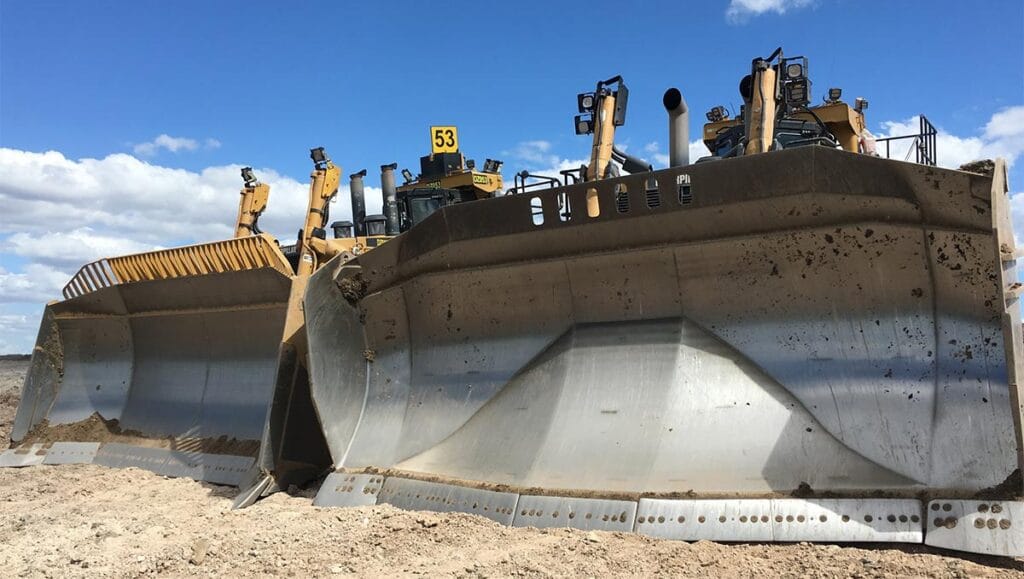
The U-blade is heavily curved with tall side wings that curl toward the machine. That curved shape holds large volumes of loose material in front of the blade across a long push with minimal spillage, which is why U-blades are built for earthmoving tasks like moving overburden, coal or sand over distance. The trade-off is reduced visibility of the cutting edge and less precision for fine grading.
Semi-Universal Blade (SU-Blade)
The SU-blade combines moderate curvature with shorter side wings than a full U-blade, giving it useful carrying capacity without losing all the operator’s view of the cutting edge. It’s a versatile blade for general dozing and land clearing, where the job doesn’t call for either extreme.
Angle Blade
An angle blade pivots up to around 25 to 30 degrees left or right, letting the operator cast material to one side instead of pushing it straight ahead. Angle blades are ideal for backfilling trenches, cutting ditches and road construction, where material needs to move to a specific side rather than simply forward.
Power Angle Tilt (PAT) Blade
A PAT blade is often described as a 4-way blade, or a 6-way blade on configurations with pitch adjustment as well. Moving the blade hydraulically from the cab allows the blade to angle and tilt for vertical adjustments without the operator leaving the seat, which is especially useful for contouring, slope work and grading tasks that need frequent, fine adjustment. Our guide to how to operate a dozer covers cab controls in more detail.
C-Blade
The C-blade, or cushion blade, is a specialised blade built to withstand repeated push-loading of scrapers. Its cushioned mounting system absorbs some of the shock when the dozer contacts the scraper’s push block, which makes it ideal for that repeated contact rather than general earthmoving. C-blade dozers are a specialised booking rather than a standard hire item, and Quotor lists them separately from general-purpose configurations.
Comparing Dozer Blade Types
The different types of blades above trade carrying capacity for grading precision. The table below shows where each is best used, to help you select the right one for the job.
| Blade Type | Best For | Carrying Capacity | Grading Precision | Angling & Tilting |
|---|---|---|---|---|
| Straight (S) | Fine grading, backfilling | Low | High | None |
| Universal (U) | Bulk earthmoving, long pushes | High | Low | None |
| Semi-Universal (SU) | General dozing, land clearing | Medium | Medium | None |
| Angle | Sidecasting, ditching, road work | Medium | Medium | Angle only |
| Power Angle Tilt (PAT) | Contouring, slope work, fine site work | Medium | High | Angle and tilt |
| C-Blade (Cushion) | Push-loading scrapers | Low | N/A | None |
Once you’ve matched a blade to the table above, Quotor’s dozer listings let you filter by configuration to confirm the right one is available near you.
Cutting and Grading Performance
S-blades give good cutting-edge visibility and predictable straight-ahead control. PAT blades add hydraulic angle and tilt for more complex grading, contouring and slope work. U-blades trade that visibility for volume, so they’re a poor fit for finish grading even though they move more material per pass.
Material Carrying Capacity
Carrying capacity is driven mainly by blade curvature and wing height. U-blades retain the most loose material over long pushes, while S-blades trade volume for cutting-edge visibility and control. SU-blades sit between the two.
Angling and Tilting Capability
Only the angle blade and the PAT blade move independently of the dozer’s direction of travel. An angle blade pivots side to side, while a PAT blade adds vertical tilt, so it can follow a slope or crown a surface without repositioning the machine.
Ground and Material Suitability
Loose granular material favours a curved blade that can retain volume. Cohesive material such as clay can be easier to control with a flatter blade, where carrying capacity matters less than penetration and visibility. Wet or soft ground is a separate consideration: it mainly affects the dozer’s traction and undercarriage suitability, not blade choice.
Choosing the Right Dozer Blade
Match the Blade to the Job
Start by matching the type of blade to the task you’re working on, not just the machine. Fine grading and site preparation call for an S-blade or PAT blade. Bulk material movement calls for a U or SU-blade. Trenching, ditching and road work call for an angle blade. Operators who already know a site’s ground conditions often read the right blade faster than any checklist. Our guide on how to become a dozer operator covers what that experience involves.
Consider Material and Ground Conditions
Match blade curvature to how loose or cohesive the material is, as covered above, and treat wet or soft ground as a separate check on the dozer’s traction and undercarriage suitability rather than a blade decision.
Match Blade Size to the Dozer
Manufacturers size blade width and height to the dozer’s class, and a heavy-duty blade built for a large dozer won’t perform the same job mounted on a smaller machine. If you’re unsure which dozer class a job needs before you get into blade choice, our guide on what size dozer you need is the place to start.
Common Blade Selection Mistakes
The most common mistake is choosing based on availability rather than the job: taking whatever blade is on hand instead of confirming it suits the material and precision needed. A close second is underestimating visibility on grading work, where a high-capacity blade that hides the cutting edge slows the operator down rather than speeding the job up.
Dozer Blade Considerations When Hiring
Confirming the Blade Configuration
Not every dozer on a hire fleet carries the same blade. Confirm the blade configuration before the machine arrives on site, not after. When you check listings on Quotor, blade type is shown alongside the dozer’s other specs, so you can check it against the job before booking.
Matching the Blade to the Planned Work
If the job changes scope, say a grading task turns into moving stockpiled material, the blade requirement changes with it. Flagging that early with your hire provider means the right configuration is available rather than working around a blade that no longer fits the task.
How Blade Configuration Can Affect Hire Suitability
Specialised blades like PAT and cushion configurations are less common on hire fleets than straight or angle blades, and that affects lead time and cost. Our guide on estimating equipment cost breaks down how configuration factors into a hire quote, and our general guide to hiring covers the booking process. If the configuration isn’t listed nearby, Quotor can help track down availability across suppliers.