
Understanding Forklift Parts
What Is a Forklift?
A forklift is a powered industrial truck built for material handling: lifting, carrying and stacking loads on forks mounted to a vertical mast. Most forklifts used on warehouse floors and construction sites are counterbalance forklifts, meaning a weight at the rear of the chassis offsets the load out front rather than relying on outriggers. For a full breakdown of how forklifts are classified and used, see what a forklift is and how it works. The parts covered in this article describe a standard counterbalance forklift specifically.
Why Understanding Forklift Parts Matters
Knowing what each component of a forklift does helps with three practical things: operating the machine safely, spotting wear or damage before it becomes a breakdown, and knowing what to check on a specific machine before hiring it. Quotor lists a range of forklifts for hire, and understanding the parts covered below makes it easier to compare listings and ask the right questions before booking one.
Main Parts of a Forklift
Mast
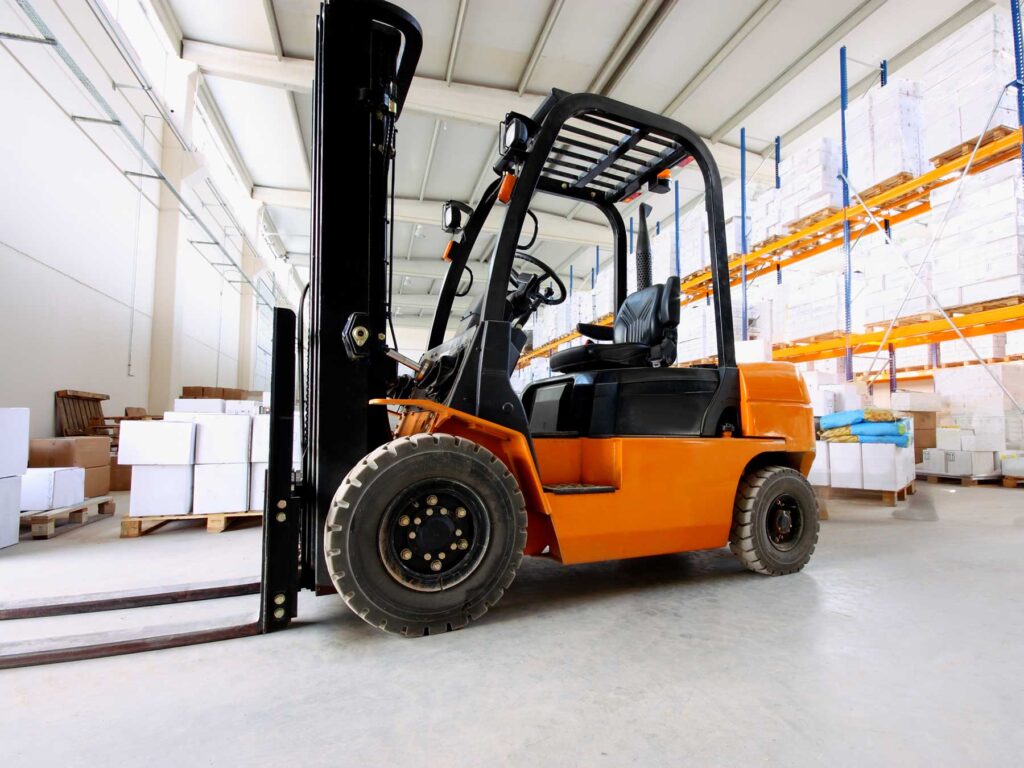
The mast is the vertical rail assembly the forks travel up and down. It’s built from nested steel channels, called stages, that telescope to reach greater lift heights than the machine’s collapsed height would otherwise allow. The mast can also tilt slightly forward or backward, helping the operator engage a load and keep it securely positioned during transport with the forks lowered.
Forks and Carriage
The forks are the two horizontal blades that slide beneath a load, most often a loaded pallet, and the carriage is the frame they’re mounted to, which rides along the mast. A forklift lifts that pallet hydraulically, unlike a hand pallet, which relies on manual leverage to move a load short distances. A load backrest sits behind the forks on the carriage, a vertical steel grille that stops a load from shifting backward toward the mast and the operator when the forks are raised.
Lift Chains and Cylinders
Lift chains and hydraulic lift cylinders raise and lower the carriage along the mast. Separate tilt cylinders angle the mast forward or backward. How these work together mechanically is covered in the next section.
Chassis and Counterweight
The chassis is the structural frame that carries the engine or motor, the mast and the operator’s cab, and it’s built around a fixed counterweight bolted or cast into the rear. The rear counterweight offsets the load carried on the forks, but rated capacity depends on the forklift’s overall stability geometry, load centre, mast configuration and attachments, which is why choosing the right size forklift means matching the job to the machine’s rated capacity rather than picking on width or footprint alone. Quotor lists rated capacity against each machine for exactly this reason.
Steering and Drive Axles
Counterbalance forklifts typically drive from the front axle and steer from the rear axle, the opposite arrangement to a car. Steering from the rear lets the machine pivot in a tighter radius, which matters in narrow warehouse aisles, while the front axle carries the engine or motor’s power to the drive wheels.
Wheels and Tyres
Forklifts commonly use cushion tyres or pneumatic-profile tyres, which may be air-filled, foam-filled or solid depending on the application. Cushion tyres suit smooth indoor floors and keep the machine’s overall height and turning circle smaller, while pneumatic-profile tyres handle gravel, dirt and uneven outdoor ground better.
Engine or Electric Motor
Counterbalance forklifts may use an internal combustion engine or an electric drive system. Combustion models run on fuels such as diesel, petrol or LPG and suit outdoor or high-throughput work, while electric forklifts use battery-powered motors that run quieter and produce no exhaust, making them the standard choice for enclosed warehouse floors. Manufacturers including Toyota, Hyster, Nissan, Linde, Big Joe and UniCarriers all build lift trucks across both drive types; see forklift brands compared for how they differ.
Battery or Fuel System
Electric forklifts run on a heavy lead-acid or lithium-ion battery that also contributes to the truck’s counterbalance stability. Combustion models instead carry a diesel or petrol tank, or a removable LPG cylinder for propane-fuelled machines.
Operator Seat and Controls
The operator seat, seatbelt and controls sit within the operator compartment, with hydraulic levers or a multifunction control managing lift, tilt and, where fitted, functions such as side-shift, alongside a steering wheel and horn. Operating these controls safely is part of what becoming a licensed forklift operator covers.
Overhead Guard
A steel frame fitted above the operator’s head protects the operator from falling objects or a shifting load. On ride-on counterbalance forklifts, it’s a structural part of the truck rather than a working attachment.
How Forklift Parts Work Together
From Power Source to Machine Movement
The engine or electric motor drives a transmission, which sends power to the drive axle and, from there, to the wheels. On combustion models this usually runs through a torque converter and hydraulic transmission; on electric models the motor drives the axle more directly. The same power source also runs a hydraulic pump, which is what moves the mast.
How the Mast, Chains and Cylinders Lift a Load
The hydraulic pump pressurises fluid and sends it to the lift cylinder, which extends and pulls the lift chains up over a pulley at the top of the inner mast section. Because the chains anchor to the carriage at one end and to the mast at the other, extending the cylinder draws the carriage and forks upward smoothly along the mast rails. Reversing the flow lowers the load at a controlled rate rather than letting it drop under gravity alone. A separate tilt cylinder, mounted lower on the mast, angles the whole assembly forward or back.
How the Counterweight and Chassis Maintain Stability
Raising or extending a load shifts the machine’s centre of gravity forward. The counterweight at the rear, combined with the chassis distributing that weight across the wheelbase, keeps the centre of gravity within a stable zone as the load goes up. As load centre, lift height or mast configuration changes, the forklift’s available capacity may decrease. The data plate gives the rated capacity for the machine’s approved configuration rather than assuming the nominal capacity applies at every height.
How Steering and Drive Components Control Movement
Because the drive axle sits at the front and the steering axle at the rear, turning the rear wheels swings the back of the machine rather than the front, which is what gives a counterbalance forklift its tight turning circle. The steering wheel connects to the rear axle through a hydraulic power steering system on most modern machines, so the operator can turn the wheels with minimal effort even under load, one of several fundamentals covered in operating a forklift safely.
Forklift Attachments
How Attachments Extend Forklift Capability
Forks aren’t the only tool a forklift’s carriage can carry. Attachments such as pole booms, drum clamps and rotating heads bolt onto the same carriage and hydraulic circuit that drives the standard forks, letting one machine handle loads that plain forks can’t grip or balance. Attachment options vary by model and hydraulic capacity, so it’s worth checking compatibility for the specific load type before hiring.
Inspecting Forklift Parts Before Hire
Worn or damaged parts don’t just affect a forklift’s lifespan. They can cause downtime mid-job or, in the worst case, contribute to an accident, which is why these points are worth checking before a machine goes out on hire.
Forks, Carriage and Mast Condition
Check the forks for cracks, bends or heel wear where they meet the ground, and look at the carriage rollers for smooth, even movement along the mast rails without binding or excessive play.
Chains, Cylinders and Hydraulic Leaks
Look for fluid staining around the lift and tilt cylinders, uneven chain tension between the two lift chains, and any sign of rust or stiff links, all signs of hydraulic wear that can affect lift speed and load control.
Tyres, Wheels and Brakes
Check tread depth and look for chunking or flat spots on cushion tyres, confirm the brakes respond promptly, and check for uneven wear that can point to alignment or axle issues.
Battery, Engine or Fuel System Condition
On electric models, check battery charge level, terminal corrosion and charge history. On combustion models, check the engine’s service hours and look for fuel or LPG system leaks around the tank or cylinder mounting.
Controls, Seat and Overhead Guard
Confirm the seatbelt and seat switch work, that the control levers respond smoothly without excessive play, the horn sounds, and the overhead guard is free of cracks, rust or previous impact damage.
Working through this list before hiring helps confirm a machine matches its listing, and it’s the same detail Quotor lists alongside service history for each machine on offer, so hirers can check a forklift’s parts before it arrives on site. For the broader hiring process beyond the machine itself, see how to hire construction equipment.
Forklift Parts and Hire Responsibility
Dry Hire Inspection and Operator Checks
Under dry hire, the operator carries out daily pre-operation checks, fluid levels, tyre condition, control response and warning lights, before each shift, separate from the one-off condition assessment done before booking. Only a licensed operator should carry these out, and this daily routine is part of the broader construction equipment management that dry hire places on the hirer.
Wet vs Dry Hire Maintenance Responsibility
Who’s responsible for servicing and repairs during the hire period depends on the agreement type. Dry hire versus wet hire sets out the general split, though the specific maintenance terms should always be confirmed in the hire agreement itself rather than assumed from the hire type alone. Quotor lists which arrangement applies to each forklift so this doesn’t have to be guessed at booking time.
Questions to Ask the Supplier Before Hiring
Before booking, ask about the machine’s service history, current engine or motor hours, date of its last inspection, and whether spare parts are readily available if something needs repair mid-hire, all of which feed into estimating equipment cost for the job. Quotor connects hirers with suppliers who can answer these questions directly, knowing a machine’s parts and history before it’s on site rather than after something goes wrong.