
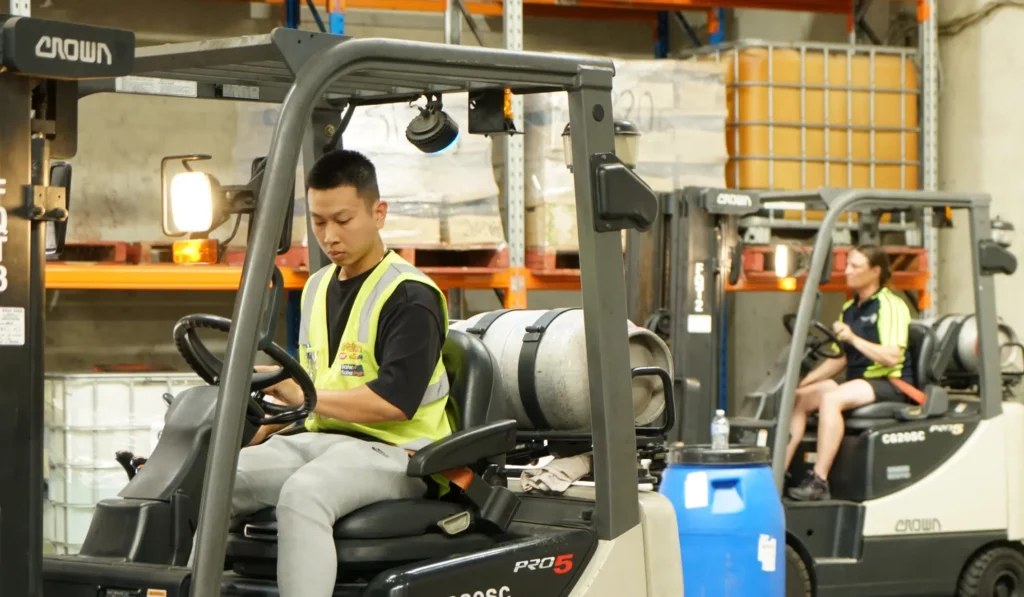
The job involves moving palletised and bulk loads around warehouses, distribution centres and construction sites, using a machine’s mast, forks and hydraulic controls. Before anyone can legally operate a forklift for work in Australia, they need a state-issued licence in the class that matches the machine. Quotor’s guide to what a forklift is covers the machine itself; this piece covers the licensing and career path into operating one, scoped to New South Wales, since forklift licensing is issued state by state even though the underlying training is nationally recognised.
Getting Started as a Forklift Operator
What Does a Forklift Operator Do?
Day to day, the job means loading, unloading and repositioning stock, operating a forklift truck to site traffic rules and load limits set by the employer. This article covers how to get licensed and hired, not the physical technique of running the machine; for that, see how to operate a forklift.
Entry Requirements
To apply for this licence in NSW you need to be at least 18 years old, provide identification, and have enough English to follow safety instructions and sit a written assessment, since the licence application itself requires this. No prior forklift experience is needed to enrol in training, though most registered training organisations expect a basic standard of maths for the load calculations covered in the course.
Skills Employers Look For
Beyond the licence itself, employers commonly look for accurate load handling, awareness of pedestrian and vehicle traffic in a warehouse, and the ability to read stock and dispatch instructions correctly. Knowing your way around the machine, covered in Quotor’s guide to a forklift’s parts, helps here too, since employers expect you to know which machine you’re actually qualified to run.
Forklift Licence Requirements
What Is a High Risk Work Licence?
Forklift operation is classed as high-risk work under Australia’s national high-risk work licence framework, which means it needs a specific state-issued licence rather than just a workplace induction. In NSW, SafeWork NSW issues this licence once you’ve completed training and passed the assessment. That’s different from equipment like dozers or excavators, which are generally covered by a site-based verification of competency rather than a mandated licence class; forklifts require the formal ticket regardless of experience.
LF vs LO Forklift Licence
NSW recognises two forklift licence classes, often just called a standard forklift ticket and an order picker ticket, and holding one doesn’t cover the other, a point that trips people up since a reach truck sounds like it should be LO territory but usually isn’t. The table below sets out what each class actually covers.
| Licence Class | Covers | Typical Equipment or Work |
|---|---|---|
| LF | Forklift truck with a mast and elevating load carriage | Counterbalance forklifts, many reach trucks, pallet handling |
| LO | Order-picking forklift where the operator’s platform elevates with the load | High-rack order picking |
| Both | LF and LO work combined | Roles requiring conventional LF work plus order picking |
Roles needing both classes are common in busy distribution centres, and each still has to be trained and assessed on its own.
State and Territory Licence Requirements
This guide uses NSW as its reference point, but the underlying training is nationally recognised. A valid licence issued by another Australian state or territory is generally recognised for interstate work in NSW, though if you permanently change your state of residence you may need to transfer the licence to the new jurisdiction. The regulator’s name changes by jurisdiction, SafeWork NSW, WorkSafe Victoria, WorkSafe Queensland, SafeWork SA and their equivalents elsewhere, so check the transfer process with the relevant regulator before moving or renewing interstate.
How to Obtain a Forklift Licence
Enrol with a Registered Training Organisation
This training has to be delivered by a registered training organisation approved for the relevant unit, TLILIC0003 Licence to Operate a Forklift Truck for LF or TLILIC0004 Licence to Operate an Order Picking Forklift Truck for LO. Most providers simply advertise this as a forklift licence course or forklift training course, though the unit code above is what actually determines the ticket you receive. Before you can be assessed you’ll also need to apply online for a high-risk work licence assessment enrolment number through your MyServiceNSW account, usually arranged early in the course.
Complete Forklift Theory and Practical Training
Training covers safety regulations, pre-start checks, load calculations and hands-on operation under supervision, with duration varying by provider, licence class and the learner’s prior experience.
Pass the Forklift Licence Assessment
Assessment covers a written test and a practical demonstration, run by an accredited assessor against the national assessment instrument, and has to take place within 30 days of your assessment enrolment number being issued. Passing gets you a Statement of Attainment from the training organisation along with a Notice of Satisfactory Assessment, the document the regulator needs before it will issue the licence itself.
Apply for Your High Risk Work Licence
With the Notice of Satisfactory Assessment in hand, you apply online through your MyServiceNSW account within 60 days, verifying your identity with two accepted identity documents rather than a fixed points system, and paying the application fee. New applicants may also be asked to visit a Service NSW Centre to have their licence photo taken before the card is mailed out. Once approved, the licence is valid for five years before it needs renewing.
Choosing a Forklift Training Provider
Check RTO Accreditation
Confirm the training organisation is registered for the specific unit and class you need, with properly accredited assessors, since an unaccredited course won’t lead to a valid licence no matter how good the instruction is.
Practical Training and Forklift Access
Ask how much genuine hands-on time is included and whether training happens on an actual forklift rather than mostly in a classroom, since practical skills are what the final assessment actually tests. A provider with its own yard space and training machines generally gives a more realistic practical assessment than one using borrowed equipment.
LF or LO Course Selection
Match the course to the job rather than the other way around. Check whether the role needs counterbalance forklift or reach-truck work, order picking, or both, before booking a course, and confirm it with the job description or a prospective employer if you’re unsure.
Course Duration and Assessment
Course length and price vary between providers even for the same training course, so compare more than one before booking. A retake policy for a failed assessment attempt is also worth asking about upfront.
Maintaining Your Forklift Licence and Competency
Licence Renewal Requirements
A forklift licence lasts five years in NSW. The regulator typically sends a renewal notice beforehand, but tracking the expiry date is the licence holder’s own responsibility. Renewing within 12 months of expiry is usually a paperwork and fee process; beyond that, training and assessment have to be repeated from scratch.
Employer Verification and Site Competency
Holding the licence doesn’t end an employer’s obligations. Under work health and safety law, the business must still confirm an operator can safely run the specific machine and site, which is why many workplaces run their own induction or verification of competency on top of the ticket itself. Quotor’s guide to preventing forklift accidents covers what that ongoing responsibility looks like in practice.
Additional Forklift Training
Operators sometimes take further training after gaining a licence: high reach forklift training for narrow-aisle reach-truck work, specific attachments or other warehouse equipment, or simply refreshing skills after time away from the machine. A reach truck stays LF territory even at height; work centred on an order-picking forklift still needs the separate LO licence class rather than additional LF training. That’s different from pursuing an entirely new licence class in another type of equipment for career progression, covered below.
Forklift Operator Career Path
Entry-Level Forklift Operator Jobs
Entry-level roles offer plenty of job opportunities in warehousing, manufacturing and retail distribution, usually advertised as forklift operator, forklift driver or a warehouse role with forklift duties included. A current LF or LO licence, whichever the role calls for, is generally the baseline requirement listed in job ads.
Warehousing and Logistics Opportunities
Logistics and distribution centres, especially around Sydney’s freight corridors, remain the largest single source of forklift work in Australia, often with shift options and further internal training toward supervisory or dispatch roles. Quotor’s forklift equipment hub is a useful reference once you’re working in the industry and need to understand or hire specific machine types for a job.
Construction and Industrial Roles
Construction and industrial sites also employ forklift operators, usually alongside other trades and often requiring a general construction induction card in addition to the licence. Machine sizes vary more on these sites, which is where knowing what size forklift a job actually needs matters.
Career Progression and Additional High Risk Work Licences
SEEK’s average salary estimate for forklift drivers in Australia generally falls between $65,000 and $80,000 a year, though this varies with location, industry and experience, and shouldn’t be read as a guarantee. Progression from here usually means adding further licence classes, dogging, rigging or crane tickets, or moving into supervisory and site logistics roles. Quotor’s equipment guides are there for whichever direction that takes you next.