
Understanding Forklift Controls
What Is a Forklift?
A forklift is a powered industrial truck built for loading, carrying and stacking loads on forks mounted at the front of the forklift. For a full breakdown of how the machine is built, see what a forklift is and how it works. This guide covers what comes next: learn how to operate a forklift safely, from the controls through to core technique.
Main Forklift Controls
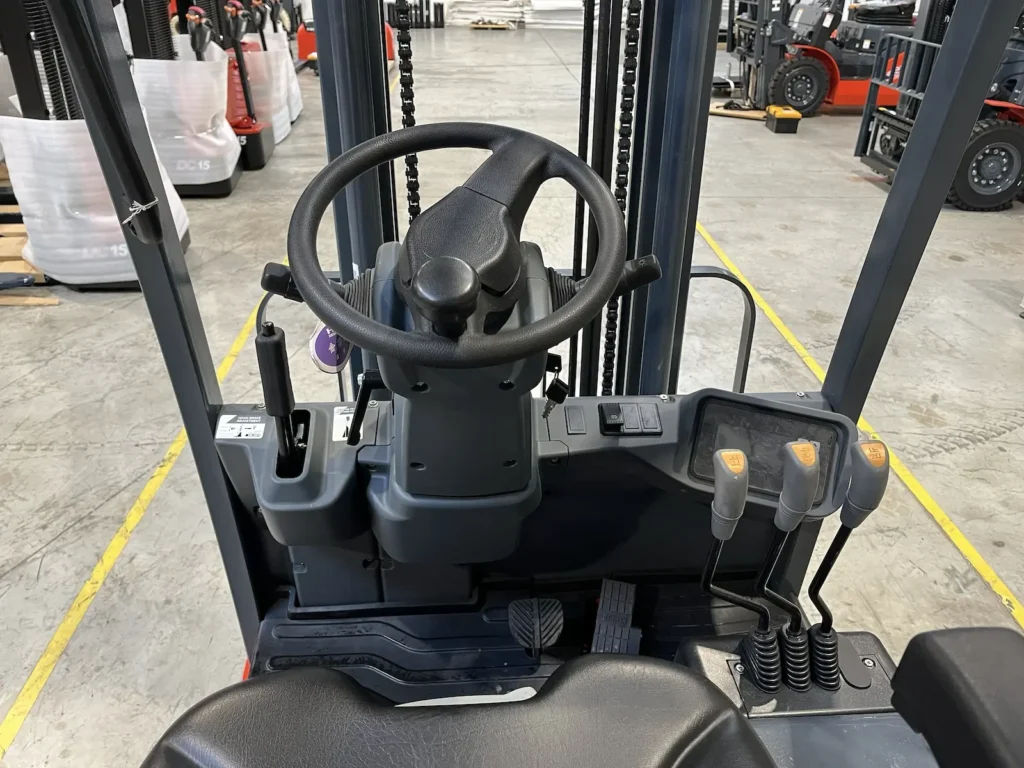
Most forklift operators start on a sit-down counterbalance forklift; some warehouses use a stand-up forklift instead, and the basic forklift controls are shared across both: a steering wheel, an accelerator pedal, a brake pedal, directional controls for forward and reverse, and a set of levers for the mast. Many internal-combustion counterbalance forklifts use an inching pedal, allowing fine low-speed positioning while keeping engine speed up for the hydraulics; the exact control layout still varies by model.
Steering, Lift and Tilt Controls
Steering is heavier and more direct than a car, since the rear wheels steer on a counterbalance forklift rather than the front. Small wheel movements swing the back wide, important when working close to racking or other machines. One lever raises and lowers the forks, another tilts the mast back for travel and forward for placing a load; exact lever positions vary between models, so confirm the layout first.
Dashboard and Instruments
The dashboard and forklift instruments show engine or battery status, hydraulic pressure and hour readouts, and warning lights for low fuel, charge or a developing fault. A horn is fitted for intersections, blind corners and reversing, and most forklifts carry a seatbelt. Newer forklifts may also include stability or load-assistance systems, but these vary by model and do not replace the rated capacity shown on the data plate.
Pre-Operation Forklift Checks
Walk-Around Inspection
Before you climb into the forklift, walk a full circuit of the machine for the forklift inspection. Check the tyres for cuts, uneven wear or low pressure, look underneath for fluid leaks, and check the mast and forks for cracks, bends or a mounting pin that has worked loose. Confirm the overhead guard and load backrest are intact, protecting against falling material. A daily inspection log should record anything found, even minor wear, so a developing fault gets caught early.
Forks, Mast and Hydraulic Checks
Check the forks are level with each other and locked to the carriage, since a slipped fork changes how the load balances once lifted. In a safe test area, check lift, lower and tilt functions for smooth operation, listening for hydraulics that hesitate or jerk. Quotor’s guide to forklift parts covers where each of these sits on the machine.
Tyres, Brakes and Steering Checks
Press the brake pedal to test for firm resistance rather than one that sinks toward the floor, and check the service and parking brakes respond correctly per the operator’s manual. Turn the steering wheel lock to lock with the engine running to feel for excessive play. On solid or cushion tyred forklifts, check for chunking or splitting; on pneumatic tyres, check pressure against the machine’s rating, since a soft tyre changes stability under load.
Controls and Safety Systems
Test the horn, lights, reversing alarm and any load-sensing warning system before you move the forklift, and operators must confirm the seatbelt buckles and retracts properly. Operators in Australia generally need a current High Risk Work Licence, sometimes called a forklift ticket or forklift certification, before they can use a forklift unsupervised. Quotor’s guide to becoming a forklift operator covers what that involves.
How to Operate a Forklift
Starting and Positioning the Forklift
Adjust the seat and buckle the seatbelt, then turn the key to start the engine or switch on an electric forklift. Release the parking brake only once seated and ready to move, and keep the forks low with the mast in the vertical position while manoeuvring without a load, positioning close enough to the pallet that it can be squared without excessive steering.
Driving Forward and Reverse
Use the directional controls to select forward, neutral or reverse, and use the accelerator to set speed, keeping the forks a few centimetres off the ground while driving empty. Reverse gets used more often on a forklift than on most vehicles, particularly when a load blocks forward vision, and driving backward means checking over the shoulder rather than relying on mirrors alone. A loaded forklift takes longer to stop than its size suggests, so brake early instead of needing to stop the forklift suddenly.
Steering and Turning
Because the rear wheels steer, the back of the forklift swings wide on any turn, wider again with the load raised. Slow down before turning rather than during it. In aisles or near racking, take turns wide enough that the rear counterweight clears fixed structures, checking behind first.
Picking Up a Load
Approach the load square on, with the forks levelled at the height of the pallet’s entry points and spaced to its width. Stop close enough that the forks slide fully under the load without repositioning halfway through, then raise the load only enough to clear the surface it is sitting on. Apply the travel tilt recommended for the machine and load, and lift no higher than needed before reversing away.
Travelling with a Load
Travel with the load low, just enough to clear the ground and any surface irregularities, mast tilted back. A raised load reduces stability and blocks vision more than most new operators expect. Where the load obstructs the forward view, travel in reverse where it is safe and practicable to do so, keeping a clear view in the direction of travel. Match speed to the aisle and surface, since a forklift stable at walking pace can become unstable at speed.
Stacking and Placing a Load
Square the forklift to the rack or stack before lifting, then raise the load to height with the mast still tilted back for stability. Level the mast only once the load nears its final position, since tilting forward early increases the chance of it sliding on the forks. Ease the load into place, lower until the forks are clear, then reverse out squarely.
Parking and Shutting Down Safely
Forklift parking starts on level, stable ground: park the forklift, lower the forks fully to the ground, and tilt the mast forward slightly so the fork tips sit flat. Engage the parking brake, put the forklift in neutral, and turn off the engine or isolate an electric forklift’s battery before leaving the seat. Chock the wheels on any grade, and never leave a forklift running or the forks raised unattended.
Safe Forklift Operating Techniques
Keeping the Load Stable
Safe forklift operation depends on the load staying within the forklift’s rated capacity for that load’s centre of gravity, not just its weight. A load heavier at the far end of the forks, or stacked unevenly, shifts the effective centre of gravity forward and reduces how much the forklift can safely carry. Quotor’s guide to preventing forklift accidents covers the load-related causes behind many of them.
| Factor | Why it matters |
|---|---|
| Load weight | Must stay within the capacity shown on the data plate |
| Load centre | A load carried further forward reduces effective capacity |
| Lift height | Capacity can reduce at greater mast heights |
| Attachment | Fork extensions, clamps and other attachments can change capacity |
| Mast tilt | Excessive forward tilt reduces stability |
| Travel height | Keeping the load low improves stability and visibility |
| Surface and slope | Uneven or sloping ground changes stability |
Driving on Slopes and Ramps
On ramps and slopes, keep a loaded forklift with the load facing uphill, whether driving up or reversing down. When unloaded, travel with the forks facing downhill unless the manufacturer or site procedure says otherwise. Never turn on a ramp, and stay within the machine’s rated gradient.
Operating in Warehouses and Confined Areas
Aisles, loading docks and racking leave little margin for error, so slow down at blind corners, use the horn, and expect pedestrians or other forklifts around every intersection. Fixed corner mirrors help but do not replace slowing down, since a mirror only shows what is already close. In tight aisles, square the forklift early rather than correcting the angle while entering a bay.
Maintaining Visibility Around the Load
A large or tall load blocks forward vision on almost every forklift, which is why reversing becomes the default travel direction for the forklift driver. Where reversing is not practical, use a spotter to guide the approach rather than creeping forward on partial vision. Keep the load low enough, and the mast tilted back enough, that the path ahead stays visible.
Building Forklift Operating Skill
Common Forklift Operating Mistakes
Forklift safety comes down to habits. The most common mistakes are travelling with the load raised instead of low, turning too sharply without accounting for rear-wheel steering, and approaching a pallet at an angle instead of square. Exceeding the capacity shown on the data plate for load centre, lift height and any attachment fitted is another recurring cause of forklift accidents, especially with heavy loads; Quotor’s counterbalance forklifts for hire are rated for specific load classes, worth checking against the job before booking one.
Improving Load Handling and Positioning
A good forklift operator learns to handle loads by developing a feel for details easy to get wrong from the seat: whether the forks sit fully under the pallet, whether the load is centred, and whether the mast is tilted back before travel begins. Matching machine to job matters too; Quotor’s guide to choosing the right forklift size is worth checking before moving to an unfamiliar type of forklift or a heavier load.
Managing Speed and Turning More Smoothly
Smooth operation comes from slowing down earlier than feels necessary, especially for anyone still learning to drive a forklift, before turns and wherever forward vision is partially blocked. Operators building experience should learn each new forklift’s control layout and rated capacity before being expected to operate the forklift independently. Quotor’s range of forklifts for hire is worth a look once the next job calls for a different size or type of forklift than the one trained on.