
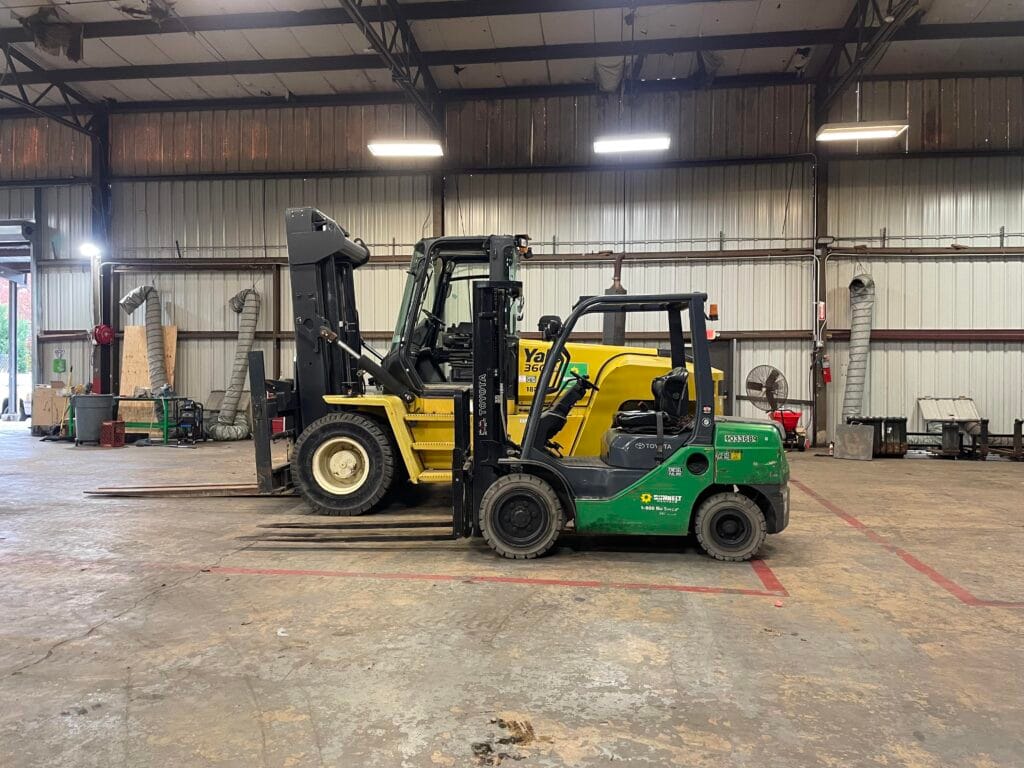
A forklift’s job looks simple: pick a load up, move it, put it down. Getting the size wrong makes that simple job expensive in one direction or another. A machine rated below the load stalls or, worse, tips. One rated well above it burns more fuel, costs more per hour to hire, and can be too wide for the racking or doorway it needs to pass through. This guide breaks forklift size down into what actually matters: rated capacity, physical dimensions, lift height, and the site conditions that decide which class fits the job.
Understanding Forklift Size
What Does Forklift Size Mean?
When people ask what size forklift they need, they mean the maximum load the machine can lift safely under a specific set of conditions. A guide to what a forklift is covers the different forklift types in more depth, but for sizing, that figure is the number to start from. Quotor groups its forklift hire range into three practical categories: counterbalance forklifts for warehouse and yard work, rough terrain forklifts for uneven outdoor sites, and telehandlers for reach as much as lift. Dimensions and lift height build on that base figure.
Forklift Load Capacity
A forklift’s weight capacity isn’t one number that applies to every load. It’s tested and certified at a specific load centre, the horizontal distance from the fork face to the middle of the load’s weight, and printed on the machine’s data plate alongside the configuration it was rated under. That load centre varies between machines and manufacturers, so the plate is the reference point for sizing a forklift, not a generic load-centre assumption. AS 2359.2 sets the requirement for fitting that data plate to a forklift in Australia, enforced as part of work health and safety law by the WHS regulator in each state, and it’s a compliance point worth checking on any machine before hire, not just a spec to note in passing.
Forklift Dimensions and Operating Weight
Alongside capacity, the dimensions of a forklift decide where it can work and how it gets there. Overall width and length set the aisle or doorway it fits through, lowered height sets the overhead clearance it needs for transport and for working under beams or roller doors, and operating weight, the machine’s own weight without a load, determines whether a suspended slab, mezzanine or loading dock can carry the machine’s maximum weight safely. A closer look at the parts of a forklift covers the mast, forks, counterweight and carriage for anyone unfamiliar with the terminology.
Common Forklift Capacity Classes
Forklift capacities span a wide range, and model names usually encode the number directly. Quotor’s listings show how brands like Hyster and Toyota number their ranges, but the classes below give a rough sense of where a machine sits before checking a specific model.
Light-Duty Forklifts
Roughly up to 2 tonnes, mostly electric counterbalance and reach trucks built for indoor load handling on smooth concrete. Quiet running and no exhaust make them the default warehouse forklift for food, retail and general warehousing, where a diesel or LPG engine would need ventilation.
Medium-Capacity Forklifts
The most common general-purpose range, about 2.5 to 3.5 tonnes, covering the bulk of counterbalance forklifts used across warehouses, distribution centres and light construction. Most standard loads and general goods handling sit comfortably within this range without needing to size up.
Heavy-Duty Forklifts
From around 4 to 8 tonnes, this class covers heavier counterbalance and industrial forklifts used for larger machinery, building products and bulk materials. Capacity class and forklift type are separate questions: a machine in this weight range can be a standard counterbalance forklift or a rough terrain forklift, depending on the ground it needs to work on rather than the tonnage alone.
High-Capacity Industrial Forklifts
Larger forklifts in this class run from around 9 tonnes up to 20 tonnes and beyond, used for container handling, steel coil and timber yards, and heavy manufacturing. These machines are wider, longer and considerably heavier themselves, which affects site access and transport as much as the job they’re lifting for.
Matching Forklift Size to the Job
Warehousing and Pallet Handling
Indoor pallet work on flat concrete rarely needs more than a light or medium-duty electric or LPG forklift. Where aisles are tight, a narrow-aisle reach truck uses a more compact stacking geometry to work in narrower racking layouts while still reaching substantial lift heights.
Loading and Unloading Trucks
Dock work usually calls for a medium-capacity forklift able to handle mixed load weights quickly, with enough lift height to clear a standard truck tray and stack incoming goods without a second handling step.
Construction and Outdoor Material Handling
Uneven ground, muddy terrain and site debris rule out standard cushion-tyre forklifts fairly quickly. Rough terrain forklifts and telehandlers, with pneumatic tyres and higher ground clearance, are built for exactly this environment, and a telehandler’s telescopic boom adds reach that a standard forklift can’t match.
Heavy Industrial and Manufacturing Work
Ports, steel yards and heavy manufacturing plants typically run high-capacity forklifts moving containers, coils or palletised steel well beyond what a standard machine can safely lift. Matching the machine to the heaviest loads it handles routinely, not the average ones, matters more here than anywhere else in the fleet.
Forklift Size Selection Factors
Load Weight and Load Centre
The single biggest sizing factor is the actual weight of what’s being lifted, checked against the forklift’s rated load at the load centre that load will sit at. A bulky or irregularly shaped load pushes its centre of gravity further from the forks than a standard load does, which lowers the safe lift below the figure printed on the plate. Getting this wrong is a common cause of a forklift being sized too small for the job on paper, even though the tonnage looked adequate at a glance.
Lift Height and Mast Configuration
Mast configuration, two-stage, three-stage or quad, determines how high a forklift lifts and how much overhead clearance it needs lowered. Standard counterbalance forklifts typically lift in the 3 to 6 metre range, and that single vertical figure is the key spec to check. Telehandlers work differently: a telescopic boom adds forward reach on top of vertical lift, and capacity changes with how far and how high the boom is extended, so both figures need checking against the machine’s load chart rather than a single lift-height number.
Aisle Width and Turning Radius
Standard counterbalance forklifts need enough aisle width to turn 90 degrees and stack, typically 3.5 to 4 metres or more depending on the model. Narrow-aisle reach trucks cut that down substantially by lifting and stacking without a full turn, which is why warehouses with tight racking tend to run reach trucks rather than standard forklifts regardless of the tonnage needed. A guide to operating a forklift covers manoeuvring technique in tighter spaces.
Indoor vs Outdoor Conditions
Tyre type follows directly from where the forklift works. Cushion tyres suit smooth indoor concrete and give a tighter turning radius, while pneumatic tyres handle gravel, mud and uneven outdoor surfaces at the cost of some manoeuvrability. Power source follows the same split: electric forklifts run cleanly indoors with no exhaust to manage, while LPG and diesel forklifts suit outdoor sites where refuelling speed and torque matter more than emissions.
Attachment Requirements
Fork extensions, side shifters, rotators and clamps change what a forklift can handle without moving up a capacity class, but each attachment adds weight and shifts the load centre, which derates the machine’s safe limit below its base rating. Any attachment needs its own entry on the data plate before use, not an assumption that the forklift’s original rating still applies unchanged.
Forklift Size and Capacity Comparison
2.5-Tonne vs 3-Tonne Forklifts
The gap between a 2.5 and 3-tonne forklift is small in machine size but matters for mixed pallet loads. A site running occasional heavier loads alongside standard stock is often better served by the 3-tonne machine across the board rather than switching forklifts mid-shift, since the hire cost difference between the two is usually modest.
3-Tonne vs 5-Tonne Forklifts
This jump is a bigger step in both machine size and manoeuvrability. A 5-tonne forklift handles heavier structural steel, machinery and bulk materials that a 3-tonne machine can’t, but it’s also wider, needs more aisle space, and costs more to hire, so the step up should be driven by a genuine load capacity requirement rather than a margin of safety that isn’t needed.
Standard vs High-Capacity Forklifts
Standard forklifts, up to around 8 tonnes, cover most warehousing, construction and general logistics work. High-capacity industrial forklifts exist for a narrower set of jobs, container yards, ports and heavy manufacturing, where the loads themselves start above what a standard machine is rated for. Hiring a bigger class when standard would do adds cost without adding usable capability.
Choosing the Right Forklift Size to Hire
Conventional mast-type forklift trucks generally need the relevant High Risk Work Licence: LF for standard forklift trucks, LO for order-picking forklifts. Telehandler licensing depends on how the machine is configured and used, so check the applicable requirements for the attachment and task before assuming the same licence covers it. A guide to becoming a certified forklift operator covers the training path. Sizing the machine correctly is a separate decision from licensing, and it’s the one that determines cost and site fit.
When a Smaller Forklift Is Enough
If the heaviest routine load sits comfortably under a light or medium-capacity forklift’s limit at the load centre it’ll actually be lifted at, a smaller machine is usually the better hire. It costs less per hour, manoeuvres more easily in tight spaces, and is simpler to get on and off site.
When to Move Up a Capacity Class
Regularly lifting close to a forklift’s limit, needing a load centre beyond what the current machine is rated for, or needing lift height a current mast can’t reach are all signs it’s time to size up rather than push a smaller machine to its limit on every load.
Avoiding an Undersized or Oversized Forklift
Undersizing shows up as a forklift working right at its rated limit on ordinary loads, which is both slow and unsafe if a heavier pallet turns up unexpectedly. Oversizing shows up as a machine that can’t fit the aisle or dock it needs to work in, or one racking up an hourly rate well above what the job justifies. Undersizing specifically is a contributor to tip-overs and dropped loads on site, covered in more detail in Quotor’s guide on preventing forklift accidents.
Hire Cost and Site Access Considerations
Hire cost generally rises with capacity, lift height and machine type, but the cheapest rate on offer doesn’t necessarily produce the lowest project cost. A smaller forklift is usually cheaper to hire and easier to manoeuvre, while a larger machine is worth the extra cost only where the load, load centre or required lift height genuinely demands it. A guide to estimating equipment cost in construction breaks down how these variables fit into a broader project budget. Before locking in a size, confirm site access, doorway widths, floor loading and overhead clearance against the machine’s actual dimensions, not just its rated load. A full look at hiring construction equipment covers the process end to end, and Quotor can help compare forklift size options across suppliers for a specific job rather than defaulting to whatever’s available first.