
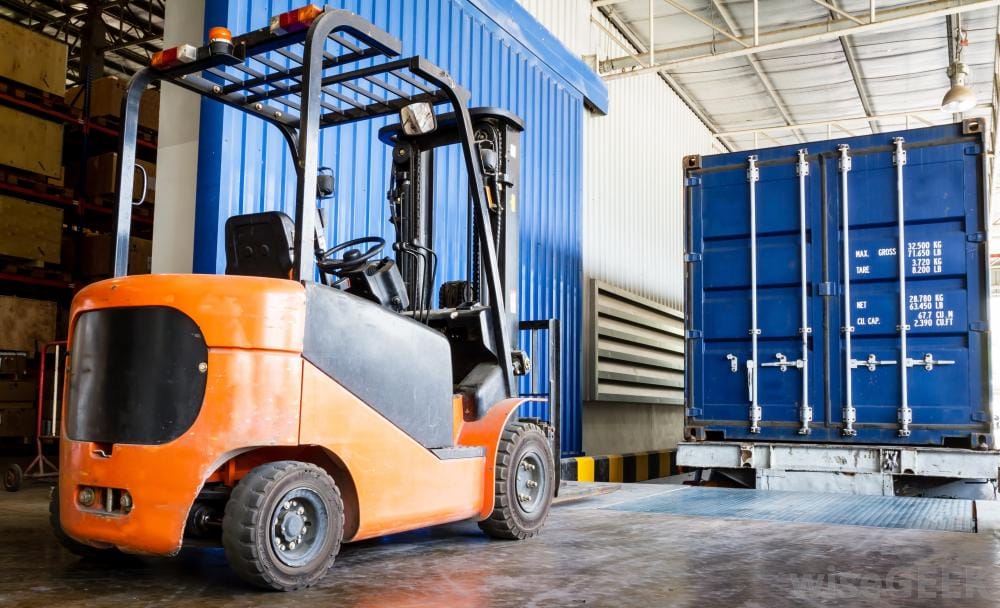
Understanding Forklift Trucks
What Is a Forklift?
A forklift truck, usually just called a forklift, is a powered industrial vehicle built to lift, lower and carry loads on a pair of fork arms mounted to a vertical mast. Quotor groups forklifts within the broader material handling equipment range, with conventional forklifts, rough terrain forklifts and telehandlers separated into practical subcategories based on how they lift and move loads, distinct from loaders that lift and carry on a bucket rather than a mast or boom. Forklifts appear anywhere goods need loading, moving or stacking quickly: warehouses, construction sites, ports and manufacturing plants.
Main Components of a Forklift Truck
The main parts of a forklift stay consistent across models: a truck frame carrying the engine or battery, a counterweight at the rear to balance the load, and a mast at the front that raises and lowers on hydraulic cylinders, each built around a piston driven by pressurised fluid. The load carriage rides up and down the mast rails on rollers, with forks at the front to lift pallets or a platform for other cargo. Tilt cylinders angle the mast forward to pick up a load and back to stabilise it in transit, and the operator controls sit in an open cab or canopy depending on the model.
How Forklifts Work
A forklift with a conventional counterbalance layout works on a simple principle: the weight at the rear offsets the load carried at the front, keeping the truck stable as the mast lifts. Understanding how a forklift operates explains why rated capacity can decrease as lift height increases, especially with longer load centres or attachments, since a higher load exerts more leverage against the counterweight. Hydraulic cylinders raise the mast and tilt the carriage, while an electric motor or internal combustion engine drives the wheels, and most models add a horn, reversing alarm and overhead guard as standard operator protection.
Common Forklift Types
Counterbalance Forklifts
The counterbalance design is the most recognisable forklift type, built with the mast at the very front and no outrigger legs, relying entirely on the rear counterweight for stability. They run on electric, LPG or diesel power: electric models are often classified as Class I forklifts under the US industrial truck classification system, while internal combustion versions fall under Class IV forklifts (cushion tyres, for indoor and semi-outdoor floors) or Class V forklifts (pneumatic tyres, for outdoor use). Capacities on standard models typically run from 1.5 to 5 tonnes, with heavy-duty models built well beyond that for container yards and industrial sites. Established manufacturers such as Toyota, Hyster, Yale, Crown and Clark Material Handling all produce standard forklift ranges in this category.
Reach Trucks
Also called high-reach forklifts, this type of forklift is built specifically for narrow aisle warehouse racking rather than open floor work. The mast extends forward on a pantograph mechanism, letting the truck reach into a rack without driving the whole chassis toward it, which makes it ideal for tight spaces where a standard forklift can’t turn. Most lift to around 10 to 12 metres in narrow aisles, well beyond what a standard forklift can safely manage indoors, but it’s built for smooth, level warehouse floors, not uneven ground.
Rough Terrain Forklifts
Rough terrain forklifts are heavy-duty forklifts equipped with pneumatic tyres, built for stability on uneven or unformed ground, ideal for construction sites, quarries and rural properties rather than warehouse floors. They fall under the Class VII forklifts category in the same US classification system, and typically pair larger axles and greater ground clearance with a more powerful engine than a standard forklift, letting them shift loads across sites a warehouse-spec machine simply can’t handle.
Telehandlers
A telehandler extends the forklift concept with a telescopic boom in place of a fixed vertical mast, letting it lift loads higher and further out, often 6 to 18 metres depending on the model, than any conventional forklift. That extra reach makes telehandlers a common choice on construction sites for lifting materials to height, and it also changes how they’re licensed. In New South Wales, a telehandler fitted with forks or a bucket does not require a High Risk Work Licence, although the operator must still be appropriately trained and competent, a different framework to the LF or LO licence a standard forklift requires. Different licence requirements can apply when a telehandler is configured for crane work or fitted with a personnel platform. Quotor’s forklift vs telehandler guide breaks down where the two machines diverge, and Quotor’s telehandler category lists available machines by reach and capacity.
Pallet Jacks and Stackers
Pallet jacks and stackers cover the lighter end of the forklift family. A pallet jack lifts a load just high enough to move it across a floor, while a stacker adds a mast to lift pallets onto low shelving, with some stand-on models adding a small platform at the front for the operator. Both are common in backrooms and storage facilities, where a full-size forklift would be oversized for the task at hand.
Forklift Applications
Warehousing and Logistics
Warehouses lean on reach trucks and electric forklifts for their manoeuvrability and low running noise, both of which matter when a machine works indoors, close to warehouse staff, for a full shift. Loading and unloading pallets between storage racking and dock doors is the core task these warehouse forklifts are built around.
Construction and Industrial Sites
Rough terrain forklifts and telehandlers handle the uneven ground and material heights typical of construction and industrial sites, moving loads across outdoor areas like laydown yards and stockpiles where a standard forklift’s cushion tyres and low ground clearance would struggle. Larger forklifts, with higher capacities, also shift heavier building materials, such as pallets of brick or steel, than a warehouse machine can handle.
Manufacturing
Manufacturing plants typically run counterbalance and narrow aisle forklifts to move stock between production lines and storage, loading finished goods onto pallets and feeding raw materials back to the line. Precise, repeatable load placement matters more here than rough-ground capability, which is why manufacturing plants tend to favour electric models for their smoother control and lower noise on a factory floor.
Loading and Material Handling
Loading and unloading trucks, whether at a dock or on an open yard, ranks among the most frequent forklift tasks across every industry, and it’s where fork design matters most: standard forks suit palletised loads, while a fork positioner or clamp attachment handles irregular cargo.
Choosing the Right Forklift
Load Capacity and Lift Height
Match the forklift to the weight of the load and the highest point it needs to reach, not an average case, since rated capacity can fall at greater lift heights. Quotor’s guide on what size forklift you need walks through sizing a machine against typical load weight and racking height.
Indoor vs Outdoor Use
Types of tyres matter as much as power source here: cushion-tyred electric forklifts are ideal for indoor use, with low emissions and a tight turning circle, while outdoor and rough terrain forklifts need pneumatic tyres and greater ground clearance to handle uneven surfaces.
Manoeuvrability and Aisle Width
Aisle width decides the type of forklift as much as anything else: a standard forklift needs considerably more turning space than a narrow aisle reach truck, so measure racking gaps before choosing between them.
Fuel Type and Power Source
Electric forklifts suit indoor, low-emission environments; LPG offers quick refuelling for mixed indoor and outdoor work; diesel delivers the most torque for heavy outdoor and rough terrain use.
Forklift Safety
Basic Forklift Safety Requirements
In Australia, forklift operation is regulated as high risk work. Most forklift types require an LF class High Risk Work Licence, while order-picking types require an LO class, issued through the operator’s state work health and safety regulator. Quotor’s guides on getting a forklift licence and becoming a forklift operator cover the training and assessment path in more detail.
Load Handling and Stability
Stability depends on keeping the weight of the load within rated capacity, carrying it low and tilted back while travelling, and never exceeding the weight the counterweight is designed to offset. Turning with a raised load, or on a slope, sharply increases tip-over risk, which is why speed limits and marked travel paths are standard on most sites.
Common Forklift Hazards
Tip-overs, pedestrian collisions in shared work areas and overloading account for most forklift incidents, along with reduced visibility around a raised load or a tall mast blocking the operator’s forward view. Quotor’s guide on preventing forklift accidents sets out the practical controls that address each of these.
Forklift Hire
When to Hire a Forklift
Hiring suits short-term projects, seasonal demand spikes, or jobs needing a different forklift type than what’s already on site, a rough terrain forklift for a single delivery, for instance, rather than tying up capital in a machine used only a few weeks a year.
Factors to Consider When Hiring
Beyond machine type and capacity, hire decisions should weigh site conditions and how long the equipment is needed. Whether to take wet hire, machine and operator together, or dry hire, machine only, often comes down to whether existing staff already hold the right licence class for the job. Dry hire also puts day-to-day operation, pre-start checks and correct use of the machine in the hirer’s hands, while maintenance responsibilities depend on the hire agreement. Quotor researches these factors across suppliers to compare available hire options against what a specific job requires.
Forklift Hire Costs
Hire cost scales with capacity, lift height and hire duration, with rough terrain forklifts and telehandlers generally costing more per day than a standard forklift, and wet hire costing more again once an operator’s wages are factored in. Quotor’s guide to hiring construction equipment explains how these factors combine across equipment types more broadly.