
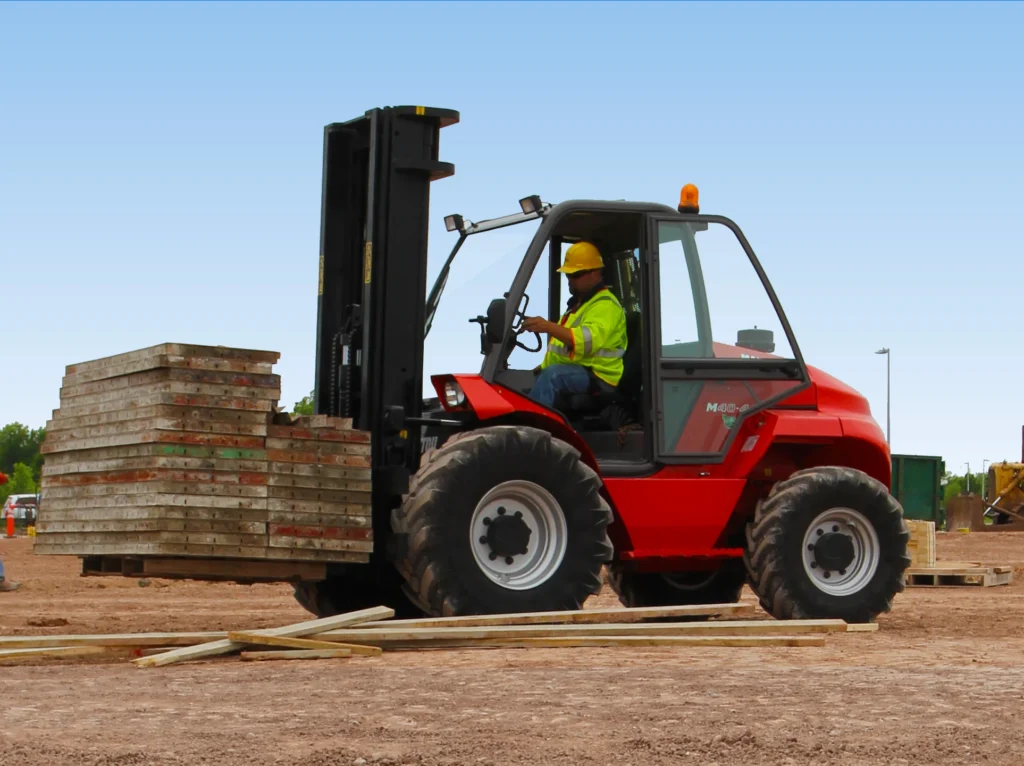
Built for ground a standard warehouse forklift can’t handle, mud, loose fill, slopes and unsealed construction sites, Quotor’s range of rough terrain forklifts spans 2WD, 4WD and compact configurations. This guide covers how they work, where they’re used, and what to weigh up before hiring one.
Understanding Rough Terrain Forklifts
What Is a Rough Terrain Forklift?
It’s a forklift built for outdoor, uneven ground rather than the smooth, sealed floors a standard warehouse machine needs. Quotor lists these machines as their own hire category, separate from counterbalance and reach models, because the undercarriage, wheels and clearance are all designed around unsealed or disturbed ground. They’re heavy-duty machines by design, built to be used outdoors on job sites, farms and industrial yards.
How Rough Terrain Forklifts Work
Most run on a vertical mast, the same basic lifting arrangement as a conventional forklift, just built onto a taller, more rugged chassis. Though rough terrain forklifts are often confused with telehandlers, the two aren’t the same machine: a telehandler uses a telescopic boom that extends forward and up, while a mast-type machine lifts straight up like a conventional model. How to operate a forklift covers the shared basics both types build on.
Rough Terrain Forklift vs Standard Forklift
What makes a rough terrain forklift different from a standard forklift comes down to the ground each is built for. A standard counterbalance forklift runs on solid or cushion tyres and needs a flat, sealed surface; a rough terrain model instead rides on large pneumatic ones and sits higher off the ground. You’ll also see “all-terrain forklift” used commercially, though it isn’t a defined category in the same way; suppliers apply it loosely to various outdoor-capable, wide-wheel traditional forklifts. In the US, these machines are grouped under Class 7 of the ANSI/ITSDF industrial truck classification, a term that turns up in supplier catalogues and training courses well beyond the US, though it isn’t an Australian regulatory category.
Types of Rough Terrain Forklifts
Two-Wheel Drive Rough Terrain Forklifts
These lighter models suit firmer, drier ground: sites with compacted access roads, or yards that only occasionally turn muddy. They cost less to hire and use less fuel, but grip drops away quickly once the ground softens.
Four-Wheel Drive Rough Terrain Forklifts
These models excel on mud, slopes and loose fill, delivering power to all four wheels so a single wheel losing grip doesn’t stall the machine. Toyota forklifts, along with JCB and Manitou, cover this class in 4WD form. For active job sites, steeper gradients or wet ground, 4WD generally offers better traction and is often the more suitable choice.
Compact Rough Terrain Forklifts
These trade some lift height and capacity for a shorter wheelbase and tighter turning circle, giving them real versatility on smaller residential or landscaping sites where a full-size model can’t manoeuvre. They’re a different product to truck-mounted forklifts carried on the back of a truck for site deliveries, which are a separate category again.
Rough Terrain Forklift Applications
These machines are often used on construction sites, farms and outdoor industrial yards, wherever ground conditions rule out a conventional model.
Construction Sites
On site, they handle material handling tasks a conventional model can’t reach: shifting pallets of block, moving steel or timber across disturbed terrain, and unloading delivery trucks parked on unformed access roads before the site is fully built up.
Uneven and Unsealed Ground
Subdivisions, civil works and any site without finished paving fall into this category. Uneven ground, loose access tracks and freshly cut unsealed surfaces are exactly the conditions these machines are built around, where a conventional forklift would risk grounding out or losing grip.
Agriculture and Rural Work
Farms use them for feed, fencing materials and produce across paddocks that are rarely flat or dry. Terrain forklifts are also common in forestry, moving logs and equipment across cut tracks that would bog a conventional machine.
Industrial and Yard Operations
Outdoor yards, quarries and scrap operations rely on the same grip and clearance for construction applications and other outdoor conditions where ground quality can’t be guaranteed.
Benefits and Limitations of Rough Terrain Forklifts
High Ground Clearance
A raised chassis helps the machine clear ruts, rocks and debris, while a wider stance and suitable tyres support stability on uneven ground, one of the factors covered in how to prevent forklift accidents.
Traction on Uneven Terrain
Grip comes from an aggressive tread pattern and, on 4WD models, power split across all four wheels. That combination adds traction and stability on slopes and loose ground, where a two-wheel-drive machine would spin a wheel and stall.
Pneumatic Tyres and Stability
They cushion the ride, and the larger tyre footprint helps reduce ground pressure and sinking on soft surfaces, while tyre compliance can improve contact with uneven ground.
Limitations Indoors and in Tight Spaces
These forklifts may struggle in the tight aisles and smooth floors of an indoor warehouse, where their width, turning circle and tread work against them. For indoor pallet handling, a counterbalance forklift fitted with cushion or solid tyres is almost always the better fit.
Choosing the Right Rough Terrain Forklift
Load Capacity and Lift Height
Lift capacities typically start around 2 to 3 tonnes and run past 5 tonnes on larger models, with lift heights generally lower than an equivalent telehandler since a vertical mast can’t reach as far forward. Match capacity to your heaviest single load, not an average, and check lift height against the tallest stack or truck tray you need to clear. Parts of a forklift breaks down how mast, forks and carriage affect these numbers.
Ground Conditions
No single factor shapes the choice of machine more than the site itself. Soft, wet or sloped ground needs 4WD and aggressive tread; firmer, drier sites can often get by on a lighter 2WD model. The table below summarises the trade-offs.
| Ground condition | Recommended drive | Recommended fit |
|---|---|---|
| Firm, dry, compacted ground | 2WD | Air-filled |
| Mud, loose gravel, slopes | 4WD | Air-filled or foam-filled |
| Debris-strewn sites (offcuts, scrap, sharp rock) | 4WD | Foam-filled |
Two-Wheel Drive vs Four-Wheel Drive
As a rule, 2WD suits stable, established sites where cost and fuel use matter more than raw grip, while 4WD earns its keep the moment mud, slope or loose fill enter the picture.
Tyre Type and Machine Size
Air-filled pneumatic tyres give the best cushioning and grip but puncture on sharp debris; foam-filled tyres cost more upfront and remove that risk entirely, which usually pays off on sites littered with offcuts or reinforcing steel. Machine size should follow site access as much as load: a compact model that can’t turn between stockpiles isn’t the right forklift for your needs, regardless of capacity.
Rough Terrain Forklift Hire
When to Hire a Rough Terrain Forklift
Most contractors and farmers who search for rough terrain forklifts for sale end up hiring instead, since project-length hire avoids the maintenance, storage and depreciation of owning a diesel machine used for a few months a year. Quotor’s forklift hire network compares availability and pricing across suppliers, so the right choice depends on your site, not just what’s sitting closest.
Factors to Consider When Hiring
Match drive configuration to your ground conditions, confirm lift capacity against your heaviest load, and check the machine will fit through gates or between stockpiles on site. In Australia, operating a mast-type rough terrain forklift requires an LF High Risk Work Licence. Operators should also be trained and competent on the specific machine they are using, including its controls, load limits and terrain restrictions. How to become a forklift operator covers the licensing path.
Rough Terrain Forklift Hire Costs
Machine size, drive type and hire duration affect price more than anything else: a compact 2WD model built to carry heavy loads on firm ground costs less than a 4WD unit rated for the same capacity. Quotor’s range of models spans both ends, so comparing quotes against your actual site conditions avoids paying for capability you don’t need.