These two machines both move heavy loads, but they’re built for different ground and different jobs. Picking between a forklift and a telehandler comes down to mast versus boom: one lifts straight up, the other reaches out. That distinction shapes material handling and logistics work, and which piece of equipment your next job actually needs.
Understanding Forklifts and Telehandlers
How Forklifts and Telehandlers Handle Materials Differently
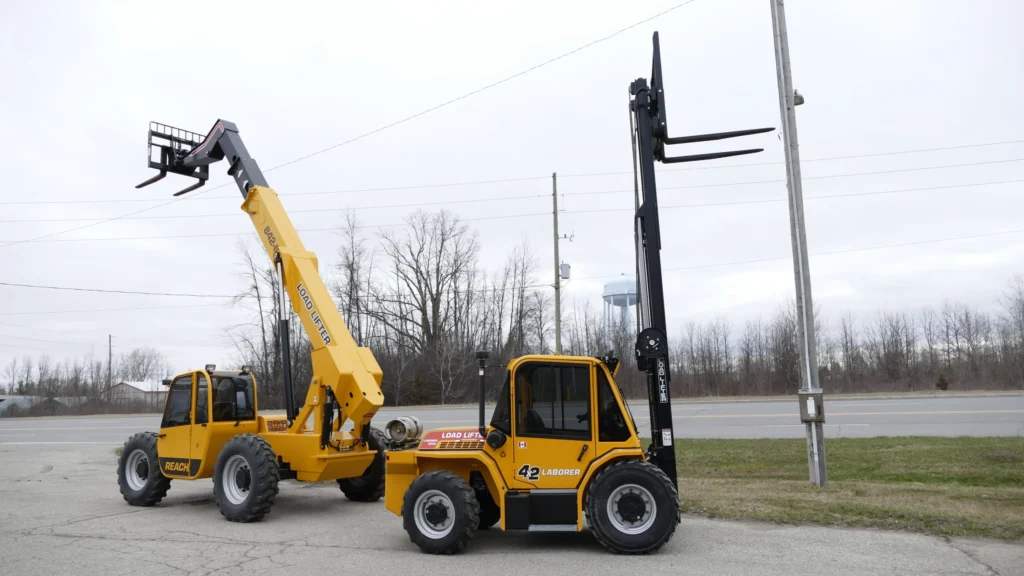
A forklift lifts straight up on a fixed vertical mast, which keeps it fast and stable on flat, hard ground. A telehandler uses a telescopic boom that extends forward as well as up, so it can reach over an obstacle and place a load somewhere a forklift’s mast can’t get to. Both are types of lifting equipment built to lift and transport materials safely, but that difference between mast and boom decides where each one can actually put a load down.
What Is a Forklift?
A forklift is a powered industrial truck fitted with pallet forks that slide under a load to lift it and move loads over short distances. Conventional forklifts commonly work in warehouse and factory settings, on flat, sealed floors such as loading docks and yards, where a tight turning circle and simple controls make using a forklift fast for repetitive pallet runs.
What Is a Telehandler?
A telehandler is a telescopic handler with an extending boom that can carry forks or a variety of other attachments. Older sites sometimes still use the name telescopic forklifts for this type of handler. Four-wheel drive and higher ground clearance let it work on uneven ground, and the boom gives it a reach a forklift can’t match, lifting loads up and over walls, scaffolding or stacked materials.
Forklift Applications
Warehousing and Logistics
Forklifts are designed for lifting and moving loads across a warehouse floor: pulling stock from racking, staging orders and loading trucks at a dock. Quotor’s forklift listings cover the specific forklift models, counterbalance trucks among them, that most warehouses run day to day; the forklifts used indoors are usually electric to avoid exhaust fumes.
Loading and Unloading
Forks slide under pallets at ground level, lift and set the load down again in one motion, which is why forklifts remain the go-to choice for loading and unloading trucks and containers. The parts of a forklift, mast, carriage, forks and counterweight, explain why: the counterweight at the rear balances the load out front so the truck doesn’t tip forward as it lifts.
Indoor Material Handling
Narrow aisles within a warehouse are part of everyday warehouse work, calling for tight turning and precise control, both strengths of a forklift’s small footprint. Because forklifts work close to racking, pedestrians and other machinery, following guidance on how to prevent forklift accidents matters as much as the machine itself.
Telehandler Applications
Construction Sites
On a construction site, a telehandler moves building materials, lifts them to upper floors and places loads where trades need them, work a forklift usually can’t reach and that might otherwise call for a crane. Quotor’s hire listings show current availability by boom length and lift capacity.
Rough Terrain Material Handling
Telehandlers are better suited for outdoor, uneven ground than a forklift, built as they are for soft ground, slopes and general site conditions that would bog a standard forklift down. A rough terrain forklift is a related type of forklift worth knowing about: it keeps a forklift’s simpler mast but adds larger tyres and extra ground clearance for outdoor sites that don’t need that extended reach.
Lifting Loads at Height and Reach
Reach is its main advantage over a forklift. The telescopic boom can lift heavy loads several storeys up or place them behind an obstacle, work a fixed mast simply can’t do. A rotating model is one type of telehandler built to slew the boom sideways, so it can place a load without repositioning the whole machine.
Forklift vs Telehandler Comparison
Lift Height and Forward Reach
A forklift lifts to the height of its mast, directly above the machine. A telehandler’s boom extends both up and forward, so it can lift and place a load metres beyond the machine’s own footprint, not just above it.
Load Capacity and Stability
The weight a forklift can lift drops as its mast rises, and a heavy-duty forklift with a higher-capacity mast handles bulk pallet loads a lighter model can’t. Both machines are rated for specific safe working loads that drop as height or reach increases. A forklift stays most stable close to the ground with the mast upright; a telehandler’s stability depends on how far the boom is extended, so its rated capacity falls off faster at full reach.
Indoor vs Rough Terrain Use
Forklifts are built for flat, sealed indoor floors. Telehandlers, and the forklift built for rough terrain, handle rough or uneven ground that would strain a typical forklift’s tyres and stability.
Attachments and Versatility
A telehandler accepts a wider range of boom-mounted attachments, including buckets, work platforms, winches and truss booms, giving it capabilities beyond straightforward pallet handling.
Manoeuvrability and Site Access
A forklift’s tighter turning circle suits narrow aisles and confined spaces a telehandler’s longer wheelbase can’t easily enter. On an open site with uneven ground, ground clearance and drivetrain matter more than tight manoeuvrability.
Hire Cost Comparison
Forklifts generally hire for less than telehandlers, largely because they’re simpler machines built for one job, and rates for the larger machine rise with boom length and lift capacity. Before comparing quotes on either piece of heavy equipment, it’s worth reading how to estimate equipment cost for a project, since hire cost is only part of the total cost of getting a job done.
Licence and Operator Requirements
Forklift Licence Requirements
Operating a forklift in Australia requires a forklift licence, formally a High Risk Work licence, and Quotor’s guide on how to become a forklift operator covers the accredited training and assessment involved.
Telehandler Operator Requirements
A telehandler fitted with forks or a bucket generally does not require a High Risk Work Licence, but the operator still needs appropriate training and competency for the machine and attachment. Licensing requirements can change with the configuration: operating one as a boom-type elevated work platform, for example, may require a WP High Risk Work Licence depending on boom length. Quotor’s guide to operating one covers the controls and competency involved.
Training and Competency
Licence aside, comfort with a specific machine’s controls still matters. Telehandler training covers boom and slew controls a standard licence never touches, and a guide on how to operate a forklift is a useful refresher even for a licensed operator moving between the two, since mast and boom controls handle differently in practice.
Choosing the Right Machine to Hire
Ground and reach decide which of the two suits a job; hire cost then decides how long to book it for. That combination is the real basis for choosing the right equipment.
When to Hire a Forklift
A forklift is best suited to flat, sealed ground with mostly palletised loads, warehouse floors, loading docks, factory yards, and it’s usually the correct equipment for the job there.
When to Hire a Telehandler
If the job involves rough ground, height, or reach past an obstacle, a telehandler is worth the higher hire cost.
Site Conditions and Load Requirements
Match the machine to the ground first, then the load. Soft or uneven ground generally rules out a conventional warehouse forklift, though a rough terrain forklift may suit sites that need a vertical mast without a telehandler’s forward reach. Flat, sealed ground with straightforward loads rarely justifies the extra cost of hiring the larger machine.
Hire Cost and Project Duration
For a short job, or the first time using a machine on a particular site, a short-term hire is a practical way to confirm the right fit before committing to a longer rental. Quotor’s guide on how to hire construction equipment covers comparing suppliers, availability and pricing before booking either machine.