
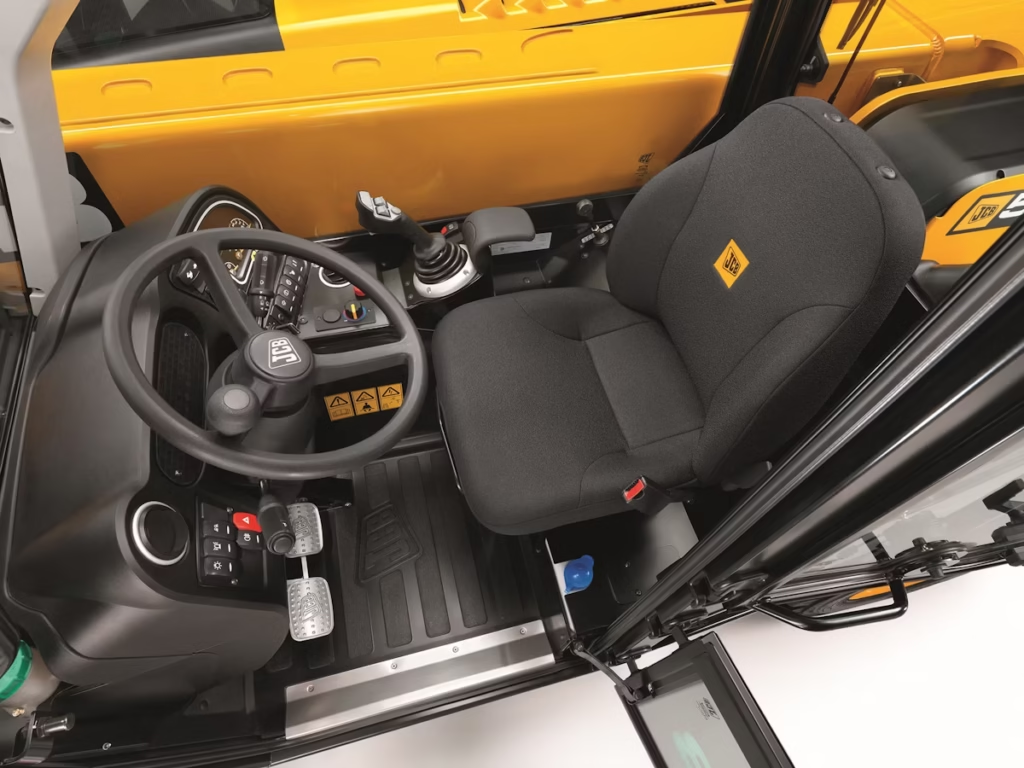
Understanding Telehandler Controls
What Is a Telehandler?
A telehandler, also known as a telescopic handler or teleporter, pairs a wheeled chassis with a boom that extends out and up, rather than sliding vertically on a mast the way a standard forklift’s does. That reach lets one machine lift, place and stack materials up high and at distance that would otherwise take two separate machines, and telehandlers are widely used in agriculture and on construction sites, and in infrastructure work too. For the full rundown of how it’s built, see what a telehandler is. This guide covers the controls, checks and technique needed to run one competently.
Main Telehandler Controls
Modern telehandlers commonly use a multi-function joystick for boom raise/lower, extend/retract and carriage or attachment tilt functions, with auxiliary hydraulics added where the fitted attachment requires them. Exact assignments vary by model, so read the operator’s manual before the first start. Quotor’s parts of a forklift breakdown covers similar cab components.
Boom, Fork and Attachment Controls
The boom has three independent movements: raise and lower, extend and retract, and, on many models, a levelling function that keeps the forks flat as the boom angle changes. A separate auxiliary control operates whatever’s fitted to the carriage, forks, a bucket, a jib or a work platform, and changes both the control feel and rated capacity. Telehandler attachment types covers what’s available and how each one handles differently.
Steering Modes and Transmission Controls
Telehandlers may offer two-wheel, four-wheel (also called all-wheel) and crab steering modes, selected from a switch or dial. Two-wheel steer is commonly used for straightforward travel, while four-wheel and crab steer improve manoeuvrability in confined areas. Transmission systems vary between hydrostatic, powershift and other drivetrains, with a forward-neutral-reverse selector for direction.
Pre-Operation Telehandler Checks
Walk-Around Inspection
Before starting the engine, walk the perimeter of the machine and check for fresh leaks under the boom and engine bay, damage to the chassis or counterweight, and anything left on the boom from the last job. Confirm mirrors are set and the reversing alarm works. A proper walk-around catches most of the faults that contribute to incidents; Quotor’s guide to preventing forklift accidents covers habits that carry across to telehandlers.
Tyres, Hydraulics and Boom Checks
Check tyre condition, pressure and wheel nut tightness, since damaged or underinflated tyres reduce how well the machine supports a raised load. Inspect hydraulic hoses and cylinders along the boom for wear, cracking or leaks, particularly where the sections telescope past each other. In a safe test area, check boom raise/lower, extension/retraction and attachment functions for smooth response, following the manufacturer’s pre-start procedure.
Forks and Attachment Checks
Inspect forks for cracks, bends or wear at the heel, and confirm the locking pins holding them on the carriage are seated correctly. If an attachment is fitted, check that the quick-hitch coupler is fully engaged and locked, not just resting in place; a partially engaged attachment is one of the more serious hazards on this piece of machinery. Confirm the attachment fitted matches the load chart for the task ahead.
Cab, Controls and Safety Systems
In the cab, fasten the seatbelt and confirm the rated capacity indicator, sometimes called a load meter, is active. Most telehandlers sound a warning as a load nears the rated limit, so test that tone before relying on it. Telehandler competency and licensing requirements depend on the machine’s configuration and the task; operating it isn’t automatically covered by a standard forklift licence, and crane or personnel-lifting configurations can add requirements. Quotor’s heavy equipment operator guide explains that broader pathway.
How to Operate a Telehandler
Starting and Positioning the Telehandler
Adjust the seat and mirrors before starting, and confirm the park brake is set and the transmission is in neutral. Start the engine following the machine’s own procedure, since starting sequences differ between models, and let it reach normal operating temperature before working under load. Assess the work area, then position the machine square with enough clearance to extend the boom without swinging into obstacles or overhead lines.
Driving and Steering
Travel with the boom fully lowered and retracted, and select the steering mode that suits the task: two-wheel steer for moving across the site, four-wheel steer once manoeuvring into a tight position. Match speed to the ground conditions and slow down further on uneven or wet surfaces. Quotor’s telehandler range lists reach, capacity and steering options across the fleet.
Raising and Extending the Boom
Raise and extend the boom only once stationary on level ground, and move the controls smoothly rather than snapping to full deflection. Raise and extend progressively as the lift requires, staying within the load chart throughout, and avoid extending further than needed, since more reach generally reduces available capacity. Watch the rated capacity indicator throughout; it warns before a load moves outside the safe zone for the current boom position, and if a malfunction or warning appears while lifting, stop and lower the load before investigating.
Picking Up a Load
Approach the load square on, with forks level and spaced to its base. Insert the forks fully beneath the load, confirm it’s centred and stable, then raise it only enough to clear the surface, using the carriage or tilt function as specified for safe travel. This differs from a standard forklift, whose mast lifts straight up rather than extending outward, so treat load pickup as its own technique rather than assuming forklift habits transfer.
Travelling with a Load
Keep the boom low and retracted while travelling, with the load close to the chassis, and avoid travelling with the boom extended. Slow down before turning, since a raised or extended load shifts the centre of gravity and makes tipping on a fast turn more likely. Use a spotter where visibility is limited.
Placing and Lowering a Load
Approach the placement point slowly, then raise, extend and lower the load into position with small, deliberate movements rather than one continuous motion. Lower it fully before retracting the boom, and confirm it’s stable before releasing the forks. Quotor’s broader forklift range suits jobs needing a different reach and height profile.
Parking and Shutting Down Safely
Lower the boom and forks fully to the ground, retract the boom, and apply the park brake before switching off the engine. On a slope, chock the wheels too, then remove the key and secure the machine if left on site.
Telehandler Operating Techniques
Managing Load Capacity and Stability
A telehandler’s rated capacity generally reduces as boom reach increases, because extending the load further from the machine increases overturning moment. Boom angle, extension, the attachment and machine configuration all affect the allowable load, so a load safe at ground level and short reach can exceed the limit once extended, even though the seat sticker figure hasn’t changed. Quotor’s guide to sizing a forklift applies the same logic when matching a telehandler to a task.
Working with the Load Chart
The load chart in the cab shows the maximum load for combinations of boom angle and extension, not a single top-line figure, and it’s specific to the machine and attachment fitted. Check the chart before lifting anything close to the rated limit, and treat the capacity indicator as a backup to the chart, not a replacement for it.
| Factor | Effect on Capacity / Stability |
|---|---|
| Boom extension | Greater reach generally reduces available capacity |
| Boom angle / lift height | Changes the load-chart operating zone |
| Attachment | Changes machine weight, load centre and applicable chart |
| Load centre | A load carried further forward increases overturning moment |
| Tyres / ground condition | Affect stability and machine support |
| Outriggers / stabilisers, where fitted | Can change the applicable capacity chart |
| Frame levelling, where fitted | Helps compensate for limited ground slope within manufacturer limits |
Operating on Slopes and Uneven Ground
Reduce load and travel speed on any slope, and keep the boom low while crossing uneven terrain rather than raised. Side-slope operation can significantly reduce stability, particularly with the boom raised or extended, so check the machine’s rated gradeability and follow manufacturer guidance before working a sloped site. Wind and other environmental factors reduce safe working load too, especially with the boom extended.
Manoeuvring in Tight Spaces
Crab or four-wheel steer lets the machine shift sideways without a wide turning arc, useful in a confined bay. Account for the rear overhang swinging wide on a turn even when the front looks clear, and reduce speed since visibility and reaction room are both reduced.
Maintaining Visibility with Raised or Large Loads
A raised load or bulky attachment can block the forward view completely. Use mirrors and, where fitted, a boom camera to compensate, and bring in a spotter for placements where the load obscures the landing point.
Building Telehandler Operating Skill
Build skill by starting with light loads close to the machine before working up to full rated capacity and reach, and get time on more than one model, since layout and feel vary between manufacturers. New operators typically start under supervision before working solo, and regular refreshers keep boom control sharp. Many telehandler roles overlap with forklift work; becoming a forklift operator sets out that related pathway.
Common Telehandler Operating Mistakes
The most common mistakes are travelling with the boom extended, judging capacity by a load’s size rather than the load chart, and treating a partially locked attachment as good enough. Choosing the wrong machine matters too, a loader or backhoe often suits pushing or digging better than a telehandler. Complacency after a run of uneventful lifts is usually what raises the risk of an incident, and the safest way to operate a telehandler is treating checks and the load chart as non-negotiable.
Improving Boom and Load Control
Build control by practising individual boom functions first, then combine movements smoothly as familiarity improves. Avoid abrupt multi-function inputs that make load movement harder to predict, and keep building time on the machine as skill develops.
Managing Steering, Positioning and Stability
Match steering mode to the task rather than defaulting to one setting: two-wheel steer for travel, four-wheel steer for close positioning. Keep the centre of gravity in mind whenever the boom is raised or extended. Together, these are the safety tips for operating a telehandler that matter most on site.