
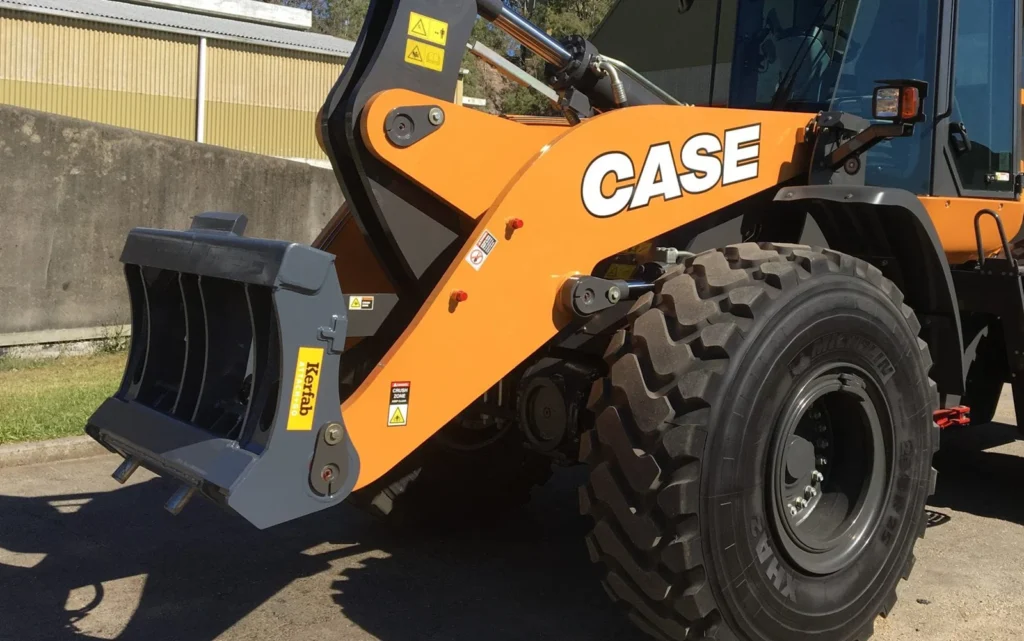
Understanding Wheel Loader Attachments
What Is a Wheel Loader Attachment?
Attachments for wheel loaders mount onto the machine’s lift arms in place of, or alongside, the standard bucket, changing what the loader can pick up, carry or process without changing the loader itself. Quotor’s guide to what a wheel loader is covers how the base machine works; this piece focuses on what’s available, what each attachment is built for, and which one suits the job.
Why Wheel Loader Attachments Matter
A wheel loader’s value on a hire fleet comes from how many material handling jobs one machine can cover, not just how much it can lift, and that versatility drives real productivity on construction sites. Swap a general-purpose bucket for forks and the same loader moves palletised block instead of scooping soil; swap again for a grapple and it clears demolition debris a bucket would spill straight back out of. That range of jobs is why loaders sit at the centre of the broader earthmoving equipment category rather than as a single-purpose tool.
Types of Wheel Loader Attachments
General-Purpose Buckets
The general-purpose bucket is what most wheel loaders are hired with by default through Quotor, designed for moving and transporting soil, sand, gravel and other loose materials. Its flat-bottom, general-purpose profile suits everyday loading and unloading work without the extra reinforcement and weight of a rock bucket.
Grapple Buckets
A grapple bucket adds a hydraulically actuated clamping arm, letting the loader close around irregular materials that would otherwise spill out: logs, scrap metal, brush or demolition debris. Because the clamp runs on its own circuit separate from lift and tilt, the loader needs an auxiliary supply it may not have without a dedicated valve. One of the more common material handling swaps in waste, recycling and site clearing.
Rock and Aggregate Buckets
A rock or aggregate bucket adds a reinforced floor plate, wear strips, heavier bolt-on cutting edges and often a spill guard to limit material loss, built for loading already broken or loose bulk materials from quarry work and heavy construction: quarry stone, crushed rock, large rocks or blasted aggregate, without the wear that would eat through a general-purpose floor. The added reinforcement improves durability, resisting abrasion and impact over long shifts of coarse, dense material.
Heavy-Duty Digging Buckets
Where rock buckets handle material that’s already loose, a heavy-duty digging bucket handles material that needs greater penetration to break free. A narrower profile, reinforced cutting edge and aggressive teeth help penetrate compacted soil, dense stockpiles and other material that a general-purpose bucket struggles to enter.
Pallet Forks
Pallet forks, sometimes called a fork attachment, slide under a stacked or palletised load to lift and move it level, the way a bucket, built to scoop loose material, can’t. They’re a common swap wherever a site needs both bucket work and pallet transport: moving blocks, bagged product or pallets around without hiring a separate forklift.
High-Tip Buckets
A high-tip bucket runs a separate tipping frame, driven by its own cylinder, that pivots near the front cutting edge instead of the bucket’s back wall. That geometry clears the side of a tall-sided truck or hopper without repositioning the loader, useful for grain, wood chips, sawdust or green waste where the material is light enough that the extra weight doesn’t eat too far into payload. The frame shifts the loader’s centre of gravity and reduces usable capacity next to a standard bucket, picked for dump height rather than as a general swap.
Other Material Handling Attachments
Rounding out the range: a broom spins a bristle drum to clear construction debris or gravel off a finished surface, an auger pairs a hydraulic drive head with a swappable bit to cut post or footing holes for landscape and fencing work, and a rake sifts rock and debris from soil for landscape and land clearing. None move the volume of a bucket, but keeping one on hand can reduce the need for a separate machine on a task that comes up often.
Wheel Loader Attachment Compatibility
Quick Couplers and Mounting Systems
Attachments mount either pin-on, secured with pins fitted by hand, or through a quick coupler that locks the plate with a lever or hydraulic cylinder. A hydraulic coupler can allow the locking mechanism to be operated from the cab, which keeps productivity up on jobs with frequent attachment changes, while manual systems require an external locking step. Coupler standards aren’t universal: pin spacing and hook geometry vary between manufacturers, so an attachment built for one brand doesn’t automatically fit another without an adapter. Knowing the changeover sequence before the machine reaches the job site helps, covered in this guide to becoming a heavy equipment operator.
Hydraulic Requirements
Buckets, forks and other attachments without moving parts only need the loader’s standard lift and tilt circuits. A grapple’s clamp, an auger’s drive head or a high-tip bucket’s tipping frame each need auxiliary hydraulic flow. Before connecting one, the operator should check its flow rating: one rated for more flow runs underpowered, one rated for less risks damage to its seals.
Matching Attachments to Loader Size and Capacity
Attachment weight and payload need to remain within the wheel loader manufacturer’s rated limits. A heavier attachment such as a grapple or high-tip bucket reduces the payload available for material, while forks and other load-handling attachments need to be checked against the machine’s applicable tipping-load and capacity specifications. Quotor’s wheel loader listings show operating weight and tipping load by machine, worth checking against an attachment’s own spec sheet before assuming a fit.
Choosing the Right Wheel Loader Attachment
Match the Attachment to the Material
Material density and abrasiveness decide the bucket before anything else. Light, low-density materials like wood chips or mulch suit light-material buckets sized for volume; dense, abrasive material like quarry rock calls for the reinforced floor of a rock bucket, since an underprotected floor wears out fast against broken stone.
Consider Loading, Digging and Handling Requirements
The task itself narrows the shortlist further. Loading already-loose material suits a general-purpose or rock bucket; breaking into a compacted face needs the aggressive tooth profile of a heavy-duty digging bucket; light grading suits the flat floor of a general-purpose bucket; moving palletised or irregular loads needs pallet forks or a grapple.
Check Machine Capacity and Site Conditions
Even the right attachment fails if the loader doesn’t suit the site. A confined yard needs a smaller loader with a tighter turning circle; a tall-sided truck needs enough dump height, a high-tip bucket question; soft or uneven ground can reduce the loader’s safe payload below the figure on its plate. Quotor’s loaders category is worth checking to compare machine classes against these constraints before settling on an attachment.
Common Attachment Selection Mistakes
The most common mistake is sizing an attachment to the loader’s horsepower rather than its rated capacity and tipping-load limits, since the two don’t track together. A close second is forgetting the attachment’s own weight: swapping a light bucket for a heavier rock bucket or grapple reduces how much material the loader can then carry safely, even though the loader hasn’t changed.
Hiring Wheel Loader Attachments
Hiring Attachments with the Wheel Loader
Many suppliers bundle a general-purpose bucket with the loader by default, since it’s the attachment fitted for most of the fleet’s working life. Grapples, high-tip buckets and augers are less consistently bundled, more often quoted as an add-on once the supplier confirms compatibility with the loader on offer. The operator is also expected to demonstrate competency for the attachment fitted, covered in this guide to hiring construction equipment.
Hiring Attachments Separately
Where the loader is already on site or hired elsewhere, an attachment can usually be sourced separately from a specialist supplier, provided the coupler, hydraulic flow and rated capacity line up with the machine it’s going onto. That check is worth doing before the attachment turns up, since a mismatch found on site costs more in downtime than the sourcing step would have. Quotor helps source both the loader and the right attachment together, so the sourcing and compatibility check happens once rather than twice.
Wheel Loader Attachment Hire Costs
Wheel loader attachment hire cost depends mainly on attachment type and size, hire duration, supplier availability and whether the attachment is bundled with the loader or sourced separately. An adapter, additional hydraulic circuit or other compatibility requirement can also affect the total hire cost. This guide to estimating equipment cost covers how these factors typically combine.
Maintaining Wheel Loader Attachments
Routine Inspection and Wear Checks
Cutting edges, teeth and grapple tines wear fastest, and an operator checking them each shift catches a worn edge before it slows the job or damages the attachment’s frame. Hydraulic hoses and fittings on powered attachments deserve the same routine look, since a slow leak is cheaper to catch early than mid-job.
Storage and Hydraulic Connection Care
Between jobs, hydraulic couplings should be capped or connected to a park stand rather than left exposed, since dirt works into the system at the next connection. Storing an attachment on a level surface, resting on its frame rather than the cutting edge, keeps it from distorting.
When an Attachment Needs Repair or Replacement
A cutting edge or tooth worn past its indicator, or visibly thinner than new, should be replaced before it goes back into service; running it further shifts wear onto the bucket frame, costing more to fix. Cracked welds or a hydraulic cylinder that’s lost pressure are reasons to pull an attachment from the roster until repaired, not reasons to keep using it carefully.