
Understanding Motor Graders and Scrapers
What Is Earthmoving Equipment?
Earthmoving equipment covers the machines used to cut, shift, shape and level ground on a construction site, from excavators and dozers through to graders and scrapers. Quotor’s guide to earthmoving equipment breaks down where each machine type fits into that picture. Motor graders and scrapers sit at opposite ends of it, each purpose-built for something different: one for a precise finish, the other for moving volume.
What Is a Motor Grader?
A motor grader is a long, wheeled machine with an adjustable blade, or moldboard, mounted between its front and rear axles. The blade tilts, angles and lifts independently, which lets the operator shave a road surface or gravel site down to a fine, smooth level. The what is a grader guide covers the grader’s parts and controls in more detail.
What Is a Scraper?
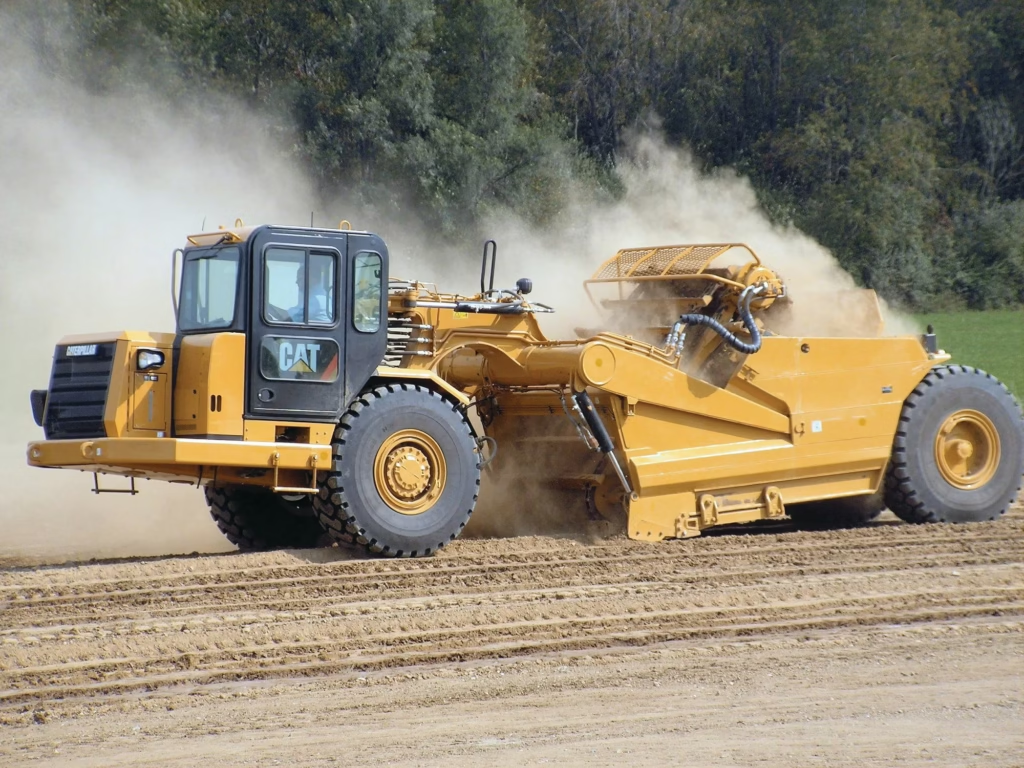
A scraper, more precisely a wheel tractor-scraper, carries a bowl with a sharp front edge that cuts into the ground, fills as the scraper moves forward, then closes to transport the load to where it’s needed. It cuts, loads, carries and spreads material in a single cycle, combining functions that would otherwise require separate loading and hauling equipment. The what is a scraper guide has the full breakdown, including towed and self-propelled versions.
Advantages of Motor Graders
Precision Grading and Levelling
This is what separates a grader from almost every other earthmoving machine on site. Paired with GPS or laser grade control, a modern grader can maintain very tight tolerances over a run, correcting uneven ground and making it suitable for final trim before paving without a second pass. The blade’s independent tilt, angle and pitch let an operator correct a slope or crown on the move rather than resetting between passes, which is difficult to match with a dozer blade.
Road Formation and Surface Finishing
Graders shape camber and cross-fall on unsealed and sealed roads, cut drainage ditches, and mix, push or spread material evenly across a surface. On unsealed roads, a periodic grading pass restores the running surface and directs water off to the sides rather than letting it pool and erode the base, which is why councils and mine sites keep graders on long-term maintenance contracts rather than one-off hires.
Best Applications for Motor Graders
Graders earn their keep on final trim before paving, ongoing maintenance of gravel and unsealed roads, shaping building pads, and any task where the finish matters more than the volume moved. Quotor lists grader hire options by size and blade width, which is worth checking before comparing quotes for a specific site.
Advantages of Scrapers
High-Volume Cut and Carry
A scraper’s whole design is built around moving a lot of material without handing the work to a separate loader. The bowl typically has a capacity of around 8 to over 30 cubic metres heaped, depending on the model, and because loading, hauling and dumping happen in one pass, no excavator or loader has to fill it first. That single-pass approach is what makes scrapers efficient on large, repetitive cut-and-fill work.
Fast Material Movement Over Distance
Scrapers are most efficient over short to moderate haul distances, where fast loading, travel and dumping keep cycle times low and outperform bringing in a loader-and-truck combination. As haul distance increases, articulated dump trucks or other hauling systems may become more economical, depending on material, gradients and haul-road conditions.
Best Applications for Scrapers
Scrapers suit large-scale cut-and-fill and excavation work: subdivision earthworks, land development, dam construction, airport pads, and any site where soft, workable material needs to move from one part of a project to another. Quotor’s scraper hire listings cover both self-propelled and towed models, which differ mainly in bowl size and how much power sits behind the cut.
Motor Grader vs Scraper Comparison
Function and Machine Design
A grader’s long wheelbase and mid-mounted blade exist to cut, shape and finish a surface it’s already standing on. A scraper’s bowl exists to take material with it: cutting, carrying and dumping are all built into the same bowl-and-apron system, whether the machine is self-propelled or towed behind a tractor. The blade is the grader’s core strength; the bowl is the scraper’s.
Cutting, Grading and Material Movement
A grader shaves off thin layers, a few centimetres at a time, to correct level and shape, and it doesn’t carry material anywhere once it’s cut. A scraper is built to dig into the ground to a controlled depth, filling the bowl, sometimes called a box, and relocates that volume elsewhere on the site. One finishes a surface; the other moves earth from where it isn’t needed to where it is.
Operating Conditions and Site Requirements
Graders work well on already-formed or semi-formed surfaces and in tighter road corridors, since they don’t need much room to manoeuvre. Scrapers need open haul routes and soil or loose material that can be cut efficiently. Rocky ground, steep grades, poor traction or high rolling resistance can all reduce productivity, while a grader is much less dependent on haul-route conditions when making a finishing pass.
Productivity and Haul Distance
Grader productivity comes down to area covered per pass, not distance carried, since the machine doesn’t haul material. Scraper productivity depends heavily on haul distance: short, well-planned cut-to-fill runs keep cycle times low, while longer hauls or awkward turnarounds quickly erode the efficiency that makes a scraper worth using over a truck.
Hire Cost Comparison
Day rates vary by size and by market, but scrapers generally sit above graders on the hire rate card. That gap tracks the machine’s scale and the volume it’s built to shift in a day. Quotor’s guide to estimating equipment cost is a useful starting point before comparing quotes for either one.
Choosing the Right Machine to Hire
When to Hire a Motor Grader
The test is simple: is the work about getting a surface level and finished, or about relocating volume from one part of the site to another? If it’s the former, a grader is the answer regardless of how big the site is. On projects that need both, a grader typically follows a scraper or dozer once the bulk earthworks are done, rather than replacing it. Where the whole project leans closer to bulk clearing than fine shaping, it’s worth checking the dozer vs grader comparison before committing to either.
When to Hire a Scraper
Ask the same question in reverse: is material sitting in the wrong place in real volume, not just at the wrong level? If a grader would need dozens of passes to redistribute what’s there, a scraper carrying it in a handful of loaded runs is usually the faster and cheaper choice, with a grader brought in afterwards only if the finished surface still needs tidying.
Site Conditions and Project Requirements
Site size and timeline are as much of a factor as the ground itself. A small residential block rarely justifies a scraper’s mobilisation cost, even where the material would suit one, since a grader or a smaller loader usually gets the work done faster once mobilisation is factored in. On a large, relatively flat site with a tight deadline, a scraper’s ability to cut and carry in one pass can be the difference between finishing on schedule and falling behind. Quotor’s full equipment range is worth a look if neither one suits the project’s scale.
Hire Cost and Project Duration
The higher day rate on a scraper is usually offset by how much material it shifts per hour, so total project cost often comes down to duration rather than the daily figure alone. For a short job, or one you’re unsure about, a short-term or trial hire is worth the extra cost before committing to a longer booking. Quotor’s guide to hiring construction equipment explains how to compare suppliers and availability once you’ve settled on a machine, and lets you check pricing for a grader and a scraper side by side before you book either one.