
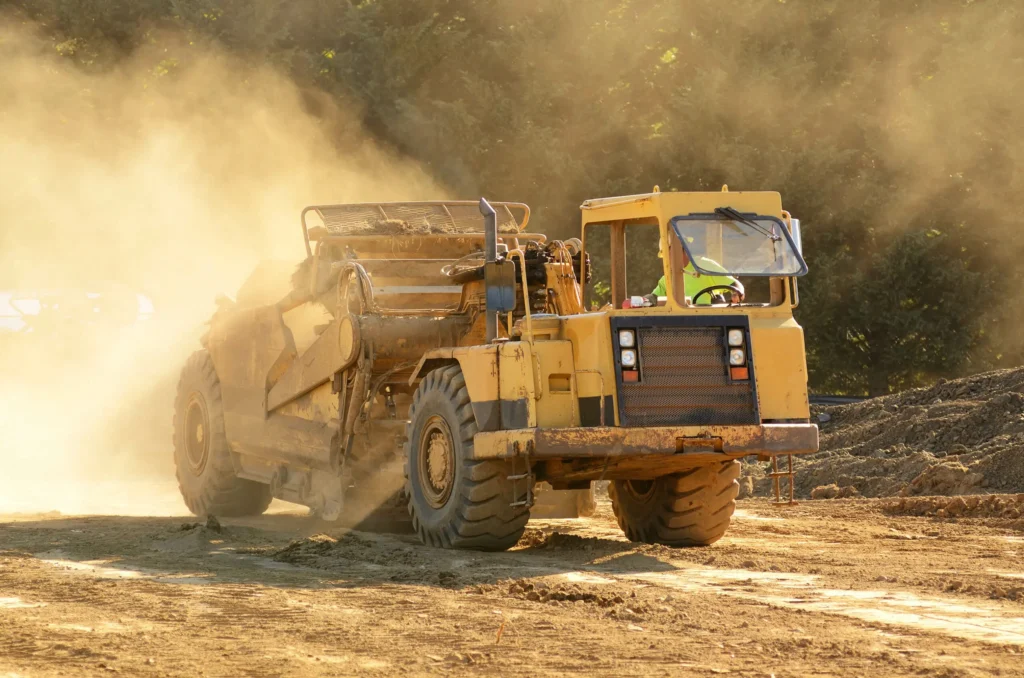
Understanding Scrapers
What Is a Scraper?
A scraper is a heavy-duty earthmoving machine that cuts, loads, hauls and dumps material in one continuous pass. Quotor lists scrapers alongside dozers, graders and loaders as core earthmoving equipment, though a scraper does the job of both an excavator and a truck in one machine. The rear-mounted bowl, sometimes called the pan or hopper, is what sets it apart from other earthmoving plant.
How Scrapers Work
The bowl is lowered by a hydraulic ram so its cutting edge, a horizontal blade, slices into the ground and fills the bowl as the machine moves forward. On tougher or rocky soils a push tractor helps force the blade through the cut; elevating scrapers use an elevator mechanism instead, lifting material into the bowl on their own. Once full, the apron closes and the load is hauled to the fill area to unload, where the ejector plate pushes material out as the scraper moves forward, spreading it in a controlled layer or grading it to fall.
What Scrapers Are Used For
Scrapers move large volumes of soil, clay or gravel over short to moderate haul distances without separate loading equipment. They suit road corridors, site pads, quarries and large civil jobs where the same cut-and-fill cycle repeats across open ground.
Types of Scrapers
Five terms turn up when people search for scrapers, though Quotor’s own scraper category is organised into three practical hire types: elevating, open bowl and pull-type. Motor and coal bowl scrapers are variants of these, split out below by propulsion and bowl design rather than as separate hire categories.
Motor Scrapers
Motor scrapers are self-propelled scrapers, with their own engine driving the wheels rather than relying on a tractor or dozer to tow them. Larger motor scrapers run twin engines, one at the front and one on the rear axle, for extra power capacity on soft soils or uneven terrain. The bowl types below describe how a motor scraper actually loads, not a separate class of machine.
Elevating Scrapers
An elevating scraper uses an elevator mechanism, a chain fitted with flights or paddles, to elevate material into the bowl as it cuts, removing the need for a push tractor. It performs best in sandy, loamy or well-graded soil, and suits fine grading work such as site preparation, road construction and agricultural land development. The elevator gives it a higher self-loading efficiency than open bowl types, though the extra moving parts carry higher maintenance costs.
Open Bowl Scrapers
An open bowl scraper has a simple open-fronted bowl with a cutting edge that scrapes and collects material as it moves. Loading relies on gravity and forward motion, though a push tractor may still be needed in harder ground. Open bowl scrapers suit large-scale earthworks, road building and mining operations, where hauling bulk material over medium to long distances matters more than fine grading precision.
Coal Bowl Scrapers
A coal bowl scraper is a specialised wheel tractor-scraper with a high-volume bowl, built to move low-density loose coal rather than soil or clay. These machines are mostly found at power generation facilities, building and managing coal stockpiles and feeding inlet supply systems. It’s a niche variant that Australian hire fleets are less likely to stock than the other types here.
Pull-Type or Towed Scrapers
A pull-type scraper is unpowered and towed behind a tractor, bulldozer or articulated truck, with a bowl that scrapes, loads and transports material much like a motor scraper’s. Lower purchase and hire costs make pull-type scrapers a common choice for farming, land grading and smaller construction jobs, particularly where a business already owns the machine needed to pull one.
Tractor Scrapers vs Wheel Tractor-Scrapers
The two terms are easy to mix up. “Tractor scraper” is often used loosely for a pull-type scraper towed behind a farm tractor. “Wheel tractor-scraper” is the more precise industry term for the self-propelled machine described under motor scrapers, where the tractor and scraper portions are permanently joined by an articulation point rather than a tow hitch. The distinction matters when searching hire listings, since the two terms point to different machines.
| Type | Power Source | Loading Method | Typically Used For |
|---|---|---|---|
| Motor Scraper | Self-propelled, single or twin engine | Open bowl or elevating | Bulk earthmoving, high daily output |
| Elevating Scraper | Self-propelled | Elevator-fed bowl | Fine grading, site prep, agriculture |
| Open Bowl Scraper | Self-propelled, push-assisted in hard ground | Gravity-fed bowl | Large-scale earthworks, mining, roads |
| Coal Bowl Scraper | Self-propelled wheel tractor-scraper | High-volume open bowl | Coal stockpile management |
| Pull-Type Scraper | Towed by tractor or dozer | Gravity-fed bowl | Farming, land grading, small jobs |
Scraper Applications
Road Construction
On road and highway jobs, scrapers cut and shift material along the corridor to shape the subgrade and spread base course before compaction. Where the job also needs fine trim and cross-fall work, a motor grader typically finishes what the scraper has roughly shaped, and Quotor’s grader-versus-scraper comparison breaks down which machine suits which part. In tougher cuts, a dozer may push-load the scraper’s bowl to speed up the pass.
Site Preparation and Earthmoving
Before footings or slabs go in, scrapers strip and stockpile topsoil, then cut and fill the job site to design levels in the same pass. A crew clearing and levelling a building pad can shift material to a stockpile and return it later without swapping equipment or waiting on a separate haul truck.
Mining and Quarrying
In mining and quarrying, scrapers strip overburden and shift loose material short to medium distances within the site boundary, work that would otherwise need a wheel loader and a fleet of haul trucks. General pit work is mostly open bowl and motor scraper territory; coal bowl scrapers are reserved for power generation coal yards, not the pit.
Large-Scale Civil Construction
Dams, canals, airports and other large civil projects are the classic scraper application, moving enormous volumes of earth over open ground in a repeating cut-and-fill pattern. At this scale, scrapers typically work as part of a wider fleet alongside dozers, rollers and graders rather than as a standalone solution.
Advantages and Limitations of Scrapers
Advantages of Using Scrapers
A scraper’s main advantage is doing four jobs, cutting, loading, hauling and dumping, without switching equipment. On an open site this reduces cycle time and lifts productivity compared with an excavator-and-truck combination, and a single motor scraper can move several thousand cubic yards of material a day under good conditions.
Limitations of Scrapers
Scrapers need open, reasonably flat ground to manoeuvre and turn, so they’re a poor fit for confined or heavily obstructed sites. Wet or sticky soils reduce traction and can bring a loaded scraper to a stop, and the economics only work at scale: an excavator and dump truck are usually cheaper for a small job.
When a Scraper Is the Right Machine
A scraper earns its place on large, open-cut jobs with repeated cut-and-fill cycles and short to moderate haul distances: road corridors, civil earthworks and bulk site prep among them. On tight, wet or small sites, other equipment usually does the job for less.
Scraper Hire
When to Hire a Scraper
Scrapers are specialised heavy equipment that most job sites only need for the length of a specific project, which makes hiring more practical than owning one outright. Quotor connects contractors with plant hire suppliers who carry the type, elevating, open bowl or pull-type, that suits the project rather than whatever’s on the yard.
Factors to Consider When Hiring a Scraper
The right type of scraper depends on soil, haul distance and how much open ground the site offers to manoeuvre in. Dry hire suits a business with a competent operator on staff; wet hire brings one in with the machine. Many contractors also require scraper operators to hold a Verification of Competency, on top of the standard White Card for site access.
Scraper Hire Costs
Rates vary materially across scraper types: a pull-type scraper costs far less to hire than a self-propelled wheel tractor-scraper, and wet hire with an operator costs more than dry hire. Machine size, attachments, mobilisation to site and local supplier availability all move the price further. Because the range across types is so wide, a few quotes matched to the specific machine and job, which is what Quotor does, give a more accurate figure than a single generic rate.