
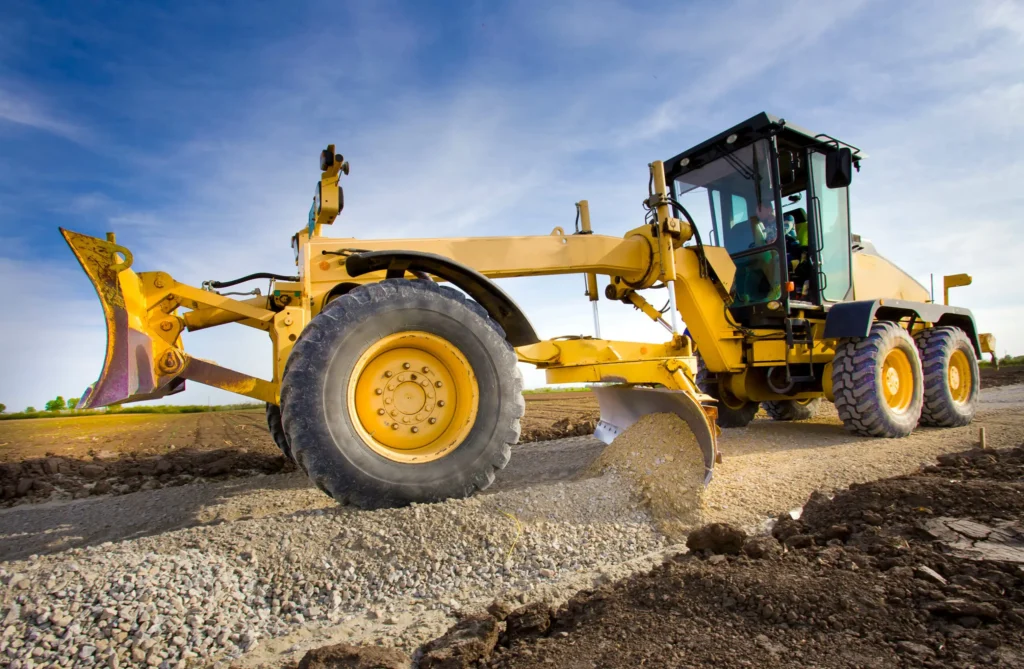
A motor grader is one piece of equipment that turns a rough, uneven site into something you can actually build on. Long, low and unmistakable with its blade slung underneath the frame, a grader is the machine crews reach for whenever a surface needs to come out dead flat or sit at a precise fall. Whether you’re comparing hire options through Quotor or just trying to work out if this is the right machine for your job, it helps to understand what a grader actually does before you start comparing models.
Understanding Motor Graders
What is a Motor Grader?
A motor grader, also known as a road grader or simply a grader, is self-propelled earthmoving equipment built around one job: producing a flat surface or a precisely sloped one. It isn’t a bulldozer wearing a different badge. A dozer pushes large volumes of material with a blade mounted at the front of the machine; a grader trims and finishes with a long blade slung between its axles, working in thin, controlled passes rather than bulk shifts. Quotor’s own comparison of the two machines breaks down when each one earns its place on a job.
Key Components of a Motor Grader
A typical grader runs on three axles: two under the cab and engine forming a rear tandem, and one carrying the front wheels for steering. The moldboard, more commonly called the grader blade, sits on a drawbar and circle assembly, an adjustable blade between the front and rear axles that can shift up, down, left or right and rotate through a wide range of angles. Many machines also carry a front-mounted scarifier and a rear ripper attachment, sets of teeth used to break up compacted soil, gravel crust or old pavement before the moldboard does its work. The operator sits in an enclosed cab with clear sightlines to the cutting edge.
How Motor Graders Work
Everything on a grader runs off a hydraulic system, worked with joysticks or levers from inside the machine. The operator sets the blade’s height, tilt and rotation, then works the site in overlapping passes, adjusting the angle as ground conditions change. Front axle oscillation lets the wheels follow uneven terrain independently, which keeps the grading consistent even when the ground underneath isn’t. It’s heavy machinery that rewards a steady hand and a good eye for level.
Types of Graders
Standard Motor Graders
Most modern motor graders use an articulated frame, with a pivot point between the front frame and the cab-and-engine section. This is what lets the machine crab-steer around curves, useful for curved roads, ditch work and snow clearing, offsetting the rear wheels from the blade line so the tandem stays on solid ground while the front wheels run over a windrow or down a slope. Rigid-frame graders still exist, mostly among older or compact utility machines, but articulated models are the standard choice across the construction industry, including everyday grading and road maintenance.
All-Wheel Drive Graders
An all-wheel drive grader sends power to the front wheels as well as the rear tandem, which can add up to 40% more tractive effort than rear drive alone. That extra traction matters on soft, wet or steep ground where a standard grader would struggle to hold its line, though AWD models cost more to buy and run, so the gain only pays off if the site actually demands it.
Specialized Graders
Compact or mini graders scale the same design down for tight urban sites, subdivisions and landscaping work where a full-size machine can’t manoeuvre. Rigid-frame graders, built without the pivot joint, still turn up on farms and smaller sites where cost matters more than manoeuvrability. Agricultural graders, often fitted with laser-guided blade control, are built specifically for levelling paddocks and farm tracks to within a few millimetres of grade. That versatility comes from adjusting the frame, drive and control setup to the job rather than needing a different machine for each one.
Quotor lists motor graders by size class, which is a more useful comparison point than horsepower alone once you’re actually choosing between machines for a job.
| Class | Typical blade width | Commonly used for |
|---|---|---|
| 12ft class | ~12ft | Municipal work, subdivisions, tight sites |
| 14ft class | ~14ft | General civil construction, road maintenance |
| 16ft class | ~16ft | Highway grading, larger civil jobs |
| 24ft class | ~24ft | Mine haul roads, large-scale earthworks |
Functions of Road Graders
Primary Grader Functions
At its core, a road grader levels ground, cutting high spots and filling low ones to leave a smooth surface with a consistent fall for water to run off. The same blade cuts and maintains drainage ditches, mixes and spreads material like gravel across a base course, and handles snow removal from roads and yards in winter.
Grading Techniques for Different Surfaces
How a grader approaches a surface depends on what it’s cutting into. Compacted gravel roads or old asphalt marked by a pothole or two often need scarifying first to break the surface up before grading can begin. Dirt roads and subgrade work usually go straight to the blade for rough shaping, then a lighter final pass for finish grading once the base course is close to level. Fine grading, the last pass before paving or turf goes down, calls for a different touch again: small blade adjustments, slow travel speed and constant attention to the level.
Importance of Precision in Grading
A grader that’s slightly off level costs money twice: once in rework, and again in the extra passes needed to fix it. That’s why most modern machines carry some form of grade control, from a simple laser reference to a full GPS-guided system that keeps the blade on line automatically. Getting a surface right in fewer passes also matters for drainage, since a poorly graded fall traps water instead of shedding it.
Motor Grader Applications
Graders are used across a wider range of settings than the name “road grader” suggests.
Road Construction
On a construction site, graders show up early and often: shaping the subgrade, spreading and levelling the base course, and cutting the final fall before kerbing or asphalt goes down. Alongside dozers and loaders, the grader is core construction equipment on almost every road job. On larger civil engineering projects, the choice sometimes comes down to a grader against a scraper for shifting and shaping material over long distances. Quotor’s grader-versus-scraper breakdown is worth a look if you’re not sure which suits your job.
Agriculture
Away from construction, graders maintain farm tracks and unsealed rural roads, and reshape paddocks so water runs to drains instead of pooling. Laser-guided agricultural graders can level a field precisely enough to improve irrigation efficiency across an entire property.
Landscaping and Earthmoving
On smaller landscape and earthmoving jobs, a grader cuts building pads to fall, shapes drainage swales and clears rough ground before turf or paving goes in. It’s the same grading work as a highway site, just scaled down. Compact graders handle most of this work, since full-size highway machines are usually more than a residential or commercial landscaping job needs.
Grader Hire and Usage
Benefits of Hiring a Grader
Given how rarely most construction projects need one full-time, grader hire almost always beats ownership. You get access to a machine sized for the specific job, without carrying the cost of a grader sitting idle between projects. Quotor researches the market on your behalf, contacts suppliers directly and compares available hire options so you’re not doing that legwork yourself.
Factors to Consider When Hiring a Grader
Blade width and drive type are the obvious factors, but who’s operating the machine matters just as much. Most commercial sites expect the operator to demonstrate competency for grader operations, evidenced by relevant experience, the RIIMPO324F unit of competency, or a current site-based verification of competency. Decide early whether you need wet hire, machine and operator together, or dry hire if you already have someone qualified on the books, since availability for each differs by supplier and by job site location.
Grader Hire Cost
Hire cost tracks machine size, blade class and hire duration, with AWD and GPS-equipped models sitting above standard rear-drive graders. Quotor’s grader hire category shows current suppliers and equipment across each size class, so you can compare quotes against your actual project scope rather than guessing at what a grader costs before you start.