
Understanding Wheel Loaders
What Is a Wheel Loader?
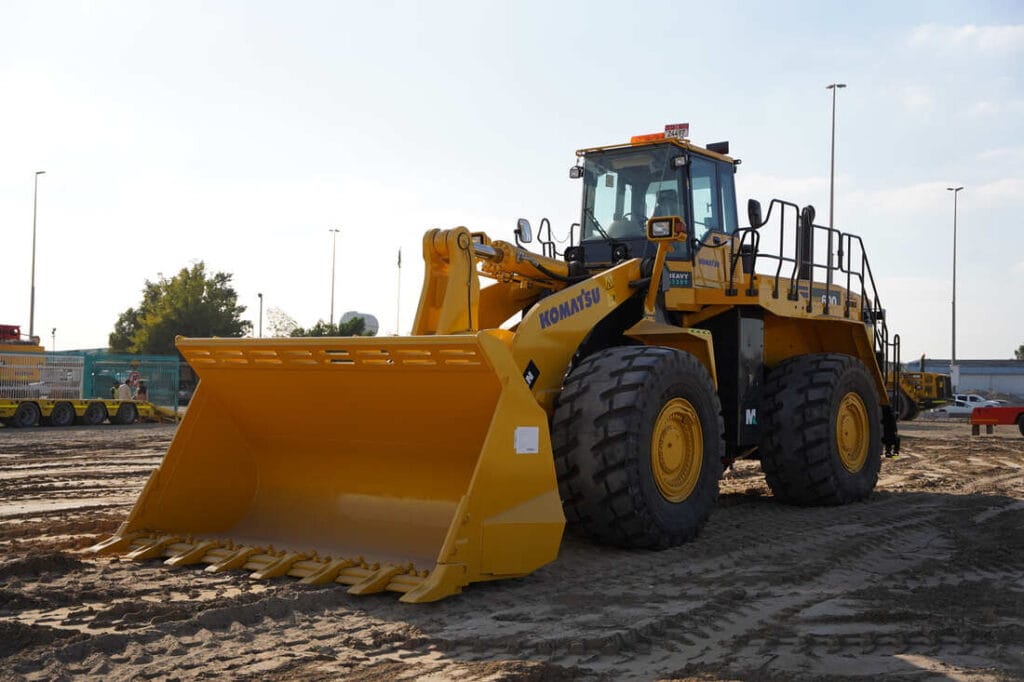
Wheel loaders, sometimes called front loaders or bucket loaders, are wheeled machines built around a front-mounted bucket, used primarily to scoop, lift, carry and load material rather than perform deep excavation. They sit within Quotor’s broader loader category alongside skid steers and compact track loaders, but their size and reach set them apart: a wheel loader can carry a larger load higher and further than most compact loaders, which is why it does the heavy lifting on quarry faces, stockpiles and large construction sites. Quotor’s guide to earthmoving equipment covers where loaders sit within that wider category.
How Wheel Loaders Work
Operating a wheel loader starts with driving up to a stockpile or muck pile, tilting the bucket down and driving forward so it fills as it moves through the material. Hydraulic lift arms then raise and curl the bucket back before the operator reverses and repositions to dump into a truck, hopper or new pile. This drive in, fill, lift, dump cycle is what separates a wheel loader from a backhoe loader, which pairs a rear digging arm with a smaller front bucket; a wheel loader carries more material per pass but can’t dig below grade the way a backhoe can.
Main Components of a Wheel Loader
As with most heavy machinery, how a wheel loader performs comes down to four components: the boom and lift arms that set reach and dump height, the hydraulic cylinders that power lifting and tilting, the cab or, on smaller machines, an open canopy where the operator sits, and the articulation joint at the machine’s centre that lets it turn without the wheels steering sharply. Tyre choice matters too, since tread pattern affects grip on loose material and wear on hard standing such as asphalt and concrete.
Types of Wheel Loaders
Wheel loader size classes vary between manufacturers, but a practical way to group hire machines is by operating weight and bucket capacity.
Compact Wheel Loaders
Compact wheel loaders generally sit under around 6 tonnes operating weight, with bucket capacities up to roughly 1.5 cubic metres. Their smaller footprint and tighter turning circle suit tight spaces on residential and light commercial sites where a larger machine would struggle.
Small and Medium Wheel Loaders
Small and medium wheel loaders typically range from about 6 to 16 tonnes, with bucket capacities from around 1.5 up to 3.5 cubic metres. This is the size bracket most hire fleets carry as an all-rounder: big enough for general construction and civil work, small enough to move between sites without special permits.
Large Wheel Loaders
Large wheel loaders start around 16 tonnes; larger models extend well past 30 tonnes for quarry and mining work, running a large bucket that can exceed 5 cubic metres in capacity. At this size the machine is usually matched to a specific haul truck or crusher feed rate rather than general site work. At the larger end of the range, transport may require oversize permits or additional transport arrangements depending on the machine’s dimensions and the route.
Integrated Tool Carriers
Integrated tool carriers, or ITCs, are a wheel loader variant built around fast attachment changeover rather than raw bucket capacity, typically using a quick-hitch system and a parallel-lift linkage that keeps forks and buckets level through the full lift cycle. They sit close to a wheel loader in size, but the emphasis on swapping attachments quickly is different enough that the comparison between an integrated tool carrier and a wheel loader is worth reading first.
Wheel Loader Attachments
General Purpose Buckets
The standard general purpose bucket is what most wheel loaders are hired with. It’s built for loose to medium-density material such as soil, sand and aggregate, and is the default choice unless the job needs something more specific.
Forks
Pallet forks turn a wheel loader into a forklift substitute for moving palletised material, timber packs or steel around a site. They’re a common swap on integrated tool carriers, useful wherever a job needs both bucket work and pallet handling.
Grapples
Grapples add a hydraulic clamping jaw over or in place of the bucket, letting the machine grip irregular material such as logs, scrap or demolition debris that would otherwise spill out. They’re common in waste handling, land clearing and recycling yards.
High-Tip Buckets
A high-tip bucket extends further forward and higher before it dumps, clearing the side of a taller truck or hopper without repositioning. The extra mechanism adds weight, shifts the machine’s centre of gravity and can reduce the usable payload compared with a standard bucket, so it is mainly chosen where additional dump height is required.
Other Wheel Loader Attachments
Brooms, snow blades, augers and rippers round out the attachment range for wheel loaders doing varied work across the year. Quotor’s guide to wheel loader attachment types breaks down which attachments suit which machine and material, useful before booking a hire.
Wheel Loader Applications
Construction and Earthmoving
On construction sites, wheel loaders load trucks, backfill trenches and move aggregate, sand and spoil between stockpiles and work areas alongside other construction equipment. Fine grading and excavation usually fall to a grader or excavator; wheel loaders keep material moving between those machines and the truck.
Quarrying and Mining
Quarry and mining operations are where the largest, heavy-duty wheel loaders earn their keep, loading haul trucks directly from the face or feeding a crusher at a set rate. Bucket capacity and cycle time matter more here than manoeuvrability, since the machine’s output is measured against the truck fleet or crusher it’s feeding.
Agriculture
On farms, wheel loaders work alongside tractors handling silage, grain, mulch and general yard work, often fitted with a bucket for most of the year and forks for the rest. Mid-size machines are common here since farm tracks and shed doorways limit how large a loader can operate.
Waste and Recycling
Waste transfer stations and recycling yards use wheel loaders with grapples or high-tip buckets to sort, stockpile and load material that doesn’t behave like clean aggregate, mixed demolition waste, green waste or scrap metal. That uneven material is why grapples are common here.
Material Handling and Stockpiling
Beyond loading trucks, wheel loaders build and manage stockpiles, moving large quantities of material into windrows for screening or blending different grades of aggregate before use. On larger sites this can take as much of the day as truck loading does.
Benefits and Limitations of Wheel Loaders
High Loading Capacity
A wheel loader’s bucket capacity, combined with a full hydraulic lift cycle, lets it move far more material per pass than a skid steer or compact track loader, useful for heavy loads that would take a smaller machine several trips. On a job measured in truckloads rather than individual scoops, that capacity difference is what saves time.
Mobility and Cycle Speed
Wheeled machines generally travel faster between the stockpile and the truck than a tracked machine, and a wheel loader’s articulated steering keeps the turning circle tight for its size. Shorter cycles add up on a worksite doing repetitive load-and-carry work.
Attachment Versatility
Swapping between a bucket, forks and a grapple lets one wheel loader cover several jobs that would otherwise need separate machines, particularly on integrated tool carriers built around fast changeover, where attachment flexibility matters more than raw capacity.
Limitations in Confined or Soft Ground Conditions
Wheel loaders need more clearance to manoeuvre than a skid steer and don’t handle soft, wet ground as well as a tracked machine, since a stuck wheel has less traction than a track. On tight residential sites, a skid steer or compact track loader is often the better fit, and the comparison between a skid steer and a wheel loader covers that trade-off.
Choosing the Right Wheel Loader
Operating Weight and Bucket Capacity
Matching operating weight and bucket capacity to the job is the first decision, since an undersized machine takes more passes to move the same volume and an oversized one struggles in tight areas. Quotor lists both figures for each machine.
Lift Capacity and Dump Height
Lift capacity and maximum dump height determine whether the machine can clear the side of the truck being loaded, particularly with larger tip trucks or hoppers. A high-tip bucket helps where dump height is tight, but capacity still needs to match the job.
Site Conditions and Machine Size
Ground conditions such as uneven terrain, access width and overhead clearance narrow down which size machine fits the site, separately from what the job needs. A wheel loader isn’t always the right call either: on sites doing more bulk pushing than loading, a dozer suits the task better, and the comparison between a dozer and a wheel loader is a useful check before booking.
Attachment Requirements
An integrated tool carrier may be the better choice where frequent attachment changes and material handling are central to the job. Quotor’s explainer on what an integrated tool carrier is sets out that distinction in more depth.
Wheel Loader Hire
When to Hire a Wheel Loader
Hiring makes sense when the machine is required for a project, seasonal workload or occasional loading work rather than being utilised consistently throughout the year. Quotor’s wheel loader category lists a range of wheel loaders by size and location.
Factors to Consider When Hiring
Hire cost depends on machine size, hire duration and attachment inclusions, but job site access and ground conditions matter just as much, since the right machine on paper can still be wrong for a cramped or wet site. The operator is generally expected to demonstrate competency for the machine and task, which may be supported by relevant training, experience or a site-based verification of competency.
Wheel Loader Hire Costs
Hire rates scale with operating weight and bucket capacity, and rise further for machines with attachment packages included. Because the range between a compact loader and a large quarry-spec machine is wide, a single indicative rate isn’t much use; comparing quoted rates for the specific size bracket a job needs gives a more useful picture.
Hiring vs Buying a Wheel Loader
Buying suits an operation running a wheel loader near-daily and able to absorb servicing, tyres and depreciation as fixed costs. Hiring suits everyone else, since it converts those costs into a rate tied to actual use and lets the machine size change from job to job.