
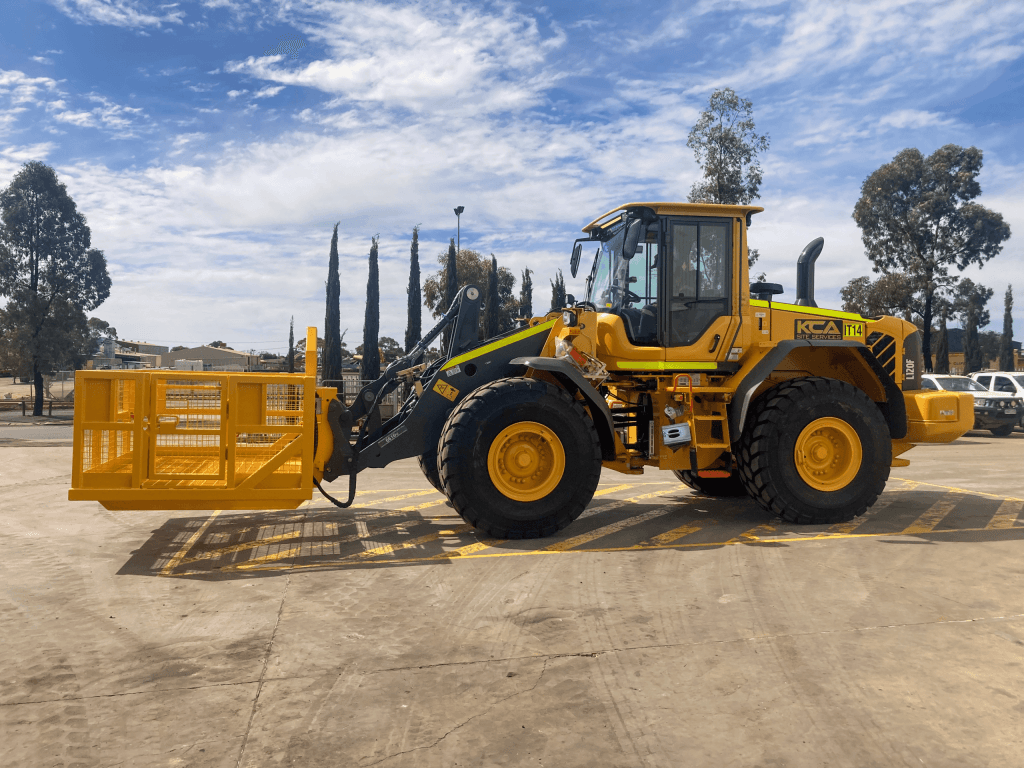
An integrated tool carrier (ITC) is a wheeled loader built around a fast attachment coupler and a lifting linkage designed for handling loads rather than just digging into them. On Quotor, ITCs sit inside the broader loader category alongside wheel loaders, skid steers and compact track loaders, built for sites where the task changes hour to hour rather than staying fixed on one job. This guide covers what sets an ITC apart from a wheel loader, the attachments it runs, where it earns its keep, and what to check before hiring.
Understanding Integrated Tool Carriers
What Is an Integrated Tool Carrier?
An integrated tool carrier is a self-propelled, articulated wheeled machine purpose-built to swap attachments quickly through an integrated quick coupler. It sits inside the wheel loader family rather than existing as a separate machine type: most ITCs start from a wheel loader, sometimes called a front-end loader, platform, then get a parallel-lift linkage and a faster coupling system in place of the standard loader arm. The result is a machine that can swap between a bucket, forks and a jib faster than bringing a second machine onto site. It’s sometimes confused with a telehandler, though a telehandler’s telescopic boom gives it more reach.
How an Integrated Tool Carrier Works
The defining feature is the linkage. Most wheel loaders use a Z-bar linkage, which tilts back sharply during a lift and gives strong breakout force for digging into a stockpile. An ITC instead uses a parallel-lift linkage, sometimes a multi-bar design and sometimes a manufacturer-specific variant, that helps keep the attachment substantially level through the lift cycle. That’s what makes it suited to carrying a load steady on forks or a jib, instead of scooping and dumping it. An ITC isn’t built to dig like an excavator; its strength is lifting and carrying material that’s already loose or staged.
Integrated Tool Carrier vs Wheel Loader
An ITC and a wheel loader can look near identical and often perform the same core task of loading and moving material. The difference comes down to linkage and intent: a wheel loader favours digging and high-volume bucket work, while an ITC favours attachment changes and material handling. Quotor’s integrated tool carrier vs wheel loader guide breaks this down in more depth.
| Wheel Loader | Integrated Tool Carrier | |
|---|---|---|
| Linkage | Commonly Z-bar | Parallel-lift / tool-carrier linkage |
| Best suited to | Bulk digging and loading | Attachment versatility and material handling |
| Breakout force | Typically prioritised | Often trades some digging performance for lift control |
| Bucket work | Optimised for production loading | More balanced across multiple attachments |
Integrated Tool Carrier Attachments
Forks
Pallet forks are one of the most common ITC attachments, used for unloading trucks, moving palletised materials and shifting bagged product around a yard. Because the parallel-lift linkage helps keep the forks level through the lift, a load stays flatter than on a standard loader arm, which matters when the load is stacked or fragile.
Buckets
General purpose buckets remain the default attachment for straightforward loading and site clean-up, and a four-in-one bucket adds grading, gripping and levelling in one tool. Bucket capacity on an ITC generally sits below an equivalent wheel loader’s, since the parallel-lift linkage trades some breakout force for lift control.
Material Handling Attachments
Jibs, hooks and grabs extend an ITC’s range into tasks a bucket or fork can’t manage, such as lowering pipe into a trench or lifting irregular loads that need to stay level in transit. This is where the machine’s material handling role separates it most clearly from a standard loader.
Other Hydraulic Attachments
Brooms, augers and grapples run off the machine’s auxiliary hydraulics rather than the lift arm, adding site clean-up, post-hole boring or scrap and vegetation handling to the same base machine. Running these well depends on the ITC supplying enough hydraulic flow to power them, easy to overlook until the attachment arrives and can’t keep up.
Integrated Tool Carrier Applications
Construction and Civil Works
On a civil construction site, an ITC handles site preparation, general material movement and pipe-laying support in one machine, switching from a bucket for grading to a jib for placing pipe as the job moves along.
Material Handling
Loading and unloading trucks, moving palletised or bagged material around a yard and staging supplies close to the work face are core ITC tasks, particularly where deliveries and material types change from one day to the next.
Agriculture
On farms, an ITC handles feed and bale movement, general yard work and odd loading jobs with fork or bucket, without needing a dedicated loader for each task.
Industrial and Yard Operations
Warehouses, transfer stations, recycling yards and parts of the mining industry use ITCs for the same reason civil sites do: material types and tasks change often enough that one machine with several attachments is more practical than several single-purpose ones.
Benefits and Limitations of Integrated Tool Carriers
Attachment Versatility
The main benefit is a versatile attachment range: a properly matched quick coupler lets an operator move between tools without bringing in a second machine, which matters most on sites juggling several material types in a single shift.
Improved Material Handling
The parallel-lift linkage helps keep loads level through the lift, reducing spillage and tipping risk on forks, buckets and jib work compared with a Z-bar loader.
Visibility and Load Control
Because the linkage geometry is more predictable through the lift cycle, operators generally have a clearer sense of where a load sits and how it will behave, supporting more controlled placement work such as setting pipe or stacking pallets.
Limitations Compared with Wheel Loaders
The trade-off for that control is breakout force. A parallel-lift linkage doesn’t dig into a stockpile as aggressively as a Z-bar wheel loader, and ITC bucket capacities tend to sit below an equivalent wheel loader’s. Quotor’s wheel loader guide covers the wheel loader side of that trade-off.
When to Use an Integrated Tool Carrier
Jobs Requiring Frequent Attachment Changes
If a job moves between forks, bucket and jib work across a single day, an ITC removes the need to bring in and coordinate a separate machine for each task. Quotor’s integrated tool carrier listings show current options for hire.
Loading and Material Handling Tasks
Sites centred on moving, staging and placing material get more out of an ITC’s lift control than a wheel loader’s extra breakout force.
Sites Requiring One Machine for Multiple Tasks
Smaller sites with limited room for multiple machines benefit from an ITC covering several roles, cutting the machines, operators and deliveries needed on site.
When a Wheel Loader Is the Better Choice
For high-volume bulk loading or digging into a stockpile, a wheel loader’s stronger breakout force and larger bucket capacity generally make it the more efficient choice. Quotor’s wheel loader category is worth checking alongside ITC listings when bulk loading, not attachment flexibility, is the main job.
Choosing the Right Integrated Tool Carrier
Operating Weight and Load Capacity
Match operating weight and rated load capacity to the heaviest attachment and load combination the job needs, not the biggest ITC available. An undersized machine struggles with stability on lift-heavy attachments like jibs and forks.
Attachment Compatibility
Select attachments that match the ITC’s quick coupler; standards vary between manufacturers, and not every attachment fits every carrier without an adapter.
Site Conditions and Access
As a wheeled machine, an ITC needs reasonably firm, even ground to operate safely, plus enough clearance to manoeuvre between tasks, so it’s worth checking site requirements before booking. Soft or steep sites may suit a tracked machine better regardless of attachment needs.
Required Hydraulic Performance
Powered attachments such as brooms and augers need a minimum hydraulic flow and pressure to operate safely, so match the ITC’s hydraulic output to what the attachment needs before booking.
Integrated Tool Carrier Hire
When to Hire an ITC
Hiring suits short-term or project-based work where the attachment mix needed doesn’t justify owning a dedicated machine, and it’s a practical way to trial an ITC against a wheel loader before committing to either. Quotor’s guide to hiring construction equipment covers the broader decision between hiring and owning.
Factors to Consider When Hiring
Confirm whether the hire is wet (machine and operator supplied) or dry (machine only, your own operator), which changes both cost and who’s responsible for running the machine safely. Operators need to be competent to use the machine for the work being performed. Evidence may include the nationally recognised RIIHAN311F Conduct operations with integrated tool carrier unit, relevant experience or a site-based verification of competency. This is sometimes referred to informally as the integrated tool carrier ticket. Also check which attachments are included in the hire and whether they suit the job’s requirements.
Integrated Tool Carrier Hire Costs
Hire cost depends on machine size, included attachments, whether the hire is wet or dry, and hire duration; longer bookings usually reduce the daily rate. Quotor’s guide to estimating equipment cost breaks down how these variables come together for construction equipment more broadly.