
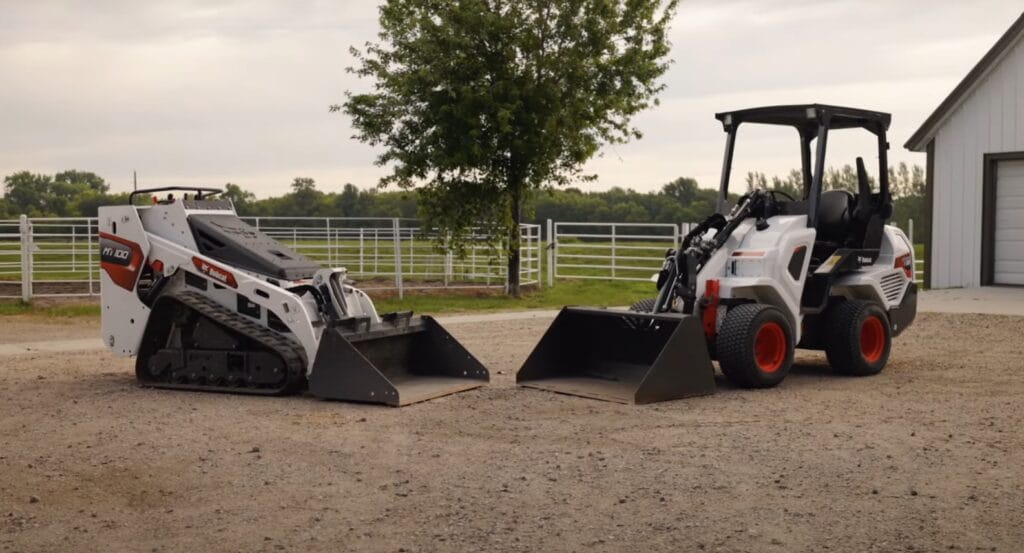
Understanding Skid Steers and Mini Loaders
How Skid Steers and Mini Loaders Handle Compact Site Work Differently
Both skid steers and compact loaders like the mini loader push, lift and carry material with a front-mounted attachment, but they sit at different ends of the same size range. A skid steer trades footprint for lifting capacity, while a mini loader trades capacity for the ability to work through narrow residential access, a trade-off that usually decides which one suits a given job site. Quotor’s loader range lists both as separate categories, alongside backhoe, wheel and Posi-Track loaders, so comparing specs before booking is straightforward.
What Is a Skid Steer Loader?
A skid steer loader is a rigid-frame machine with lift arms either side of the cab and an attachment on the front, steered by running the wheels on one side faster than the other so the tyres skid the machine around within roughly its own footprint. Frame sizes range from small, under about 790 kilograms rated operating capacity, up to large frame machines over 1,000 kilograms, built for construction, landscaping and material handling work.
What Is a Mini Loader?
A mini loader is a smaller, lightweight loader designed for sites too tight for a full-size skid steer. Many use a stand-on operating platform, although compact seated and articulated designs also exist, with wheeled and tracked models available depending on the ground conditions.
Skid Steer Best Uses
Material Handling and Loading
Fitted with forks or a bucket through a quick-attach coupler, a skid steer moves pallets, aggregate and general site material faster than a mini loader can manage at similar cycle times, since its larger frame carries a heavier load per pass. A closer look at skid steer attachments covers the full range available to hire.
Grading and Site Cleanup
A grading bucket or box blade lets a skid steer level and spread material across a site in fewer passes than a smaller machine needs, while its tight turning circle keeps repositioning to a minimum on cramped construction sites.
Jobs Requiring Higher Operating Capacity
Where a construction site regularly needs to lift close to or above a tonne, a medium or large frame skid steer is the better fit. A mini loader, as a lighter compact loader with a smaller hydraulic system, is not built to match that rated capacity.
Mini Loader Best Uses
Tight Access and Residential Sites
Many mini loaders are narrow enough for residential side access, courtyards and passages that rule out a full-size skid steer.
Landscaping and Light Earthmoving
Moving soil, spreading mulch and levelling garden beds are common mini loader jobs, and a tracked model spreads its weight to reduce the risk of rutting or marking a finished lawn during earthmoving work close to an established landscape.
Jobs Requiring a Smaller Machine Footprint
On sites where the working area itself is the constraint, a courtyard, an indoor renovation or a narrow side passage, a mini loader’s compact dimensions matter more than its lifting capacity.
Skid Steer vs Mini Loader Comparison
Size and Site Access
Mini loaders are substantially smaller and lighter than most skid steers, which is why site access often decides between the two before lifting capacity does.
Operating Capacity and Lift Performance
A skid steer’s rated operating capacity, up to and beyond 1,000 kilograms on large frame models, outperforms a mini loader’s lighter-duty hydraulics, so jobs measured in tonnes moved per hour generally favour the larger machine.
Manoeuvrability and Turning
Both machines mostly steer the same way, by running one side faster than the other, though some articulated mini loaders pivot at a centre joint instead. The practical difference is turning radius: a mini loader turns within a tighter space simply because it is smaller.
Ground Conditions
Skid steer loaders are wheeled machines, well suited to hard surfaces such as concrete or compacted hardstand. Where a job needs tracks for soft or uneven ground, a Posi-Track loader is the comparable option in a similar size class. A mini loader sidesteps that choice by coming with wheels or tracks within the one category, so ground conditions can be matched without changing machine type.
Attachments and Versatility
Both machines use a quick-hitch coupler to swap buckets, forks, augers and sweepers in minutes. A skid steer’s greater machine capacity generally lets it run larger or more demanding attachments, while mini loaders cover many of the same attachment types at a smaller scale.
Transport and Site Access Requirements
A mini loader’s lower weight generally means simpler trailer and tow-vehicle requirements, though capacity still needs checking against the specific model and attachments. A skid steer’s greater weight and width call for wider site access and a heavier-rated trailer.
Hire Cost Comparison
Hire cost for either machine tracks size, attachments and hire duration rather than one flat rate. A mini loader can cost less overall on small or access-restricted jobs where a skid steer’s extra capacity would go unused, while a skid steer can lower total job time where the work involves sustained loading or heavier material. Maintenance costs during a hire period follow hours of use and ground conditions more than machine type, so they are worth budgeting around expected run time rather than assuming one machine is cheaper to run than the other. Quotor’s guide to estimating equipment cost breaks down what drives a quote.
Choosing the Right Machine to Hire
When to Hire a Skid Steer
A skid steer suits jobs where lifting capacity or attachment power matters more than squeezing through a gate: construction, demolition and larger landscaping projects with normal site access. Quotor’s skid steer loader listings cover the full frame-size range.
When to Hire a Mini Loader
A mini loader is the better call whenever site access is the limiting factor: narrow gates, indoor work or established gardens where a larger machine risks damage. Quotor’s mini loader listings include both tracked and wheeled models by location.
Site Conditions and Project Requirements
Matching machine to job starts with measuring the tightest access point on site and weighing that against the load the job actually needs moved, a process the equipment procurement guide sets out in more detail for larger projects.
Commercial sites generally expect the operator to show competency for whichever machine is booked, supported by training, experience or a site-based verification of competency regardless of the loader’s size, a requirement covered by Quotor’s guides to hiring construction equipment and to becoming a heavy equipment operator more broadly.
Hire Cost and Project Duration
Hire duration should follow the amount and type of work rather than machine size alone. A mini loader can be efficient for short, access-restricted landscaping and renovation work, while a skid steer may complete higher-volume loading and grading faster. Quotor compares available skid steers and mini loaders by size, attachment and location so the machine is matched to both the site and the expected workload.