
Understanding Backhoe Attachments
What Is a Backhoe?
A backhoe loader combines a front loading bucket with a rear digging arm on one wheeled chassis, letting one operator load material at one end and excavate at the other. For the full breakdown of how it’s built and controlled, see Quotor’s guide to what a backhoe loader is.
Why Backhoe Attachments Matter
A backhoe loader has attachment points at both ends. The rear dipper arm takes buckets, augers, hammers, grapples, rippers and thumbs; the front loader end takes its own tools, covered later in this article. Swap the standard rear bucket for an auger and the same backhoe drills post holes instead of digging a trench, without hiring in a second machine. Understanding both attachment points matters as much as understanding the backhoe itself, which is why Quotor lists backhoe loaders alongside the attachments they’re commonly paired with before a reader settles on a machine size.
Types of Backhoe Attachments
The rear dipper arm carries the widest range of attachments and is the focus of this section; the front loader end is covered separately below.
Backhoe Buckets
The standard digging bucket is the attachment most backhoe loaders arrive with, narrow and toothed for breaking into ground. Standard buckets suit general digging and trenching in ordinary soil. Rock buckets use reinforced tines and thicker steel for demolition rubble or compacted ground, trading some capacity for durability. Grading or ditching buckets are wider with a smooth cutting edge instead of teeth, better suited to batter work, drain shaping and finishing than a narrow digging bucket. Bucket width and edge type are the first thing to check against the job, since a bucket sized for digging trenches handles demolition rubble poorly.
Augers
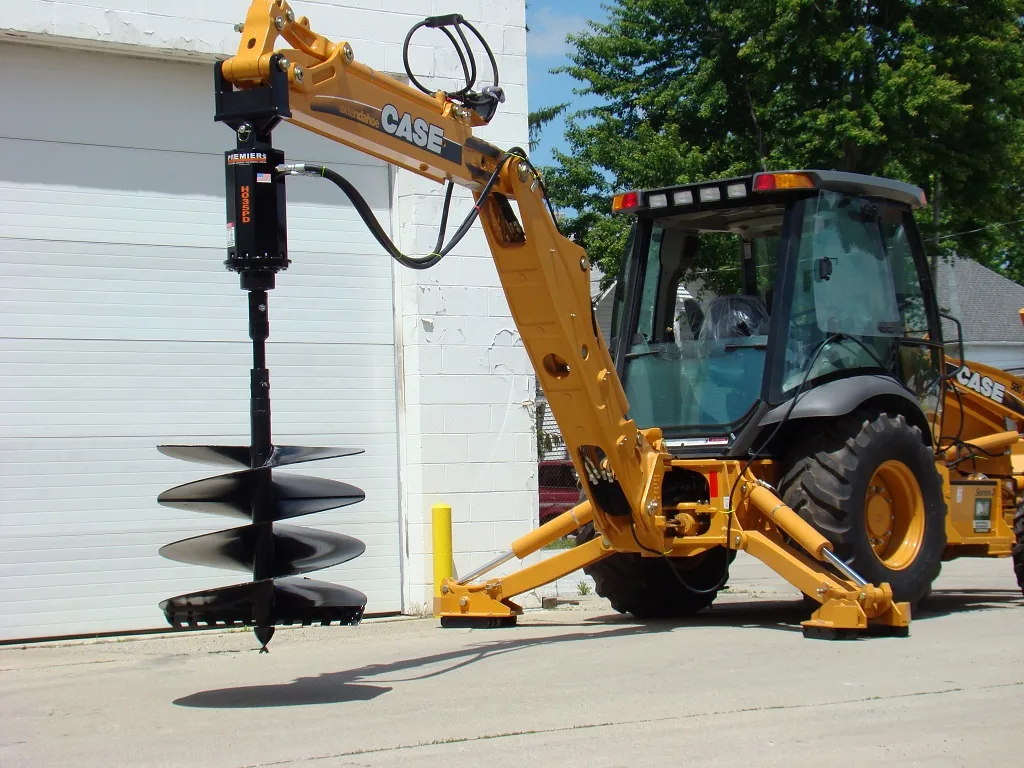
An auger attachment turns the digging arm into a drill, using a rotating bit to bore holes for fence posts, footings or plantings. Bit diameter and length vary, and the attachment needs enough hydraulic flow to keep the bit turning under load, particularly in denser soil. Where a bucket needs several passes to open a narrow hole, an auger attachment drills deep into the earth in one continuous motion, which is the main reason contractors reach for one over a bucket for post hole work.
Hydraulic Hammers
Hydraulic hammer attachments replace the bucket with a percussion tool for breaking concrete, asphalt or rock that’s too hard to dig through directly. They’re commonly used ahead of demolition projects to break up a slab before the material is loaded out with a bucket, or to open trenches through existing pavement. Hammer weight needs to match the backhoe’s size and hydraulic output. An undersized hammer on a big machine wastes capacity, while an oversized one can outrun what the hydraulic system can safely deliver.
Grapples
A dedicated grapple replaces the bucket with jaws that open and close to grasp irregular material, brush, logs or demolition debris, that a bucket can’t scoop cleanly. It’s the attachment of choice for material handling jobs where the load doesn’t sit flat: land clearing, storm cleanup, or sorting waste on a demolition site. For simpler pick-and-place work, many backhoes instead use a hydraulic thumb working against the existing bucket rather than swapping to a dedicated grapple.
Rippers
A ripper attachment is a single reinforced tooth, occasionally two, mounted in place of the bucket and used to tear into hard-packed or frozen ground, tree roots or shallow rock that a standard bucket stalls against. It doesn’t move material, it loosens it, so ripping is a first pass before a bucket comes back to load out.
Thumb Attachments
A thumb mounts to the dipper arm alongside the bucket and acts as a second jaw, closing against the bucket to grip pipe, boulders, logs or debris that would otherwise slide back out. Because it mounts alongside the bucket, adding a thumb usually doesn’t need a separate coupler change.
Front Loader Attachments
The front loader end takes a different set of tools to the rear arm: general-purpose and 4-in-1 buckets, pallet forks, brooms and other material-handling tools. A general-purpose front bucket is broadly similar to buckets used on Quotor’s other loaders, while a broom clears loose material off a finished job site rather than digging into it. This article focuses on the rear arm, but it’s worth checking what the front end is rated for before assuming this list covers the whole machine.
Backhoe Attachment Compatibility
Mounting and Coupler Compatibility
Attachments may pin directly to the dipper arm or connect through a compatible quick coupler, which speeds up tool changes: hydraulic couplers often allow the attachment to be released from the cab, while manual couplers require an external locking step. Mounting dimensions and locking systems aren’t universal across manufacturers, so an attachment bought or hired from outside the backhoe’s own brand needs its mounting checked before it turns up on site. This is one of the areas where the differences between backhoe loader brands show up in practice, not just on a spec sheet.
Hydraulic Requirements
Anything that moves under its own power, an auger’s rotation, a hammer’s percussion, a grapple’s jaws, draws from the hydraulic system rather than the arm’s normal motion. Hydraulic flow and pressure need to match what the attachment is rated for. Too little flow and a hammer or auger underperforms; too much and seals or hoses wear out faster than they should. A rundown of the parts of a backhoe loader covers where the hydraulic system sits in the machine if you want the underlying detail.
Matching Attachments to Backhoe Size
Attachment weight, mounting dimensions and hydraulic demand all need to fall within the backhoe’s approved specifications, not just its general size class. Hydraulic tools such as hammers and augers need compatible flow and pressure, while heavier attachments also need to stay within the machine’s lifting and stability limits. Quotor’s backhoe loader listings break machines down by size and weight, which is a reasonable starting point for checking what a given model can actually run.
Choosing the Right Backhoe Attachment
Match the Attachment to the Task
Start from what the job actually requires rather than which attachment happens to already be on the machine. Digging a trench calls for a standard bucket, breaking out an old driveway calls for a hammer, clearing storm debris calls for a grapple. Selecting the right attachment before the job starts, rather than mid-job, avoids the cost of a second hire or a delayed coupler swap.
Consider Material and Ground Conditions
Ground and material dictate attachment choice as much as the task does. Loose material like sand or mulch is usually front loader work, but compacted ground, asphalt or rock on the rear arm may need a heavy-duty or rock bucket, ripper or hydraulic hammer before the material can be loaded out. Wet ground changes traction and can make a heavier attachment harder to control safely, which is worth factoring in before hire, not after.
Common Attachment Selection Mistakes
The most common mistake is undersizing: picking a light-duty bucket or hammer for ground it can’t handle, which slows the job and wears the attachment out early. The second is skipping the hydraulic and coupler check covered above, and finding on site that the attachment doesn’t fit or the backhoe can’t run it. Reading up on how to operate a backhoe loader before changing attachments helps avoid both.
Hiring Backhoe Attachments
Hiring Attachments with the Backhoe
Some hire providers include a standard bucket and may offer common attachments such as hammers or augers with the machine, while others price attachments separately. This suits jobs needing only one or two attachment types already stocked by the provider. Quotor’s backhoe loader listings show which attachments a given hire company includes as standard, worth checking before hiring one separately.
Hiring Attachments Separately
Less common attachments, a specific auger bit size, a grapple, a heavy-duty ripper, are more often sourced as a separate attachment rental, either from the same provider or a specialist attachment supplier. This is where the coupler compatibility check above matters most, since a separately hired attachment isn’t guaranteed to fit the backhoe it’s paired with. It also helps to already be comfortable running the base machine; anyone new to backhoes might look at what it takes to become a heavy equipment operator before adding specialty attachments.
Backhoe Attachment Hire Costs
Attachment hire cost depends mainly on attachment type and size, hire duration, supplier availability, and whether it’s bundled with the machine or hired separately. Compatibility can also affect cost if the required coupler, hydraulic lines or attachment setup isn’t already fitted to the backhoe. Guides to estimating equipment cost and how to hire construction equipment cover the cost side in more depth. Quotor helps line up the right backhoe and the attachment it needs to run in one hire rather than two separate bookings, with the full range of machines browsable through the equipment listings.