
Understanding Backhoe Loader Brands
This guide covers popular backhoe loader brands available in Australia, from established names to newer entrants, to help you pick the right one for the job.
What Is a Backhoe Loader?
A backhoe loader is one of the most recognisable pieces of construction machinery, combining a front loader bucket and a rear excavator arm on one wheeled chassis so a single operator can handle digging and loading without swapping machines. That versatility keeps backhoe loaders in demand on sites of every size. For the full breakdown of how it works, see what is a backhoe loader. Backhoe loaders are still widely used in the global construction industry for urban construction and small and medium-sized projects, alongside utility trenching. Browse Quotor’s current backhoe loader listings to see what’s available.
Why Backhoe Loader Brand Matters
Any backhoe loader can dig a trench and move a pallet on most construction projects. What separates brands in practice is what happens after the machine reaches the site: how quickly parts show up, how many dealers stock the model locally, and how well it holds value at resale. Backhoe brand also affects hire availability, since not every supplier carries every make.
How Backhoe Loader Brands Differ
The basic layout, front loader bucket, rear backhoe arm, articulated dipperstick, is similar across brands, and the fundamentals carry over from make to make, as covered in how to operate a backhoe loader. Where brands diverge is engine output, dig depth, transmission and cab technology. Some manufacturers, Kubota among them, build their loader backhoes on utility tractor platforms, while other brands like Caterpillar and JCB design purpose-built construction chassis from the ground up.
Leading Backhoe Loader Brands
Caterpillar
Caterpillar offers purpose-built construction backhoe loaders in centre-pivot and side-shift configurations, with the mix varying by market, part of a wider range spanning construction and mining equipment. Cat’s Australian range centres on side-shift models like the 428 and 432, while other markets carry a broader centre-pivot lineup. The range is backed by Cat’s global dealer and parts network, and higher-spec models add features such as advanced hydraulic controls and a rotating operator’s seat that faces the backhoe arm directly when digging.
JCB
JCB is widely credited with building the first backhoe loader in 1953, when founder Joseph Cyril Bamford combined a front loader with a rear excavator arm, a design that has since sold more than a million units. JCB offers one of the broadest purpose-built backhoe ranges on the market: in Australia the lineup spans the compact 1CX through the 3CX, 4CX and 5CX, with features varying by configuration. Quotor lists JCB 3CX backhoe loaders for hire directly.
CASE Construction
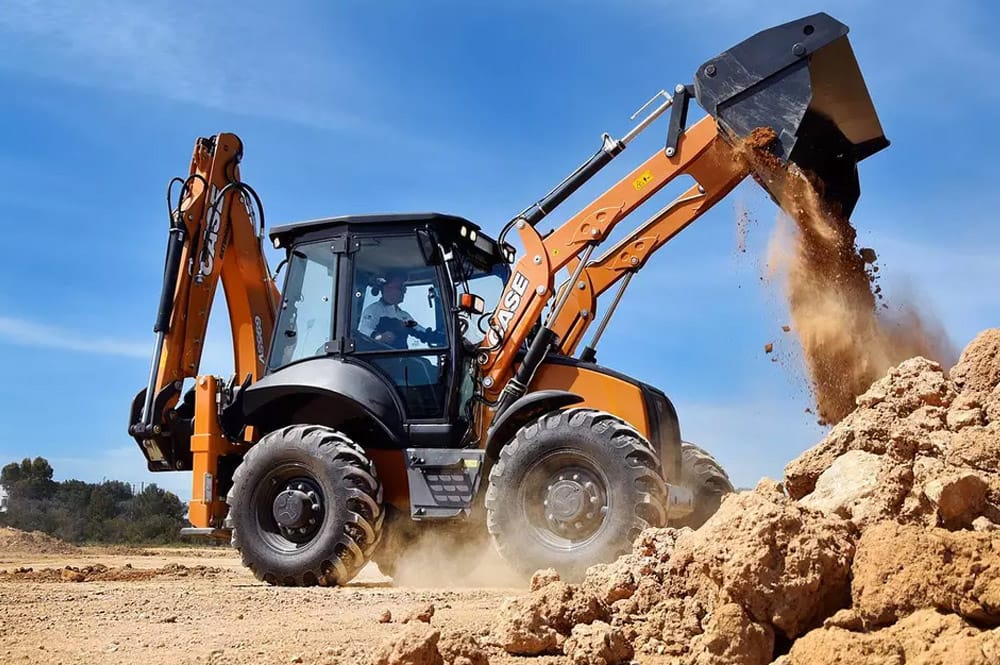
CASE Construction, part of CNH Industrial alongside New Holland, introduced the first factory-integrated backhoe loader in North America, the Model 320, in 1957. CASE backhoe loaders are popular with utility crews for features like the Extendahoe extendable dipper and the 580 Super N’s ProControl swing-dampening system, and in 2024 the company launched the 580EV, among the first commercially available electric backhoe loaders.
John Deere
John Deere backhoe loaders span a full-size range from the compact 310 G-Tier through the larger 710 P-Tier at 148 horsepower. A 2025 update across five backhoe models added what the company describes as the industry’s first factory-installed rear camera on a backhoe loader, plus a wider cab for easier switching between loader and backhoe controls.
New Holland
New Holland Construction, CASE’s sister brand under CNH Industrial, builds its D-Series loader backhoes through its own dealer network. The B75D and B95D anchor the range, running 74 and 97 horsepower with dig depths past 18 feet, with tool-carrier and long-reach options.
Komatsu
Komatsu’s WB93 and WB97 backhoe loaders, now in their -8 series and EU Stage V compliant, are equipped with advanced hydraulic systems, including Komatsu’s Closed Load Sensing system, for efficient operation across power and economy modes. A long-life diesel particulate filter is rated for 8,000 hours, and KOMTRAX telematics come standard, for remote visibility into machine location and service alerts.
Kubota
Kubota takes a different approach, building its three-model tractor loader backhoe lineup, the B26TLB, L47TLB and M62TLB, on the same compact utility tractor platforms used across its agricultural range. The M62TLB, Kubota’s largest, runs a 63-horsepower diesel engine to a 14-foot dig depth. This tractor-based design tends to keep purchase and running costs lower than purpose-built construction backhoes, suited to rental fleets and smaller contractors.
Volvo
Volvo Construction Equipment discontinued its own line of Volvo-branded backhoe loaders in 2015, transferring production to its Chinese sister company SDLG. Buyers researching Volvo backhoe loaders today are generally looking at older, used machines rather than a current model; Volvo’s construction range now centres on excavators, wheel loaders and articulated haulers instead. For Volvo’s current equipment range, see Volvo’s listings.
Other Backhoe Loader Brands to Consider
Regional and Less Common Manufacturers
Not every backhoe loader on the market comes from the eight brands above. SDLG, Volvo’s Chinese sister brand, now produces backhoe loaders for the value segment Volvo itself exited. Smaller regional manufacturers with a limited international footprint are worth checking directly with your local supplier, since availability and parts support vary widely.
Newer and Expanding Backhoe Loader Brands
Two brands have expanded into the category more recently with genuine traction. Bobcat, long known for skid steers and compact track loaders, entered the North American backhoe market in 2024 with the B760, a machine with an 18-foot-5-inch dig depth and 180 degrees of backhoe swing; it’s now also listed through Bobcat’s Oceania range. The B760 meets emissions rules without a diesel particulate filter, adding to durability and cutting maintenance downtime. Sany, a Chinese manufacturer, has built a two-model US lineup with the SLB95 and the newer BHL95, the latter with a telescopic stick reaching 22 feet. Both brands have a shorter track record than the century-old names above, worth weighing against any price advantage.
For a quick side-by-side view of where each brand sits:
Comparing Backhoe Loader Brands
| Brand | Main position | Particularly worth considering for |
|---|---|---|
| Caterpillar | Purpose-built centre-pivot and side-shift backhoes | General civil and construction work |
| JCB | Backhoe specialist, range spanning 1CX through 5CX | Mixed loading and digging on roadable sites |
| CASE | Long-established range, including an electric model | Utilities and general construction |
| John Deere | Full-size construction backhoes with recent cab and camera updates | Civil and utility work |
| New Holland | Purpose-built D-Series backhoes, sister brand to CASE | General construction |
| Komatsu | Construction-focused backhoes with load-sensing hydraulics and telematics | Civil works where available |
| Kubota | Tractor-loader-backhoe architecture | Landscaping and lighter utility work |
| Bobcat | Newer full-size backhoe entrant | Contractors already running Bobcat equipment |
Caterpillar vs JCB
Caterpillar and JCB are the two biggest global names in the category, but they compete differently. Caterpillar splits its range between centre-pivot and side-shift configurations depending on market and leans on Cat’s global dealer network, while JCB backhoes carry the heritage of the category’s original specialist, dating to 1953, spanning the compact 1CX through the full-size 5CX. For most buyers, dealer proximity and current financing offers matter more day to day than which brand invented the category.
CASE vs John Deere
CASE and John Deere are both established, purpose-built construction backhoe specialists with deep dealer networks. CASE’s point of difference is the 580EV, an electric option Deere doesn’t yet match, alongside the ProControl swing-dampening system across its range. Deere’s 2025 update added a factory-installed rear camera and a wider cab, features not yet standard on CASE’s lineup. Parts availability for either brand depends heavily on the local dealer, more than any inherent difference between them.
Kubota vs New Holland
These two sit at different ends of the same size class. Kubota’s tractor-based TLBs are lighter and aimed more toward landscaping, property maintenance and lighter utility work, while New Holland’s purpose-built D-Series machines sit closer to conventional construction backhoes, better suited to deeper digging and heavier site work. The choice usually comes down to the size and duration of the job rather than brand preference alone.
Choosing the Right Backhoe Loader Brand
Different backhoe loader brands suit different jobs, and choosing a backhoe loader brand comes down to five practical factors.
Machine Size and Model Range
The type of backhoe loader that suits a job depends on scale. Match dig depth and operating weight to the job before comparing brands: a compact tractor-based TLB from Kubota suits landscaping and small utility trenches, while a full-size machine from Caterpillar, JCB, CASE or Deere handles deeper trenching and heavier site work. Quotor’s loader category covers alternatives worth checking if a backhoe loader turns out to be more machine than the job needs.
Parts and Dealer Support
The established brands are generally known for their reliability, but a strong local parts supply and service network usually matters more day to day than the badge on the bonnet. See what makes up a backhoe loader if unsure what to ask a dealer before hiring or buying.
Reliability and Serviceability
Engine, transmission and hydraulic system access all affect a machine’s durability and how much downtime it costs over its working life. Cab comfort and day-to-day operator comfort improve with features like Deere’s wider swivel space or Caterpillar’s rotating operator seat, and engines built to low emissions standards, Tier 4 Final or Stage V, are now standard here, generally with better fuel efficiency than the Tier 3 designs they replaced.
Availability for Hire
Not every backhoe loader brand is available through every supplier, and popular backhoe loader models can book out during busy construction seasons, so brands available can shift week to week. Checking early avoids being locked into the wrong machine.
Purchase Price and Resale Value
Tractor-based TLBs like Kubota’s generally cost less upfront and hold value differently than purpose-built machines from Caterpillar, JCB or CASE. Resale tends to track dealer network strength and parts supply more closely than headline horsepower, which matters when trying to find the best backhoe loader for the long term.
Hiring Backhoe Loaders by Brand
Comparing Brand Availability Across Suppliers
Quotor makes it possible to compare which backhoe loader brands are available through different suppliers. That’s useful when a project has a preferred brand but flexible timing.
Matching Brand and Model to the Job
Once you know the dig depth and load capacity a job needs, matching that to specific backhoe attachments, breakers, augers or trenching buckets, narrows the brand and model list further than horsepower alone.
Brand Preference vs Available Machine
Brand can help narrow the shortlist, but the specific machine’s dig depth, loader capacity, attachments and supplier support matter more than the badge alone. If the preferred brand is unavailable, compare equivalent machines rather than compromising the project specification to secure one make. For general hire guidance, see how to hire construction equipment. Quotor is built to help you compare backhoe loader brands and match the machine to the job, not just the badge.